Fashion Museums In Paris: Where To See Costume, Textiles And Style
Paris runs exactly two museums dedicated to dress. The better fashion trail spreads much wider, and most of it is free.
Short answer
The Palais Galliera is Paris's dedicated fashion museum, charging €14, while the Musée des Arts Décoratifs sells its fashion galleries by exhibition. Around them, the Musée de Cluny shows medieval textiles for €14, the Musée Jacquemart-André shows dressed interiors for €19, and the city's free museums, including Carnavalet and Cognacq-Jay, hold costume at no cost.
What Counts As A Fashion Museum In Paris?
Paris has exactly two museums dedicated to dress: the Palais Galliera, the city's fashion museum, and the fashion galleries inside the Musée des Arts Décoratifs. Neither is sold on this site. The honest fashion itinerary spreads wider, through the medieval textiles of the Musée de Cluny at €14, the dressed interiors of the Musée Jacquemart-André at €19, and three city museums whose permanent collections cost nothing at all.
Paris carries its reputation as a capital of dress, and it backs that reputation with two institutions whose whole purpose is clothing. The Palais Galliera mounts the couture exhibitions that make headlines, and the Musée des Arts Décoratifs keeps fashion galleries that are ticketed exhibition by exhibition. Those are the dedicated pair, and any honest guide has to start by admitting their limits: both rotate their displays, both charge separately for what is showing, and neither is a permanent room of dresses you can rely on finding.
This site does not sell tickets to either of them. Every figure in this Paris Museums guide comes from the venues' own published conditions rather than from a visit, because nobody on our side has walked these rooms. What we can do is map the subject properly. A clothes-minded visitor in Paris is really following three threads: historic textiles, dressed domestic interiors, and the costume holdings tucked into museums most people visit for other reasons.
The trail that follows covers the two dedicated venues first, with their real prices and their real limits. Then it moves outward: the woven wool of the Middle Ages at the Musée de Cluny, the collector's interiors at the Musée Jacquemart-André, the free costume holdings of the Musée Carnavalet and the Musée Cognacq-Jay, the rotating shows at the Musée Bourdelle, and the immersive format of the Atelier des Lumières as the modern end of the line. That is the shape of the subject. It is not one museum. It never was.
The Dedicated Fashion Museums And What They Cost
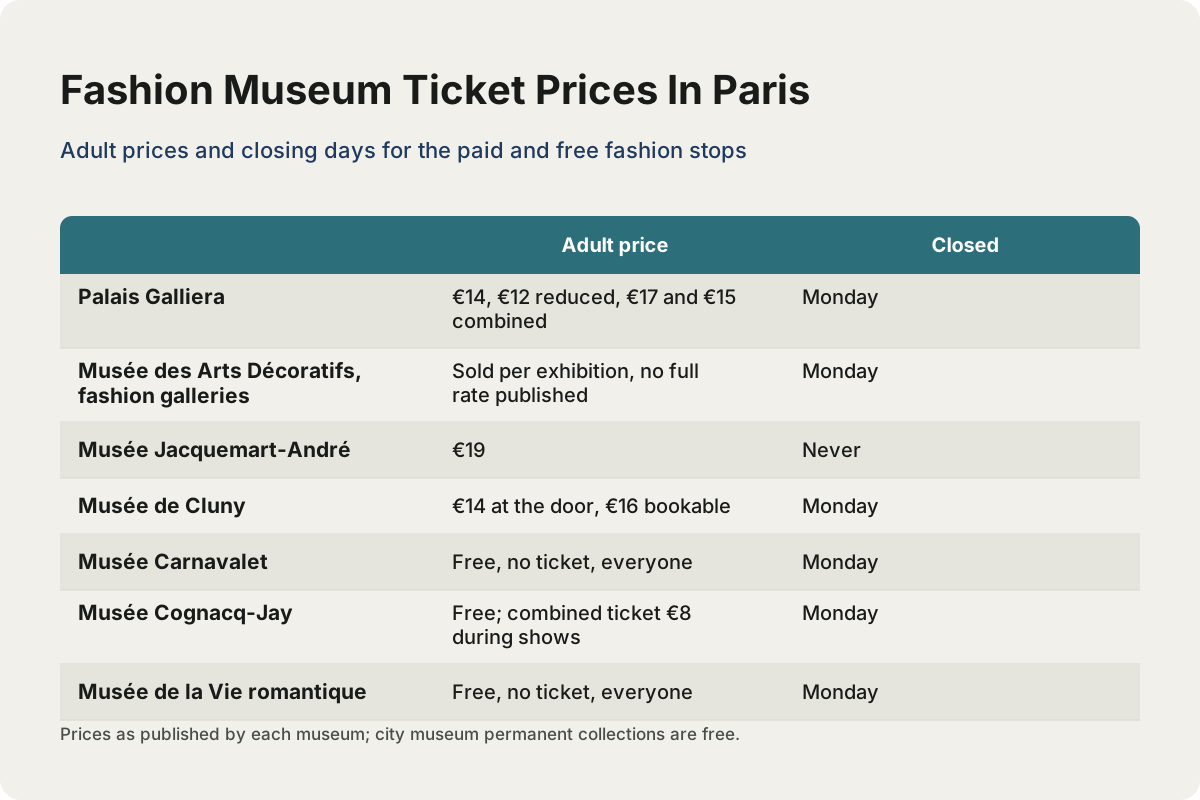
The Palais Galliera charges €14 full rate and €12 reduced, with a combined ticket at €17 and €15, and it closes on Mondays. The Musée des Arts Décoratifs sells its fashion galleries by exhibition, and no full adult rate is published where this site could read one. It also closes on Mondays. Neither venue is covered by the Paris Museum Pass.
Start with the Galliera, because it is the name most visitors arrive with. It is the City of Paris's own fashion museum, and it is one of the only three city venues that charge all year round, alongside the Catacombes and the Crypte archéologique. Its own page sets the conditions for whatever couture show is running, and the exhibitions are the entire visit: there is no permanent collection on display in the ordinary sense, so the ticket you buy is the ticket for the show of the season. Plan around a specific exhibition, or plan around nothing.
The Musée des Arts Décoratifs is the second dedicated stop, and the honest note here is about price. Its fashion galleries are real and seriously curated, but admission is structured exhibition by exhibition, and a full adult rate is not published in any form this site could verify. State that plainly and move on. The building also closes on Mondays, which matters more than usual on a fashion trail, as the planning section below shows.
| Venue | What a ticket buys | Adult price | Closed |
|---|---|---|---|
| Palais Galliera | The temporary couture exhibition only | €14, €12 reduced, €17 and €15 combined | Monday |
| Musée des Arts Décoratifs, fashion galleries | The temporary fashion exhibition only | Sold per exhibition, no full rate published | Monday |
One more structural fact, and it decides budgets. The Paris Museum Pass buys nothing at any city museum, the Galliera included, and it never includes temporary exhibitions anywhere, which is precisely where all the fashion content lives. A pass of any duration is simply not a fashion tool in Paris. The dedicated pair rewards specialists who time a trip around a named exhibition. Most visitors do better with the wider trail, and the three bookable stops below are where a fashion day actually gets built.
Musée Jacquemart-André: Dressed Interiors And The Collector's Eye
The Musée Jacquemart-André charges €19, holds a 4.7 rating across 2,677 reviews, opens every day of the week, and sits in the 8th arrondissement at 158 boulevard Haussmann. Entry is timed, so a booked slot is part of the visit rather than an option. It is not on the Paris Museum Pass and has no free day.
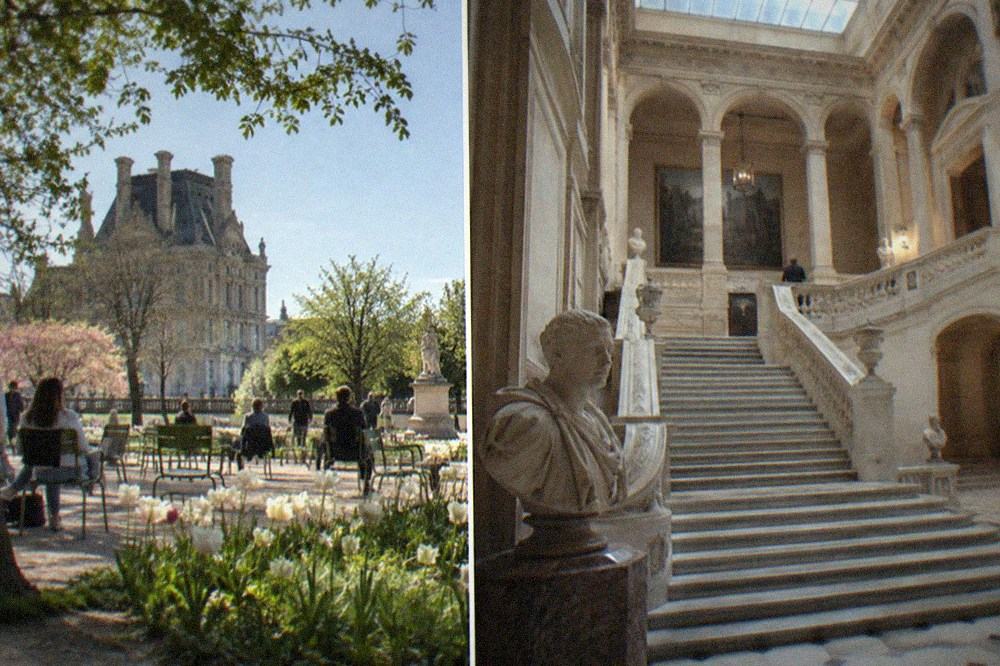
Of every stop on this trail, the Musée Jacquemart-André is the one that teaches you how to read dress. It is a house museum: a mansion preserved as its collectors left it, with period rooms, textiles and decorative arts kept whole, the furniture, panelling, porcelain and painting of a single collecting sensibility sitting together. For a fashion-minded visitor that context is the point. Clothing was never made to be seen in a white gallery. It was made for rooms like these, and the museum lets you see the room and the objects the clothes once lived among, in the same visit.
Practically, the museum is unusually convenient. It opens every day, closed never, which on this trail is rare: nearly every other fashion-relevant stop in Paris shuts on a Monday. Admission is €19, reviewers rate it at 4.7 across 2,677 reviews, and the visit needs a timed slot, so entry is booked rather than bought at a counter. Full details are on our page for Musée Jacquemart-André tickets and opening times, and the question of how long to allow has its own answer in how much time the Musée Jacquemart-André needs.
The museum's other role on this trail is as the anchor for the days when everything else is shut. Pair it with the Palais Galliera in a single 8th-arrondissement-and-beyond day if a couture show is running, or use it as the Monday stop when the city museums close. Because it opens daily and holds its 4.7 rating across a large review base, it is also the lowest-risk booking of the three paid stops, the one to fix first if your dates are still loose.
The Lady And The Unicorn: Textiles At The Musée de Cluny
The Musée de Cluny is Paris's national museum of the Middle Ages, and it holds the Lady and the Unicorn, the celebrated cycle of woven wool hangings that is the closest thing Paris has to a permanent fashion masterpiece. Admission is €14 at the door, the bookable ticket is €16, and the museum is free on the first Sunday of every month with no reservation. It closes on Mondays, at 6 place Paul Painlevé in the 5th arrondissement.
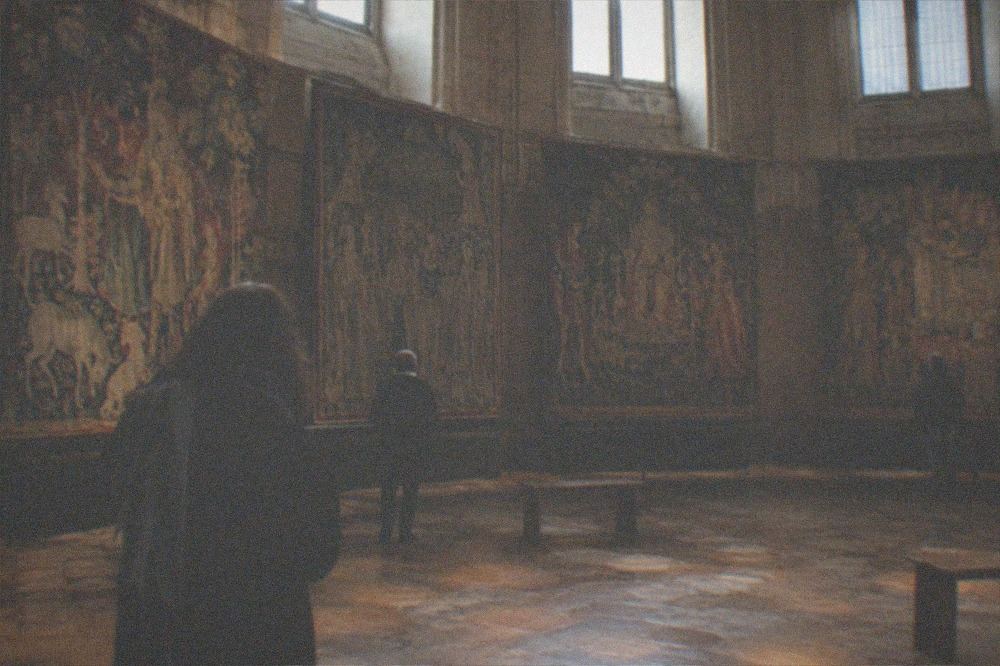
Fashion did not begin with couture houses, and the strongest textile object in Paris is five centuries older than the Galliera's programme. The Lady and the Unicorn cycle, held at the Musée de Cluny, shows dress rendered with an accuracy that painting of its era rarely attempted: fitted bodices, fur linings, woven patterns, the cut and drape of court clothing in the late Middle Ages. For anyone who thinks about clothes as construction, this is the room in Paris. The hangings are wool, dyed in a limited palette that has survived, and they reward the long look far more than any single visit allows.
The pricing is worth doing the arithmetic on. The door price is €14, the bookable skip-the-line ticket is €16, and from the United States the bookable entrance reads from $18.65, a platform from-price that is not the same figure as the door price in euro. The museum also gives itself away free on the first Sunday of every month, with no reservation needed, one of the most generous national-museum rules in the city. Our page on Musée de Cluny tickets and free Sundays carries the practical detail, and whether the medieval rooms are worth the detour is argued in where the Lady and the Unicorn hangs and whether it is worth it.
A useful pairing: the Musée de Cluny sits in the 5th arrondissement, walkable from the boulevard Saint-Michel, and its medieval holdings make a natural first half of a day whose second half drops into the Marais and the free city museums described next. Do the arithmetic on the door price only if you are certain of your date. If the first Sunday of the month falls inside your trip, the same rooms cost nothing.
Free Costume Holdings: Musée Carnavalet And Musée Cognacq-Jay
The Musée Carnavalet and the Musée Cognacq-Jay are both city museums whose permanent collections are free to everyone, no ticket, a policy in force since December 2001. Both close on Mondays. The Musée Cognacq-Jay sells a combined exhibition ticket at €8 when a show is running, and during exhibitions only part of the visit stays free. The free pair costs nothing but rewards exactly the visitor this page is written for.
Paris runs two museum systems with two different free rules, and the difference decides your fashion week. The city's own museums, the Paris Musées network, keep their permanent collections free to every visitor every day they are open, a policy the city has printed since December 2001, on its own tariffs page. National museums, the Louvre included, are free only on the first Sunday of the month, and some only in winter months. For a fashion trail built on city museums, every open day is a free day.
The Musée Carnavalet is the museum of the history of Paris itself, in the Marais at 23 rue de Sévigné, and its holdings include the material culture of how the city dressed itself across centuries. The permanent collection is free, no ticket, no queue for a cash desk. Full visiting detail is on our page for Musée Carnavalet's free entry and hours. The Musée Cognacq-Jay, a few streets away in the same district, holds the decorative and fine arts of the eighteenth century, an age when dress, furniture and painting were designed as one ensemble. It is free on the same city terms, with one printed caveat, given in the table below.
| Museum | Permanent collection | During a temporary exhibition | Closed |
|---|---|---|---|
| Musée Carnavalet | Free, no ticket, everyone | Exhibitions ticketed separately | Monday |
| Musée Cognacq-Jay | Free, no ticket, everyone | Only partly free, combined ticket €8 | Monday |
| Musée de la Vie romantique | Free, no ticket, everyone | Exhibitions ticketed separately | Monday |
What does free actually cost you? Two things, and both are manageable. The first is the closed day: every free city museum in this guide shuts on Monday, without exception, so a Monday arrival means starting with the daily-open paid stops above. The second is the exhibition caveat, the same rule that has the Maison de Victor Hugo ticketed at this moment. When a paying show occupies a free museum, part of the building closes to the free ticket. Check which side of that rule your dates fall on, then enjoy the fact that the strongest costume-adjacent holdings in Paris cost nothing on any other day.
Musée Bourdelle: Sculpture Studios And Rotating Exhibitions
The Musée Bourdelle is a free city museum of sculpture at 18 rue Antoine Bourdelle in the 15th arrondissement, and its draw for a fashion-minded visitor is the rotating temporary exhibition programme. The city prints the caveat itself: only partly free while a show is running. It closes on Mondays, like every other stop in the free city network.
The Musée Bourdelle is the stop on this trail that most often surprises people. It preserves the studios and gardens where Antoine Bourdelle worked, with plaster, marble and bronze at full scale, and alongside that permanent free collection it runs a serious temporary exhibition programme that regularly turns to costume, stage design and the body in dress. The permanent part is free, no ticket. The exhibition part charges, and during a show only part of the visit stays free, the caveat the city prints for this museum in the same breath as its free entry.
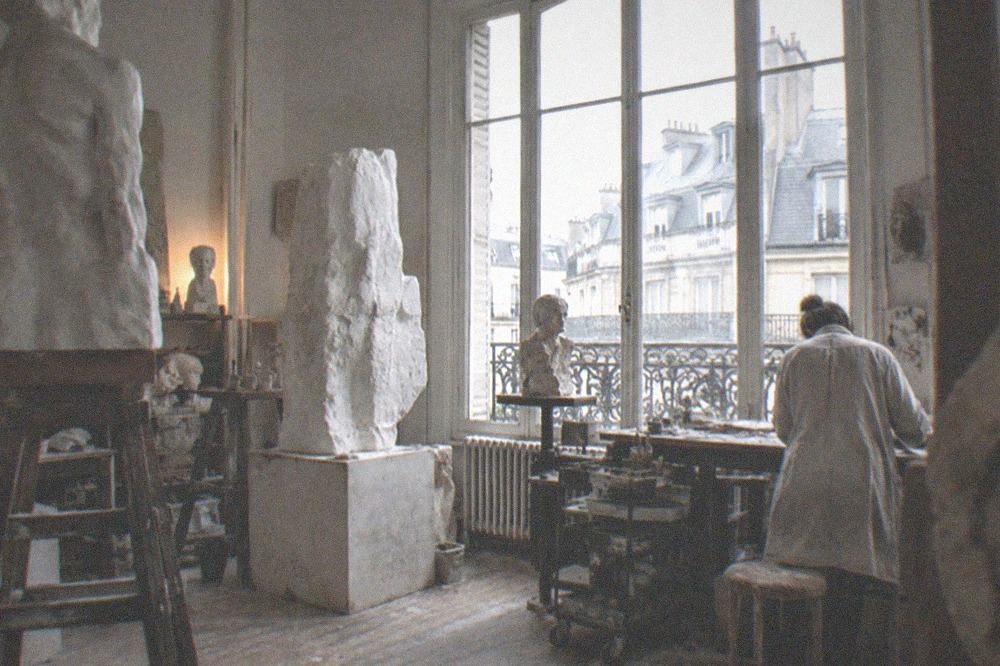
The mechanics of the caveat are the same one explained above, the rule that has the Maison de Victor Hugo ticketed at present. Nothing about it is hidden. What it means in practice is that the Bourdelle splits into two visits: the free wander through the studios, which is generous and needs no planning, and the paying show, which needs a decision made before you arrive. Visitors who come for sculpture alone never notice the difference. Visitors who come for the exhibition programme, the reason this museum earns a place on a fashion trail, should check what is running before setting out.
For planning purposes, treat the Bourdelle as the flexible stop. It costs nothing on an ordinary day, so it can absorb a spare afternoon the way the timed, booked stops cannot. If a costume or stage-design exhibition is running when you visit, the paying half becomes the main event and the €8-style combined-ticket logic of the city network applies here too, with the price of each show set by the museum for that show. Closed on Monday, free most of the week, and the only stop on this trail where the biggest risk is arriving during something unmissable without a ticket.
Atelier des Lumières: The Modern End Of The Trail
The Atelier des Lumières charges €19.50 online, and the ticket is always for whatever immersive show is running, never for a permanent collection. It opens every day, requires a timed slot, and holds a 4.1 rating across 670 reviews. It sits at 38 rue Saint-Maur in the 11th arrondissement and is not on the Paris Museum Pass.
Fashion trails in Paris usually end somewhere historic. This one can end in a former industrial hall, floor to ceiling in projected image and sound. The Atelier des Lumières runs rotating immersive shows, and the single most important practical fact about it is that there is nothing else to see: the ticket buys the running show and only the running show. Visitors who arrive expecting a collection, any collection, are the ones who leave disappointed, and the reviews reflect that split, 4.1 across 670 reviews, lower than most stops on this trail precisely because the format divides opinion.
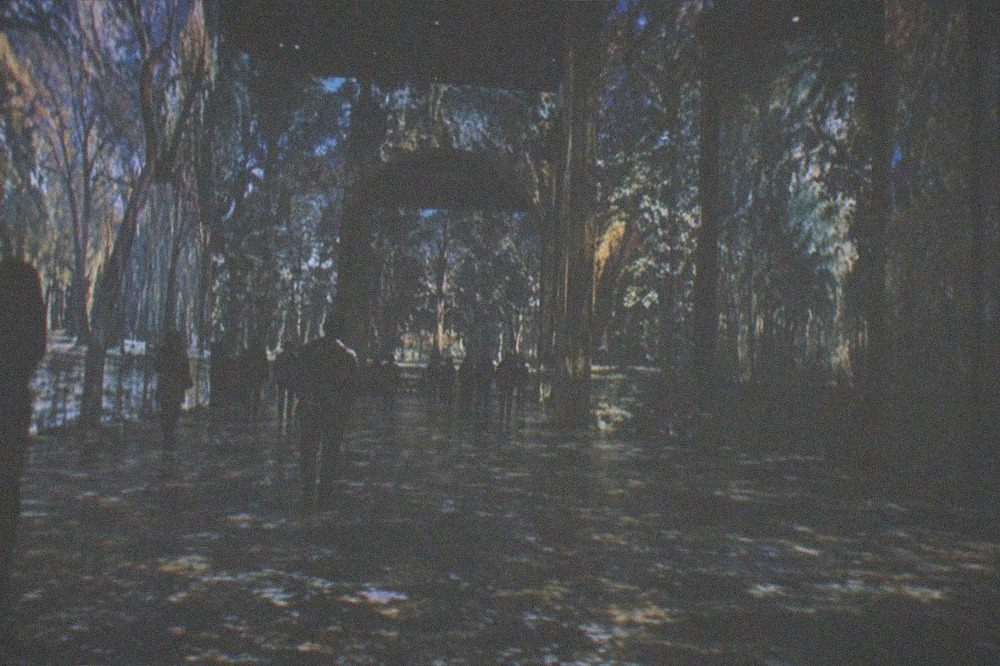
For a clothes-minded visitor the appeal is format rather than content: this is how contemporary fashion imagery is staged for audiences now, all surface, scale and music, the opposite of a glass case. Whether that belongs on the same trail as the Lady and the Unicorn is a matter of taste. What is not a matter of taste is the schedule: the shows rotate on their own cycle, the venue opens daily, entry is timed, and the €19.50 ticket is sold for the show currently running. Confirm what is playing during your dates, then book the slot. The venue's exclusion from the Paris Museum Pass, shared with the Musée Jacquemart-André, means there is no pass arithmetic to do here, just a slot to pick.
Who should this stop be for? Visitors whose interest in fashion extends to how it is presented, photographed and projected, and families or groups who need one stop that satisfies companions bored by textiles. Everyone else should weigh the format against the price honestly: the Atelier is a night out more than a museum visit, and the trail has plenty of daylight left for the free rooms of the Marais.
How To Plan A Fashion Trail Through Paris
Avoid Mondays for the core of this trail. The Musée de Cluny, the Palais Galliera, the Musée Carnavalet, the Musée Cognacq-Jay and the Musée Bourdelle all close that day, while the Musée Jacquemart-André and the Atelier des Lumières open daily. A two-day plan pairs the daily-open stops with the closed-Monday stops, and the three paid trail tickets are €19 plus €14 plus €19.50, as printed above.
The Monday problem is the single biggest trap on a fashion itinerary. Five of the seven stops in this guide shut on the first day of the working week, which is why the two daily-open venues, the Musée Jacquemart-André and the Atelier des Lumières, are worth booking before you travel: they are your Monday. The pattern repeats across the wider city, and the planning detail for that bigger picture is in our guide to the best museums in Paris for a short trip, with the free network mapped separately in free museums in Paris, venue by venue.
| Stop | Door price | Closed day | Notes |
|---|---|---|---|
| Musée Jacquemart-André | €19 | None | Timed entry, open daily |
| Musée de Cluny | €14 | Monday | Free first Sunday, no reservation |
| Atelier des Lumières | €19.50 online | None | Ticket is for the running show only |
| Palais Galliera | €14 | Monday | Exhibition-only museum |
| Musée Carnavalet | Free | Monday | Permanent collection always free |
| Musée Cognacq-Jay | Free | Monday | €8 combined ticket during shows |
| Musée Bourdelle | Free | Monday | Only partly free during shows |
The budget is modest by Paris standards. The three paid trail tickets run €19 at the Musée Jacquemart-André, €14 at the Musée de Cluny and €19.50 at the Atelier des Lumières, and the free city museums around them cost nothing on any day they open. Add the Palais Galliera at €14 only if a couture exhibition is running during your dates, and remember that its shows are the entire visit rather than a permanent display. A pass changes none of this arithmetic, because the pass buys nothing at the city museums and never includes the temporary exhibitions that make up the fashion programme.
Build the trail in this order. Day one: the Musée de Cluny in the morning for the woven wool, the Marais free pair in the afternoon, the Musée Bourdelle on whichever day has the freest afternoon. Day two: the Musée Jacquemart-André in the morning, the Palais Galliera if a show earns it, the Atelier des Lumières in the evening, when projected halls are at their best. Book the timed stops, walk into the free ones, and keep your Mondays for the two venues that never close.
Common Questions About Fashion Museums In Paris
What is the main fashion museum in Paris?
The Palais Galliera, the City of Paris's own fashion museum. It charges €14 full rate and €12 reduced, closes on Mondays, and its exhibitions are the entire visit, since there is no permanent collection display in the ordinary sense. Time a trip around a named show or expect nothing specific.
Is the Palais Galliera ever free?
No. It is one of only three city venues that charge all year, alongside the Catacombes and the Crypte archéologique. The city's free-every-day rule covers the permanent collections of eleven other museums, and the Galliera is not one of them.
Which fashion-related museums in Paris are free?
The Musée Carnavalet and the Musée Cognacq-Jay keep their permanent collections free to everyone, no ticket, as part of the city network in force since December 2001. The Musée Bourdelle is free too, with the printed caveat that only part of it stays free while a temporary exhibition is running. All three close on Mondays.
Do you need to book the Musée Jacquemart-André in advance?
Yes, entry is timed, so a booked slot is part of the visit rather than an option. Admission is €19, the museum opens every day of the week, and it holds a 4.7 rating across 2,677 reviews, which makes it the lowest-risk booking on the trail.
Is the Musée de Cluny worth visiting for fashion?
Yes, for historic textiles. It holds the Lady and the Unicorn, the celebrated cycle of woven wool hangings that shows late medieval dress in remarkable detail. Admission is €14 at the door, the bookable ticket is €16, and the museum is free on the first Sunday of every month with no reservation needed.
Is the Atelier des Lumières a fashion museum?
No. It is an immersive venue where the ticket, €19.50 online, is always for whatever show is running, never for a permanent collection. It suits visitors whose interest in fashion extends to how it is staged and projected, and it opens every day of the week.
Does the Paris Museum Pass cover the fashion museums?
Not the ones that matter here. The pass buys nothing at any city museum, the Palais Galliera included, and the Musée Jacquemart-André and Atelier des Lumières are both on the pass's own exclusion list. It also never includes temporary exhibitions, which is where Paris's fashion content lives.