Free Museums In Paris: Which Ones Are Actually Free, And When
Most guides compress Paris free museum rules into one wrong sentence. Paris runs two separate free systems, the biggest museum in the city follows neither, and three city museums that guides call free have charged for decades.
Short answer
Eleven City of Paris museums are free to everyone all year with no ticket, including the Musée Carnavalet and the Petit Palais. National museums are free the first Sunday of the month, and CMN monuments only from January to March and November to December. The Louvre is never free on a Sunday: it is free the first Friday after 6pm, plus 14 July.
How Many Museums In Paris Are Actually Free?
Paris has two completely separate free systems, and almost every guide conflates them. Eleven City of Paris museums are free to everyone, all year, with no ticket of any kind. National museums are free only on the first Sunday of each month, and the state monuments follow a third, seasonal rule. The Louvre, the museum everyone assumes is on the list, is not free on any Sunday of the year.
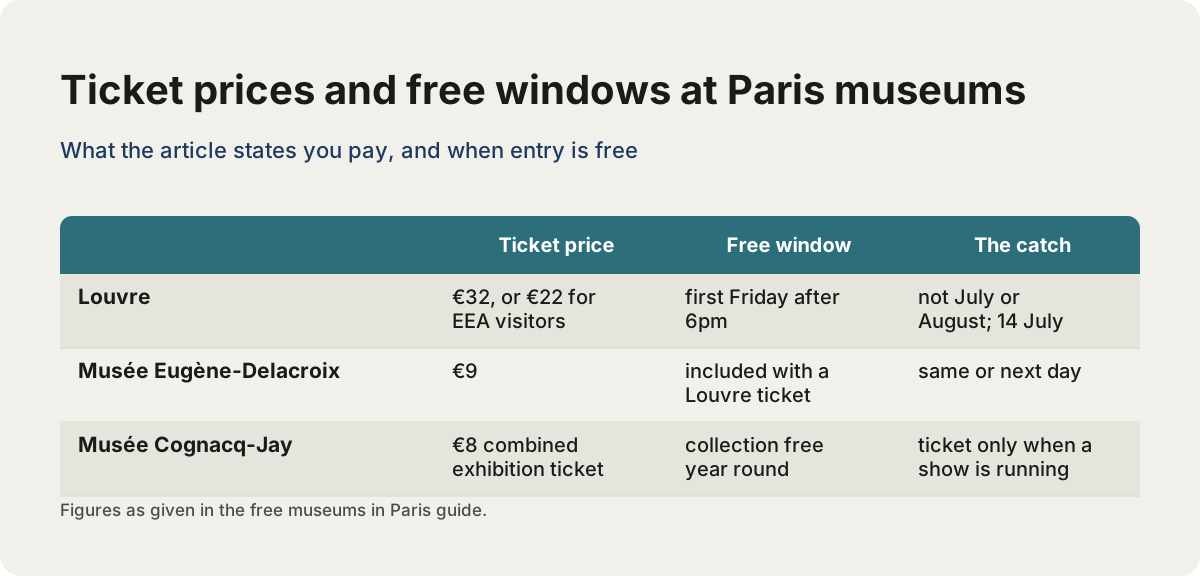
The single most repeated error in Paris travel writing is that the Louvre is free on the first Sunday of the month. It is not, and it has not been. The Louvre's own admission page states the real rule: free entry on the first Friday of the month after 6pm, except in July and August, and on 14 July. That is the only recurring free window at the most visited museum on earth, and it is an evening one. The museum's own hours and admission page is the source, and it contradicts a remarkable amount of published guidance.
The second error is quieter but just as common: treating all Paris museums as one category. They are not. The city's own network, Paris Musées, has made its permanent collections free to everyone since December 2001. The national museums, run by the state, have a monthly free Sunday instead. The state monuments, run by the Centre des monuments nationaux, have a free Sunday that only exists for five months of the year. A visitor who plans around the wrong rule will either pay for something that was free or queue for something that is not.
The honest headline count: roughly 15 to 17 Paris museums are free with no condition at all, and about a dozen more are free on a specific day. The two systems do not overlap. A city museum is free every day it opens. A national museum is free one Sunday a month. The Louvre is free neither way, at any point on a Sunday.
The Eleven City Museums That Are Free Every Day
Eleven City of Paris museums charge nothing for their permanent collections, every day they are open, for every visitor, with no ticket and no reservation. The list is published by the city itself and includes the Musée Carnavalet, the Petit Palais and the Musée d'Art Moderne de Paris. Three sister sites, covered below, are paid and always have been.
This is the city's own policy, in force since December 2001, and it is stated on the city's official tariffs page. You walk in. There is no queue for a ticket because there is no ticket. The full list:
| Museum | Arrondissement | Caveat the city itself prints |
|---|---|---|
| Musée Carnavalet, Histoire de Paris | 3e | none |
| Petit Palais | 8e | none |
| Musée d'Art Moderne de Paris | 16e | none |
| Musée Cernuschi | 8e | none |
| Musée de la Vie romantique | 9e | none |
| Musée de la Libération, Leclerc, Moulin | 14e | none |
| Maison de Victor Hugo | 4e | ticketed during exhibitions |
| Maison de Balzac | 16e | free outside exhibition periods |
| Musée Bourdelle | 15e | only partly free during exhibitions |
| Musée Cognacq-Jay | 3e | only partly free during exhibitions |
| Musée Zadkine | 6e | only partly free during exhibitions |
Four of the eleven carry the exhibition caveat, and those caveats matter more than they look on a table. The other seven are simply free, permanently, for their permanent collections. Note what is not on the list: the Catacombes, the Palais Galliera fashion museum and the Crypte archéologique, which belong to the same city network but have charged since long before anyone reading this was born.
All eleven close on Mondays, like every city museum in Paris. If your free-museum day is a Monday, this entire list is shut, and you need the Monday-open page instead. The museums that never sell a ticket obviously do not appear on a ticketing site, which is exactly why so many guides forget they exist.
The two heavyweights deserve the first visit. The Musée Carnavalet tells the entire history of Paris across two joined Marais mansions, and its permanent collection is the largest free art-historical display in the city. The Petit Palais, opposite the Grand Palais, holds a free fine-arts collection strong in Dutch painting and French 19th century work, with a courtyard garden that is free too. Both are covered in depth in the best museums in Paris guide, for readers who want the fuller case for each.
What The Free Eleven Still Charge For
A temporary exhibition suspends free entry at the free city museums, and that is not a footnote but the most common way a free museum turns out not to be. The Maison de Victor Hugo is ticketed until 22 November 2026 for exactly that reason: an exhibition occupies the apartment, and the city sells the two together. Balzac is free only outside exhibition periods. Bourdelle, Cognacq-Jay and Zadkine stay only partly free during a show.
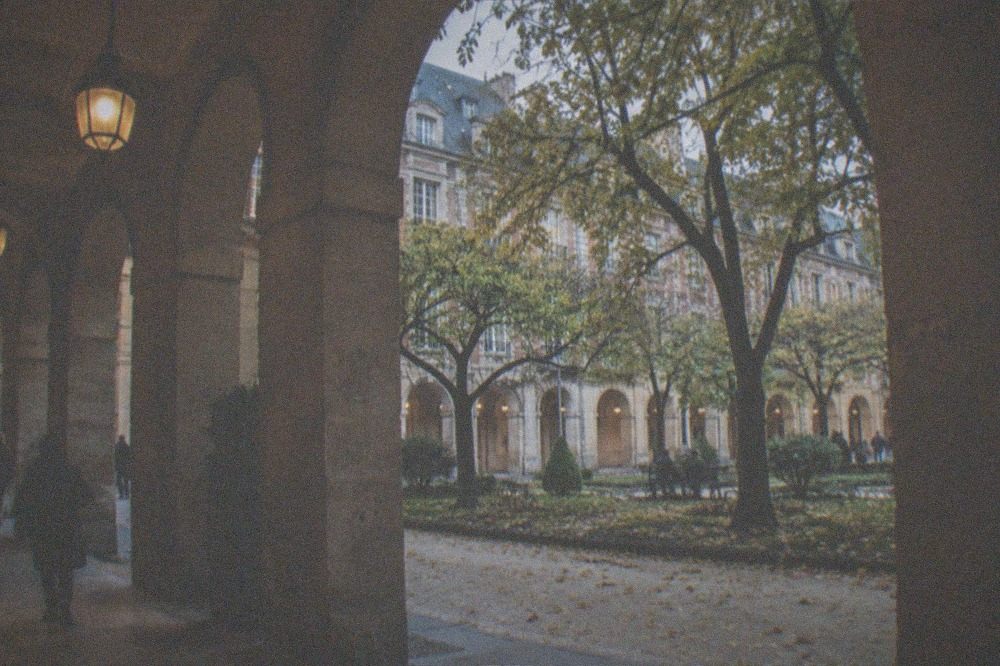
The Victor Hugo case is the clearest live example. The apartment at Place des Vosges, where Hugo lived from 1832 to 1848, is normally free with no ticket at all. A temporary exhibition currently occupies it, and the permanent rooms are sold with the show as a combined ticket. A visitor who arrives expecting the free Hugo apartment finds a ticket desk. That is the system working exactly as the city prints it, not an exception to the rule.
The three partial-free museums behave slightly differently. During an exhibition, the permanent collection rooms stay free and the exhibition rooms are ticketed. At the Musée Cognacq-Jay, the 18th century art collection, free year round, sits a few doors from the Marais lanes that most visitors reach on foot anyway, and the combined exhibition ticket is €8 when a show is running. Outside exhibition periods there is nothing to pay at any of them.
The practical rule for the free eleven: check what is showing before you go, not because the permanent collection will cost money, it will not, but because an exhibition may have absorbed the rooms you came for. If you are going to the Marais cluster anyway, several museums sit within a few minutes of each other, and a walk through Le Marais without the crowds style planning pays off on any afternoon.
The Maison de Victor Hugo sits on Place des Vosges, and one free walking tour route stops essentially at its door. A free, pay-what-you-want walk that ends on the square can double as the orientation walk for the whole Marais cluster, and the Musée Carnavalet is under ten minutes away on foot.
Why The Louvre Is Never Free On A Sunday
The Louvre has no free Sunday, at any time of year. Its recurring free window is the first Friday of the month after 6pm, it does not apply in July or August, and the only other free date is 14 July. Most published guides, and nearly every listicle, state the opposite. The first-Sunday rule that applies to other national museums was never the Louvre's rule.
This is worth a section of its own because it is the site's sharpest correction and because the wrong version is everywhere. A visitor who plans a free Sunday Louvre visit will arrive at a ticket desk that expects €32, or €22 for visitors from the EEA, and the two-tier pricing is in force now rather than announced. The evening Friday rule is the real thing: after 6pm on the first Friday of each month, entry is free, except in July and August when the scheme pauses entirely.
Two practical notes make the Friday rule usable. First, it is an evening visit, so you get the galleries in the last opening hours rather than a full day. Second, it is popular, and the free evening functions like any other free window in Paris: capacity is finite and the queue reflects that. Treat it as a bonus evening rather than the centrepiece of a first trip.
The Louvre's ticket also has a companion perk worth knowing: the Musée Eugène-Delacroix, at €9, is included with a Louvre ticket on the same or the next day. That does not make either free, but it is one of the few genuine two-for-one arrangements among the paid museums, and readers comparing ticket strategies will find it broken down in how much a Louvre ticket costs.
For the record, the free-under-26 rules are separate from the Friday window and apply all month. Under-18s are free with photo ID, and EU and EEA residents under 26, including holders of a long-stay permit or visa over four months, are free too. What gets checked is residency, not nationality, which surprises a lot of non-EU visitors who live in Europe.
National Museums That Are Free One Sunday A Month
Most Paris national museums are free the first Sunday of the month, all year, but the free slot often has to be booked: at the Musée d'Orsay and the Musée de l'Orangerie, a timed reservation is obligatory even though the ticket costs nothing. Rodin's free Sunday runs only October to March. Guimet is free first Sunday including its temporary shows.
The pattern is broad but full of holes, and the holes are what catch people out. The table below is the honest version of the rule.
| Museum | Free first Sunday? | The catch |
|---|---|---|
| Musée d'Orsay | yes, all year | online booking obligatory for the free slot |
| Musée de l'Orangerie | yes, all year | timed reservation obligatory |
| Musée Picasso Paris | yes | no reservation needed |
| Musée du quai Branly | yes | permanent and temporary collections both |
| Musée Guimet | yes | permanent and temporary at the Iéna site |
| Musée de Cluny | yes | permanent collection |
| Musée des Arts et Métiers | yes | plus free every Friday 18:00 to 21:00 |
| Musée Rodin | seasonal | October to March only, no booking needed |
| Musée de l'Armée | no | conditional exemptions only |
The Orsay and Orangerie catches deserve emphasis because free entry is not the same as free access. The ticket costs nothing on the first Sunday, but a booked time slot is compulsory, and the free slots go the way free slots go. A Paris Museum Pass does not exempt you from booking, it only covers the price. Rodin's is the opposite trap: guides list it as free first Sunday without the seasonal limit, and visitors in April find a €14 ticket.
The one genuinely unusual entry on that table is the Musée des Arts et Métiers. It is free the first Sunday of the month like several others, but it is also free every Friday evening from 18:00 to 21:00, all year. No other Paris museum has that rule. A Friday evening at the science and industry museum, with the old instruments and the Foucault pendulum, costs nothing, fifty-two weeks a year.
The Musée de Cluny, the medieval museum on the Left Bank, is one of the most useful first-Sunday picks: a €14 door ticket, no published rating on the resale side, and a permanent collection that includes the Lady and the Unicorn tapestries, which is the single most loved object in the building. Its dedicated page is here. Several Latin Quarter walks pass the museum's medieval garden, and the Majestic Latin Quarter free walk stops at the Cluny Museum itself, which makes it an easy pairing with a free Sunday visit.
The Winter-Only Rule At The Monuments
Panthéon, Sainte-Chapelle, the Conciergerie and the Arc de Triomphe are free the first Sunday of the month only from 1 January to 31 March and from 1 November to 31 December. From April to October there is no free Sunday at any of them. The rule comes from the state monuments body and applies to its whole estate, and summer visitors lose it entirely.
The wording, from the conditions of gratuity published by the Centre des monuments nationaux, is unambiguous: the monuments are free on the first Sunday of the month in winter, never between April and October. That covers the Panthéon, Sainte-Chapelle, the Conciergerie, the Arc de Triomphe, the Château de Vincennes and the Basilique Saint-Denis among others, and the official gratuity conditions page states it directly.
| Monument | Door price | Free first Sunday |
|---|---|---|
| Panthéon | €16 summer, €13 winter | January to March, November to December |
| Sainte-Chapelle | €16 EEA, €22 others | January to March, November to December |
| Conciergerie | €13 | January to March, November to December |
| Arc de Triomphe | €22 summer, €16 winter | January to March, November to December |
Note the pricing around the rule. The Arc de Triomphe and the Panthéon run seasonal and even day-of-week pricing: the Arc is €22 from April to September except Wednesdays at €16, and €16 the rest of the year, and the Panthéon mirrors that pattern at €16 and €13. A free first Sunday in February saves more than it does in November only if you were going anyway. Sainte-Chapelle adds the two-tier structure, €16 for EEA visitors and €22 for everyone else, so the free Sunday means different savings for different visitors.
One caution for pass holders planning around these monuments: even in the free months, Sainte-Chapelle and the Conciergerie still require a timed reservation, and a pass does not remove that requirement. The winter free Sunday can therefore involve a booked slot exactly like Orsay's, which is the second lesson of the day that free entry and free access are different things.
The Three City Sites That Always Charge
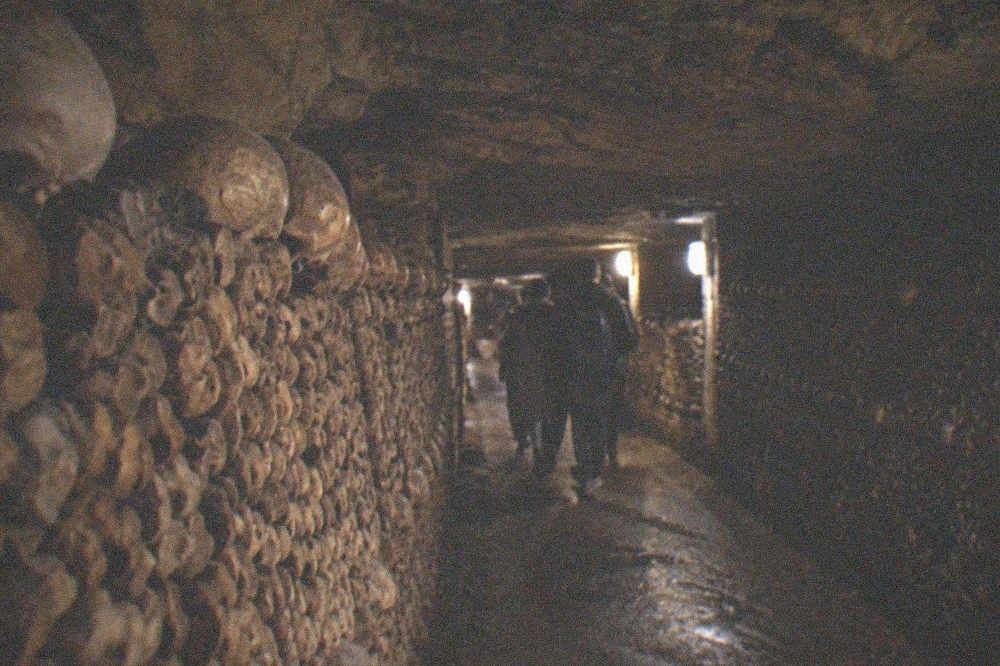
Three Paris Musées sites are paid and always have been: the Catacombes at €31 with the audioguide included, the Palais Galliera fashion museum, and the Crypte archéologique, which is shut for works. Any guide that says all fourteen city museums are free is wrong, and the Catacombes is the most expensive ticket in this entire roster.
The Catacombes are the one that bites, because they sit on every Paris itinerary and because the price surprise is doubled by scarcity: timed slots sell out days ahead, and every resale and skip-the-line product costs several times the €31 door price. It is also closed on Mondays like its sister sites, and it is the only Paris Musées site where booking a slot in advance is not optional advice but close to a necessity. The full breakdown is in how much a Catacombs ticket costs.
Palais Galliera, the city's fashion museum, charges €14, or €12 reduced, and a combined ticket with something else in the network runs €17 or €15. It is a small, sharp venue whose shows rotate completely, so it is worth checking what is on rather than treating it as a permanent collection. The Crypte archéologique on the Île de la Cité, €11 when it was last open, is closed for conservation works, and no free-museum plan should include it this year.
None of the three belongs in a free itinerary, and none ever did. The free eleven are the free eleven. The reason this needs saying out loud is that the number fourteen gets repeated: fourteen city network sites, of which eleven are free. The arithmetic is simple but the wrong sentence, "all city museums are free", costs a visitor either €31 or a wasted walk.
Free Museums By Neighbourhood
The free museums cluster, and a day built around one cluster beats a list of eleven scattered names. The Marais holds Carnavalet, Cognacq-Jay and the Hugo apartment within a ten minute radius. The Latin Quarter holds the Musée Curie and, a walk away, Cluny on its free Sunday. The Champs-Élysées stretch holds the Petit Palais and the Musée d'Art Moderne on either side of the river.
The Marais is the strongest free cluster in Paris, and all of it is closed on Monday. The Musée Carnavalet's history of Paris, the Cognacq-Jay's 18th century rooms and the Place des Vosges apartment where Hugo wrote are a single afternoon on foot, and every one of them is free whenever it is open. A pay-what-you-want walk through Le Marais covers the Place des Vosges and the Hôtel de Sully courtyard that frames the eastern approach to it, and the guides work on tips alone: you book a free slot and pay what the walk was worth at the end.
The Latin Quarter pair works differently because one of the two is conditional. The Musée Curie, in the radium laboratory where Marie Curie worked, is free with no ticket, but it is the free museum most likely to be shut when you arrive: it closes Sunday, Monday and Tuesday, all of August, and 20 December to 5 January. Cluny nearby is free only on first Sundays. A free Latin Quarter walk passes within a hundred metres of the Curie museum on the way from the Panthéon down to the Luxembourg gardens, which makes the Curie a natural stop on a walk day rather than a destination in itself.
The Champs-Élysées end is the free cluster people never plan. The Petit Palais and the Grand Palais face each other across Winston Churchill Avenue, and the Petit Palais charges nothing while the Grand Palais exhibitions are ticketed one by one. Cross the river to the 16e and the Musée d'Art Moderne, with its own permanent collection free, is a short walk along the riverbank. the free Eiffel Tower walking tour sets off from the Place de la Concorde, fifty metres from the Petit Palais steps, and its route runs along the same riverbank the art museum sits on, so a morning walk and an afternoon of free art share one stretch of the Seine.
The Right Bank Free Route, End To End
A free Right Bank day runs from the Arc de Triomphe down the Champs-Élysées to the Petit Palais, crosses to the Musée d'Art Moderne, and finishes at the Eiffel Tower's public parks, all on pay-what-you-want walking tours and free permanent collections. The only tickets anyone needs on that route are metro fares, because no museum pass covers any of it and none of it needs one.
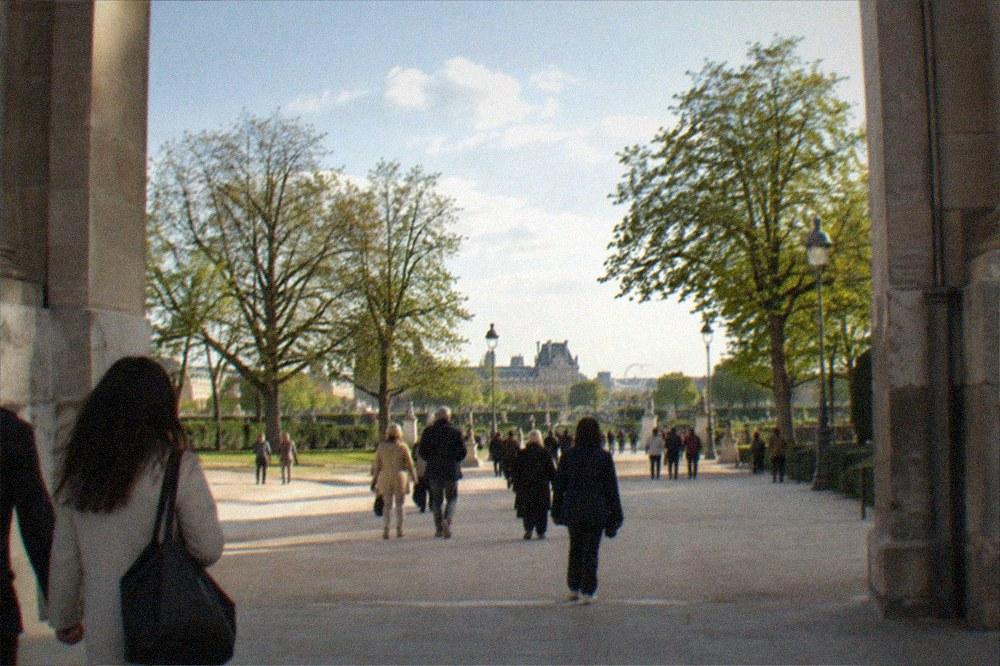
The walk itself is a known quantity: several free tours run the length of the avenue, and one of them, meeting at the Place de la Concorde by the Tuileries basin, runs from the Grand Palais end toward the Eiffel Tower. The all-encompassing free Paris walk covers the Arc de Triomphe, the Champs-Élysées and the Tuileries before ending at the Louvre, and its guides are tipped at the end rather than paid upfront. The Petit Palais sits directly on that route, which is the whole point: the free art and the free walk occupy the same afternoon.
The Musée d'Art Moderne de Paris is the quiet star of the free Right Bank. Its permanent collection, free to everyone, includes major modern painting, and it stays open into the evening on some days, which pairs well with a sunset walk along the river. It closes on Mondays with the rest of the city network. the Hidden Stories monuments walk passes within a few hundred metres of it on the way toward Passy and the riverbank museums.
Two notes close the route. The Musée Guimet, the Asian art museum in the 16e, is not one of the free eleven: it charges €15 or €12 reduced, with no age-based reduction at all, and its free window is the first Sunday of the month, permanent and temporary collections both. And the Latin Quarter tour by Walkative is the free option on the other side of the river if your day starts there instead, stopping at the Panthéon and the Luxembourg gardens near the Zadkine museum, which is free, partly, when an exhibition is not on.
Does The Paris Museum Pass Help With Free Museums?
No. The Paris Museum Pass buys nothing at any of the eleven free city museums, because their permanent collections already cost nothing, and it never covers temporary exhibitions, which are the only thing those museums sell. At €85 for two days, €105 for four and €125 for six, counted in hours from first scan, the pass is a tool for the paid list, not the free one.
The honest way to frame the pass, on a page about free museums, is that the two subjects barely touch. A visitor spending two days in the free eleven needs no pass at all. A visitor mixing the Louvre and Orsay with the free city museums needs to understand that the pass covers the first two and does nothing at the third group, and the pass's own site lists its fifty-five covered sites, a list that includes no Paris Musées city museum.
Two further pass facts belong on any free-museum page because they interact with the free rules. The pass still demands a separate free timed reservation at eight sites, including the Louvre, Orsay, the Orangerie and Versailles, so it never removes the booking obligation that the free Sundays also carry. And the pass exclusion list includes the Eiffel Tower, the Catacombes, the Opéra Garnier, the Musée Marmottan Monet and the Atelier des Lumières, so the expensive half of the paid roster is outside it too. The full arithmetic, including whether it ever pays for itself, is worked through in the Paris Museum Pass guide and in whether the pass is worth it.
For the family of four, one more note: the pass is adult-only because under-18s and EU and EEA residents under 26 are already free at most covered sites. On a free-museum itinerary the under-18 rule barely matters, since the eleven city museums charge nobody anything anyway. The Paris museums for kids guide covers the age rules where they actually bite, at the paid venues.
The Friday And Sunday Free Windows Worth Planning Around
Three recurring free windows beat everything else on this page for a short trip: the Musée des Arts et Métiers every Friday evening from 18:00 to 21:00, the national museums on the first Sunday of the month, and the winter-only free Sundays at the state monuments. The Louvre's first-Friday-evening window is the bonus, not the plan, because it vanishes in July and August.
The Friday evening at the Arts et Métiers is the most underused free slot in Paris. Fifty-two evenings a year, no booking pattern to learn, no seasonal cut-off, and a museum whose collection of scientific instruments, clocks and machines is arguably better in the half-light of an evening visit than at midday. It closes Mondays like its colleagues, and its door price is €12 when you pay.
The first Sunday is the workhorse. Orsay, the Orangerie, Picasso, quai Branly, Guimet and Cluny all open free on it, with the booking catches already listed above. Rodin joins only from October to March. If your trip includes a first Sunday, plan the paid national museums onto it and leave the free eleven for the other days, because the free eleven do not care which day it is.
The winter Sundays at the monuments are for November-to-March visitors, and they stack: a free first Sunday in February could put the Panthéon, the Conciergerie and the Arc de Triomphe into one day at no cost, while the Louvre across the river charges full price on the same afternoon. That contrast, a completely free Left Bank day beside a €32 ticket, is the clearest picture of how unevenly the free rules fall across this city.
GuruWalk, the platform behind the free walks named above, works on a simple model: you reserve a place at no charge, join the walk, and tip the guide what the experience was worth at the end. The walks are not ours and they are not museum tours, they are city walks whose routes happen to pass several of the free museums on this page, which is why they fit a zero-euro museum day so well.
Common Questions About Free Museums In Paris
How many museums are free in Paris?
Roughly 15 to 17 are free with no condition at all: eleven City of Paris museums, plus the Musée Curie, the Musée de la Préfecture de Police, the Mémorial de la Shoah, Le Plateau and the Musée d'Archéologie nationale's permanent collection. About a dozen more, the national museums, are free on the first Sunday of the month.
Is the Louvre free on the first Sunday of the month?
No. The Louvre is free the first Friday of the month after 6pm, except in July and August, and on 14 July. The first-Sunday rule belongs to other national museums, and the Louvre has not had a free Sunday in years.
Which Paris museums are free every day?
The eleven City of Paris permanent collections: Carnavalet, Petit Palais, Musée d'Art Moderne, Cernuschi, Vie romantique, Libération, Victor Hugo, Balzac, Bourdelle, Cognacq-Jay and Zadkine, with the exhibition caveats at the last five. The Musée Curie is also free whenever it is open.
Are the Catacombes one of the free city museums?
No. The Catacombes are a Paris Musées site but they have always charged, and at €31 with the audioguide included they are the most expensive ticket in the network, alongside the paid Palais Galliera and the Crypte archéologique, which is closed for works.
Do I need a reservation for a free Sunday at Orsay?
Yes. The free first-Sunday ticket at the Musée d'Orsay still requires an online timed reservation, and the Orangerie works the same way. Free entry is not the same as free access, and the free slots run out.
When is the Panthéon free?
The Panthéon is free the first Sunday of the month only from January to March and November to December. From April to October there is no free Sunday, and the door price is €16 in summer, €13 in winter.
Can I visit free Paris museums on a Monday?
Not the city ones. All eleven free Paris Musées museums close on Mondays, as do Orsay, Rodin, Picasso, quai Branly, Cluny and the Catacombes. Open daily and free of a closed day are the monuments like Sainte-Chapelle and the Arc de Triomphe, though they charge outside their winter free Sundays.
Is the Musée Rodin free on Sundays?
Only from October to March. The Musée Rodin is free the first Sunday of the month in that window, with no booking needed, and charges €14 the rest of the year, including on summer first Sundays.
The two free systems are the whole trick to planning this: the city eleven are free whenever they are open, the national museums are free one Sunday a month with booking catches, the state monuments are free only in the cold half of the year, and the Louvre, as Paris Museums keeps having to say, is never free on a Sunday at all.