Where To See Monet In Paris: Four Museums Ranked By What You Actually See
Monet spent his last decades painting the same pond, and Paris ended up holding most of it. Four venues matter, and each one shows you something the others cannot.
Short answer
The Orangerie puts eight Water Lilies panels in two oval rooms built for them, entry €11 at the door. Marmottan Monet holds the world's largest Monet collection including Impression, soleil levant, €14. Musée d'Orsay carries the canonical Impressionist floor, €16 online. Giverny, 75 km out, is the garden itself, €13, open only from spring to early November.
Paris holds more Monet than any other city on earth, and it holds it in four places that reward completely different kinds of visitors. Two of them are purpose-built rooms you walk into and stop talking. One is a conventional museum with the greatest hits of the whole Impressionist movement. The last one is not in Paris at all: it is the garden the paintings came from, an hour west by train, and it closes for the winter.
This guide ranks the four by what you actually stand in front of, not by fame. It gives real door prices, real closed days, the free-entry rules that apply at each, and the train you need if you decide to go all the way to Giverny. The short version for people skimming: if you have one afternoon, do the Orangerie and then walk across the river to Orsay. If you have a full day and a train ticket appetite, add Giverny in season. If you are a Monet obsessive, Marmottan is not optional.
Before the ranking, one framing fact that changes how you plan. The two Paris rooms that hold the most Monet sit a fifteen-minute walk from each other on opposite banks of the Seine, and they close on different days. The Orangerie closes Tuesday. Marmottan closes Monday. Orsay closes Monday too. So a Tuesday is a bad day for this itinerary and a Monday is worse, while Wednesday through Sunday works for all three city venues. Giverny, uniquely, has no weekly closed day but a whole closed season.
The Four Monet Venues At A Glance
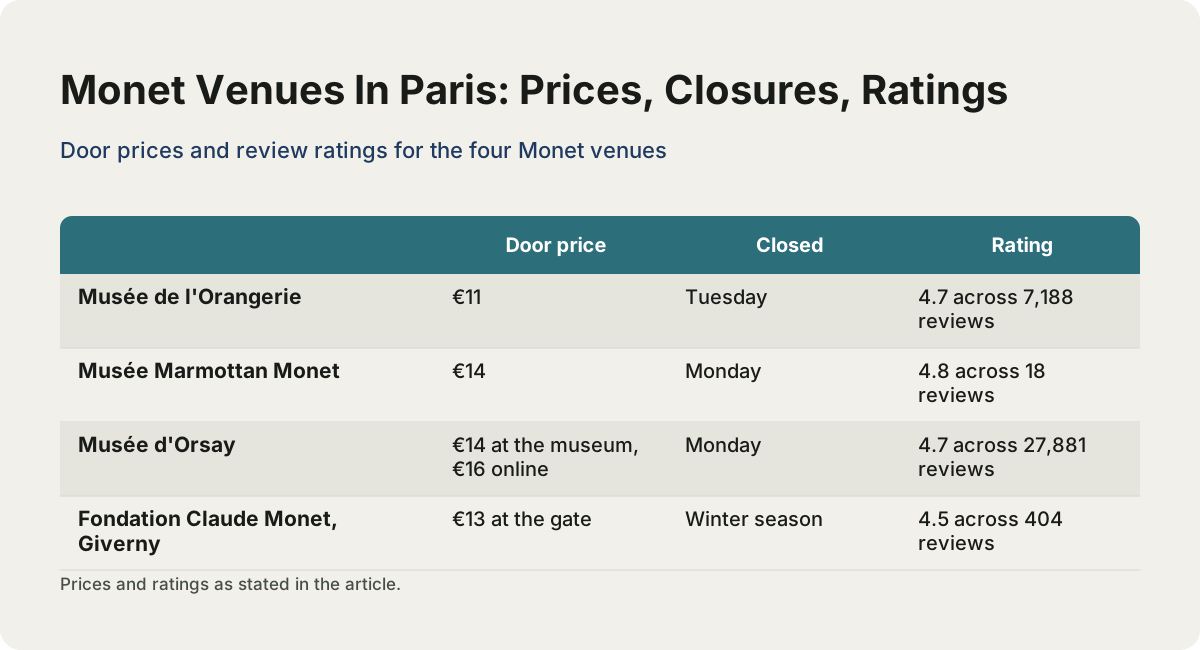
Four places hold the Monet that matters: the Orangerie with eight Water Lilies panels in two oval rooms, Marmottan Monet with the world's largest single Monet collection, Musée d'Orsay with the full Impressionist floor, and Fondation Claude Monet at Giverny, which is the house and garden that produced the paintings. Door prices run €11, €14, €14 and €13, and only three of the four are in Paris.
The table below is the whole decision in one place. Everything in it is a door price in euro, paid at the museum itself, which is worth remembering because several of these venues sell online tickets at a slightly different figure, and the Orsay actually charges more online than at the door.
| Venue | What You See | Door price | Closed | Rating |
|---|---|---|---|---|
| Musée de l'Orangerie | Eight Water Lilies panels, two oval rooms | €11 | Tuesday | 4.7 across 7,188 reviews |
| Musée Marmottan Monet | Largest Monet collection in the world, Impression, soleil levant | €14 | Monday | 4.8 across 18 reviews |
| Musée d'Orsay | Full Impressionist floor, Monet among peers | €14 at the museum, €16 online | Monday | 4.7 across 27,881 reviews |
| Fondation Claude Monet, Giverny | The house and the garden itself | €13 at the gate | Winter season | 4.5 across 404 reviews |
Two notes on that table. The Marmottan review count is small because the venue is small, a townhouse in the 16th arrondissement rather than a grand national museum, not because visitors are disappointed. And the Orsay figures point at a real inversion: booking online costs €16 against €14 at the door, which is the opposite of what most people assume about buying ahead.
Musée de l'Orangerie: The Water Lilies As Monet Intended Them
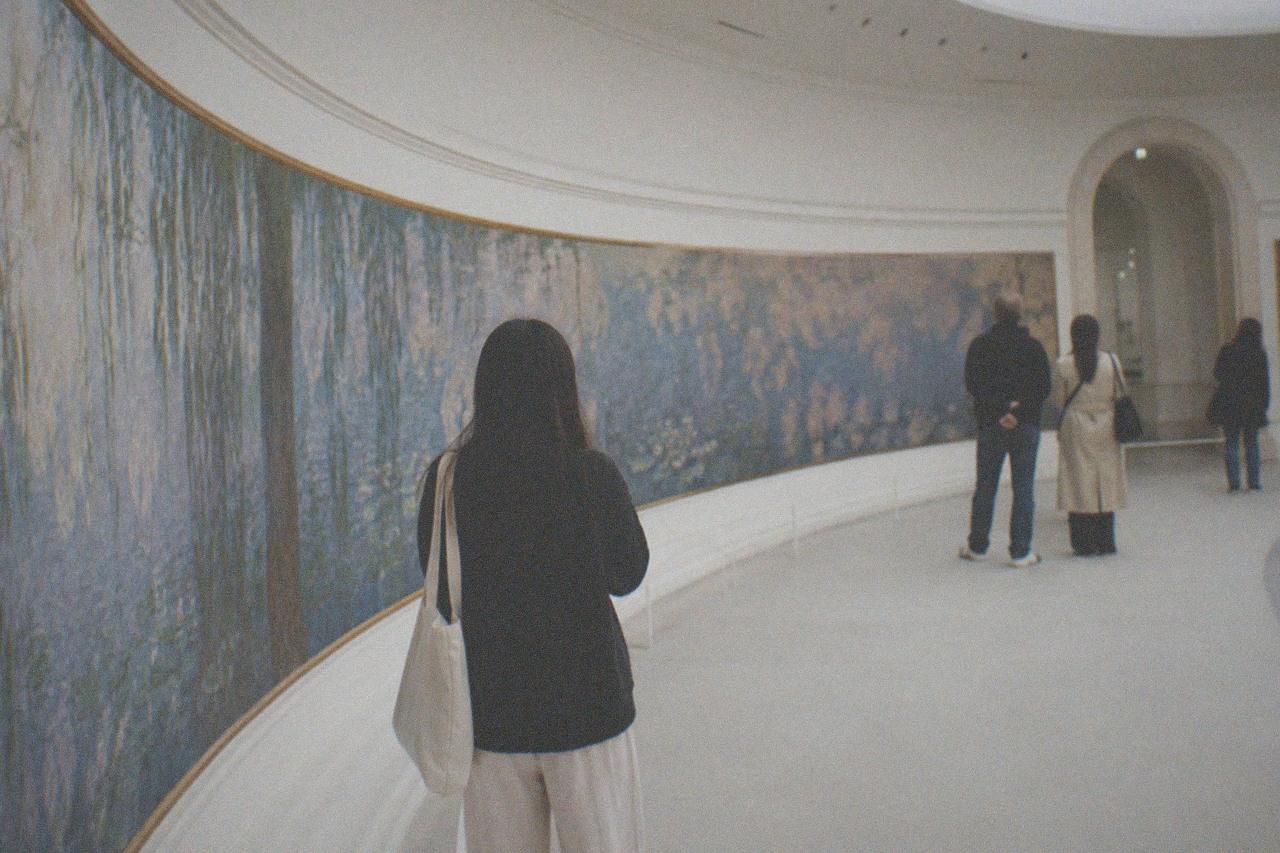
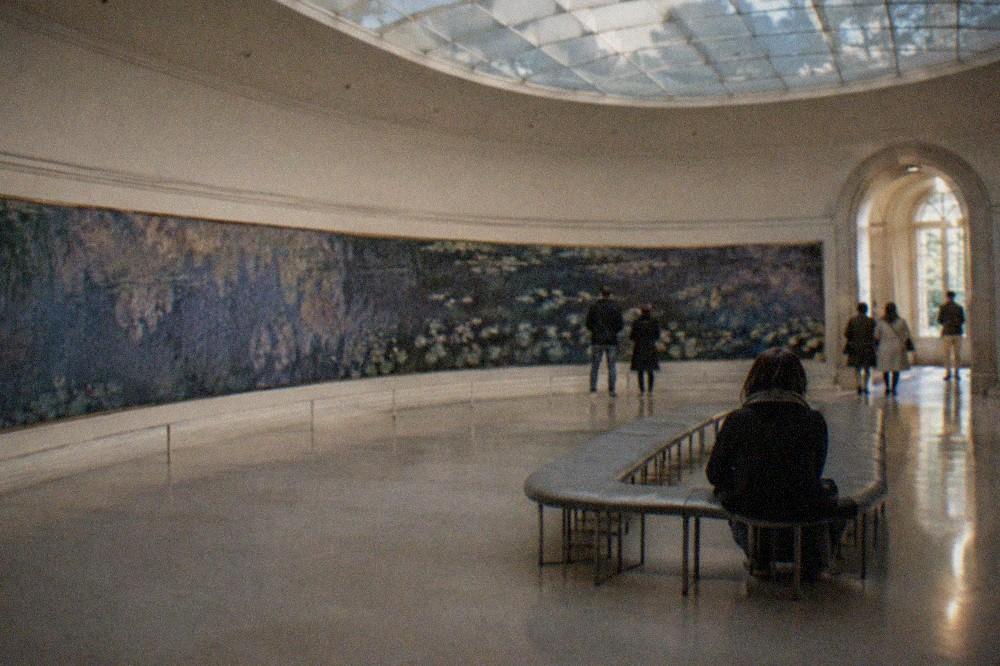
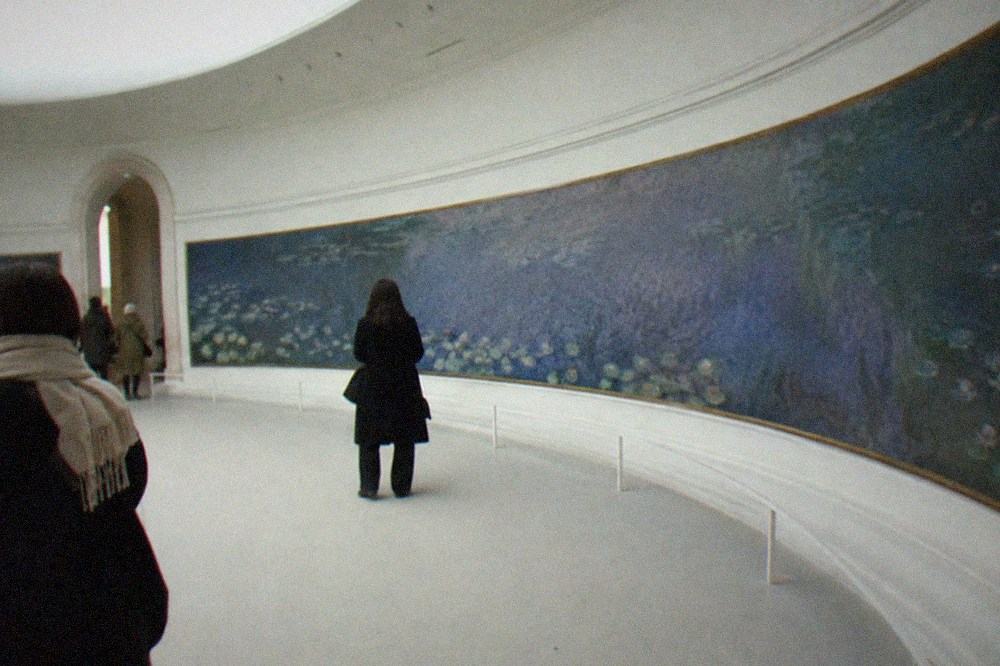
The Orangerie is the answer to the question most visitors actually have, because it is the only place where Monet's Water Lilies hang the way he designed them to hang: eight panels across two oval rooms, lit from a skylight above, with no frame between you and the pond. Entry is €11 at the museum, and the museum closes Tuesday.
Monet gave these panels to France the day after the Armistice, in 1918, as a war memorial, and he worked with the architect to specify the rooms. The result is the closest thing Paris has to a secular chapel: curved walls, diffuse top light, water and willow reflections wrapping around you at eye level. Reviewers consistently say the experience is meditative rather than museum-like, and the most common complaint is only that the rooms fill up, which is why timed entry exists.
The museum also holds a strong basement floor, the Jean Walter and Paul Guillaume collection, which runs from Renoir and Cézanne up to Picasso and Modigliani. Visitors expecting a single-room museum are regularly surprised by this, and it turns a thirty-minute visit into a ninety-minute one. If your Monet interest is broad rather than single-minded, that downstairs floor is a genuine second museum included in the same €11.
Practically: the museum sits at the corner of the Tuileries garden, the metro is Concorde, and the free first Sunday rule requires a booked timed slot even though the ticket costs nothing. For a full walkthrough of the ticketing question, our piece on Orangerie tickets and visit length covers the booking mechanics and what the timed entry actually controls. The Orangerie can also be booked as a product, from $15.70, which bundles the skip-the-line convenience.
The trio above is this guide's core choice: the Orangerie for the immersive rooms, Marmottan for the collection, Giverny for the garden. If you only ever book one Monet experience in Paris, most visitors should make it the Orangerie, because the two oval rooms are the one thing that exists nowhere else in the world.
For tickets and opening questions specific to this museum, see our Orangerie ticket page, which carries the current door price and the closed-day rules in one place.
Musée Marmottan Monet: The World's Largest Monet Collection
Marmottan holds the largest single Monet collection in the world, well over a hundred works, including Impression, soleil levant, the 1872 harbour canvas that gave the whole Impressionist movement its name. Entry is €14 at the museum, the venue is closed Monday, and it is deliberately left off the Paris Museum Pass.
That collection exists because of two bequests. Michel Monet, the painter's younger son, left the museum his father's personal collection in 1966, the canvases Monet kept in his own studio and never sold, and the donor community around the museum has added to it since. So where Orsay shows Monet as the market and the Salon saw him, Marmottan shows Monet through his own eyes, including late works and studies the public never saw during his lifetime.
Impression, soleil levant hangs here, and it is smaller than almost anyone expects, a misty orange sun over Le Havre harbour that a critic seized on in 1874 to mock the whole group as impressionists. Standing in front of the canvas that named the movement is a different experience from standing in front of the Water Lilies, more art history than immersion, and the two visits complement rather than duplicate each other.
The setting matters too. Marmottan is a former hunting lodge in the 16th arrondissement, near the Ranelagh gardens, reached by metro to La Muette and a walk. It never feels crowded the way the Orangerie or Orsay do, and the room density is low. Reviewers consistently praise exactly this: the rating sits at 4.8, across a small count of 18 reviews, on a venue that most Paris itineraries simply never reach. The published review count is low because this is a specialist museum, not because of any access problem. Our dedicated piece on what is special about Marmottan Monet goes deeper on the hang and the timing.
Note that the box above points back to the Orangerie rather than Marmottan, deliberately: if you are choosing a single timed-entry booking for a Paris Monet trip, the oval rooms are the stronger first pick for most visitors, with Marmottan as the connoisseur's second stop. Marmottan's own bookable entrance ticket reads $16.89 against the €14 door, so buying at the museum is genuinely cheaper here if you can risk the queue.
Musée d'Orsay: The Canonical Impressionist Floor
Orsay does not have the most Monet, but it has the most context: a whole floor of Impressionism, with Monet hanging beside Renoir, Degas, Pissarro, Sisley and Cézanne, plus the largest single collection of his work in a national museum. Entry is €14 at the museum against €16 online, and the museum closes Monday.
The top floor of the Orsay is the room most people picture when they picture Impressionism, and Monet carries a large share of it. The museum's own collection pages give the count, and the museum's holdings include Blue Water Lilies, the Gare Saint-Lazare canvases and a run of Rouen Cathedral fronts that show the same motif under different light, which is the clearest single demonstration anywhere of what Monet was actually chasing: not the object, but the light on it.
That is the argument for Orsay in a Monet ranking. The Gare Saint-Lazare sequence in particular is the answer to anyone who says the Water Lilies are all the same painting: here is Monet painting steam and glass and modern iron, inside a railway station, ten years before he ever dug a pond at Giverny. The museum is also the physical home of the movement's wider story, so a visitor with two hours sees the whole argument rather than one man's late period.
Practically, Orsay is huge and the crowds match. Timed entry is compulsory, the free first Sunday requires a booked slot, and the building's current renovation, running to summer 2028, modifies some access routes while keeping all collections open. For the question of advance booking, our Orsay advance-ticket guide runs the numbers, and if you are wondering about the other famous canvas people chase in this building, see our piece on whether Starry Night is at the Orsay. It is not, and this guide's ranking assumes you know that.
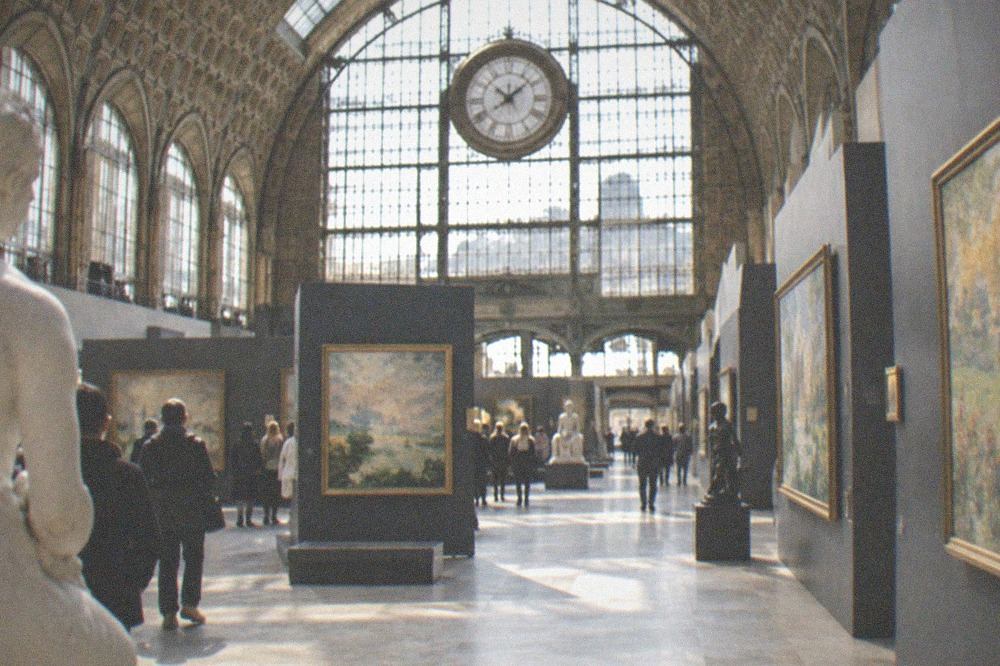
One planning note that belongs here rather than in a footnote: the museum's door and online prices differ, €14 against €16, and the difference is not a booking fee, it is the online ticket simply costing more. For a museum where timed entry is compulsory, that surprises people who have internalized the usual buy-ahead logic. Booking still makes sense for a guaranteed slot, but do it knowing the price relationship is inverted.
For the museum's own practical details, our Orsay ticket page collects the current prices and closed-day rules, and the official museum site carries the same figures at the Orsay's own rates page.
Fondation Claude Monet At Giverny: The Garden Itself
Giverny is the only one of the four that is not a museum, it is the place: Monet's house, his flower gardens and the water garden with the Japanese bridge, 75 km from Paris, open from spring to early November, closed all winter, and entry at the gate is €13. There is no weekly closed day while it is open, and the nearest station is Vernon, reachable by train from Paris Saint-Lazare.
Everything above needs a caveat about season, because the fresh reads pin it precisely: the foundation runs from 1 April to 1 November, and shut from 2 November to the end of March. If your trip is in February, Giverny is simply not on the menu and this section does not apply. The garden is the source material for the Water Lilies you saw in the Orangerie's oval rooms, and visitors consistently describe the visit as a loop: you stand in the Orangerie, you understand the pond, then you stand at the pond and understand the panels.
Getting there is straightforward but has steps. The train from Paris Saint-Lazare to Vernon-Giverny takes roughly 45 to 60 minutes, then the foundation is 10 to 20 minutes further by shuttle, bike or taxi. The walk-and-bike option is genuinely pleasant in season, the road is flat and signposted, and bikes are rentable at the station. A booked product from $118.66 covers transport and entry together, which is why the platform from-price is so far above the €13 gate: you are buying the logistics, not the garden.
Inside, the visit splits into three parts: the pink house with the blue kitchen and the Japanese prints Monet collected, the clos normand flower garden with its rigid axis Monet designed himself, and the water garden across the road with the bridge. Reviews rate the experience 4.5 across 404 reviews, and the criticism pattern is seasonal: the crowds in May are dense, and the light in late afternoon is the one photographers should plan around. Our piece on Giverny tickets and distance covers the booking question in detail, and the foundation's own site carries the official season dates at claudemonetgiverny.fr.
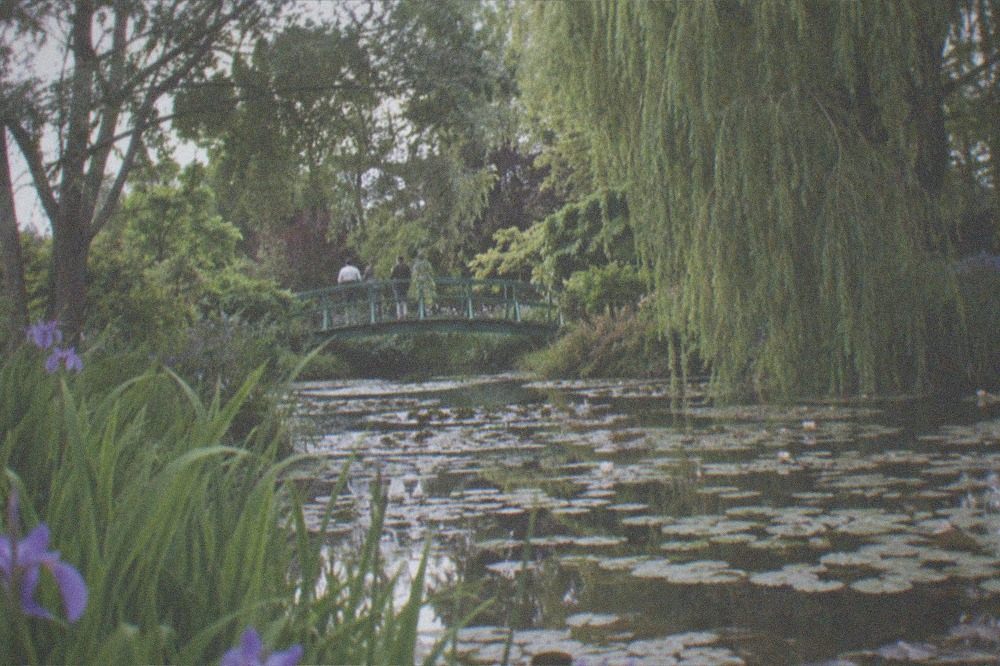
Note what that tile sells: not the garden alone but the round trip, because Giverny is the one Monet destination where transport is the hard part. The €13 ticket at the gate is the cheap version if you are confident on the train; the booked product is the version where someone else owns the schedule.
How To Choose Between The Four
Choose by what you want Monet to do to you: the Orangerie for immersion in the Water Lilies, Marmottan for the artist's own studio collection and the canvas that named the movement, Orsay for Monet among his contemporaries, Giverny for the landscape that produced it all. If you only do one, do the Orangerie; if you only have two hours in Paris, still do the Orangerie.
The decision comes down to three variables: how much time you have, whether you want art history or atmosphere, and whether the garden season is open. The table below collapses it.
| If you have... | Do this | Why |
|---|---|---|
| Two hours | Orangerie only | The oval rooms are short to walk, deep to feel, and central |
| Half a day | Orangerie, then walk to Orsay | Fifteen minutes on foot, opposite banks, different Monet |
| One full day | Orangerie, Marmottan, Orsay | All three fit between Wednesday and Sunday |
| Two days, spring to autumn | All four, Giverny on day two | Train out in the morning, garden in full light |
| A Monet obsession | Marmottan first | The studio collection, Impression, soleil levant, no crowds |
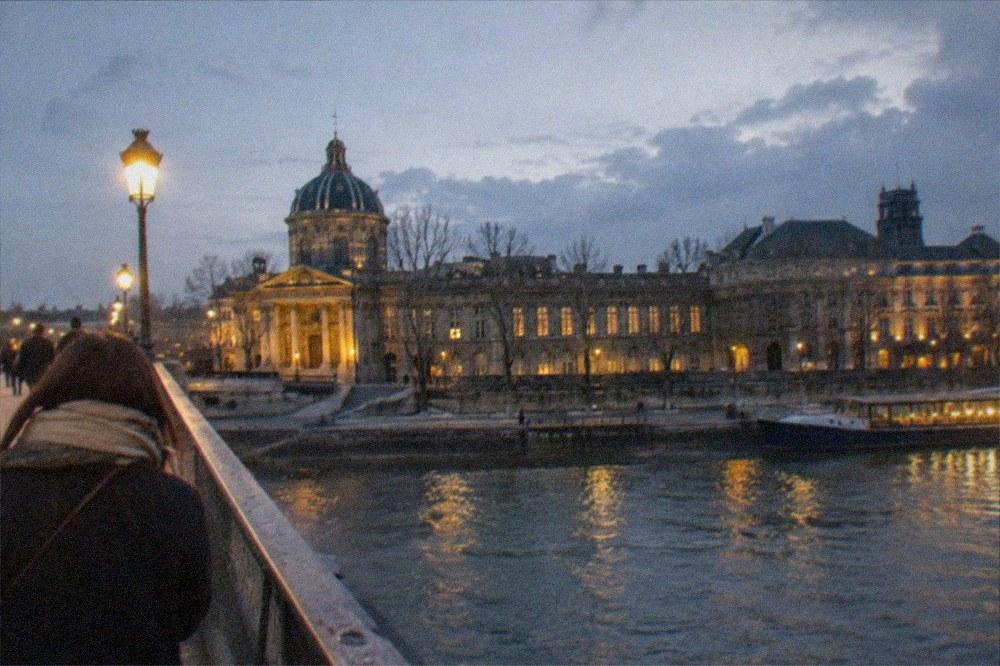
The Orangerie and Orsay pairing deserves its own sentence because it is the highest-value half day in this entire topic. You leave the Tuileries corner, cross the Seine via the Passerelle Léopold-Sédar-Senghor, and you are at the Orsay within a quarter hour, having gone from the immersive pond rooms to the full Impressionist argument. Two museums, one walk, two completely different Monet experiences, both timed-entry, both bookable with free cancellation.
Tickets, Free Days And Closed Days, Venue By Venue
Every one of the four has a different rule set: the Orangerie and Orsay are free the first Sunday of the month with a mandatory booked slot, Marmottan has no free day at all, and Giverny has no free day and no winter either. The closed days split by camp: Orangerie closed Tuesday, Orsay and Marmottan closed Monday.
The first-Sunday rules are the part worth double-checking, because free at these museums does not mean walk-in. The Orangerie's free Sunday carries an obligatory timed reservation. The Orsay's free Sunday carries an obligatory online booking too. Marmottan is the odd one out in the other direction: no free Sunday at all, not on the Paris Museum Pass, always €14. Giverny is outside all of these systems, a private foundation with a season and a gate price.
| Venue | Free entry rule | Timed entry | Bookable from |
|---|---|---|---|
| Musée de l'Orangerie | First Sunday monthly, booked slot required | Yes, compulsory | $15.70 |
| Musée Marmottan Monet | No free day, not on the pass | Yes, compulsory | $16.89 |
| Musée d'Orsay | First Sunday monthly, booked slot required | Yes, compulsory | $15.12 |
| Fondation Claude Monet, Giverny | No free day, seasonal opening | Timed in season | $118.66 |
Two structural facts close this section. The Paris Museum Pass covers the Orangerie and the Orsay but still requires you to make a separate timed reservation at each, and it buys nothing at Marmottan, which is not on the pass list at all. The pass prices, €85 for 2 days, €105 for 4 days, €125 for 6 days, are on the official pass site at parismuseumpass.fr, and a Monet-only itinerary is exactly the kind of narrow plan where the pass rarely pays: two of these four venues are outside it. If you are weighing the pass for a wider trip, our Paris Museum Pass guide runs the arithmetic properly.
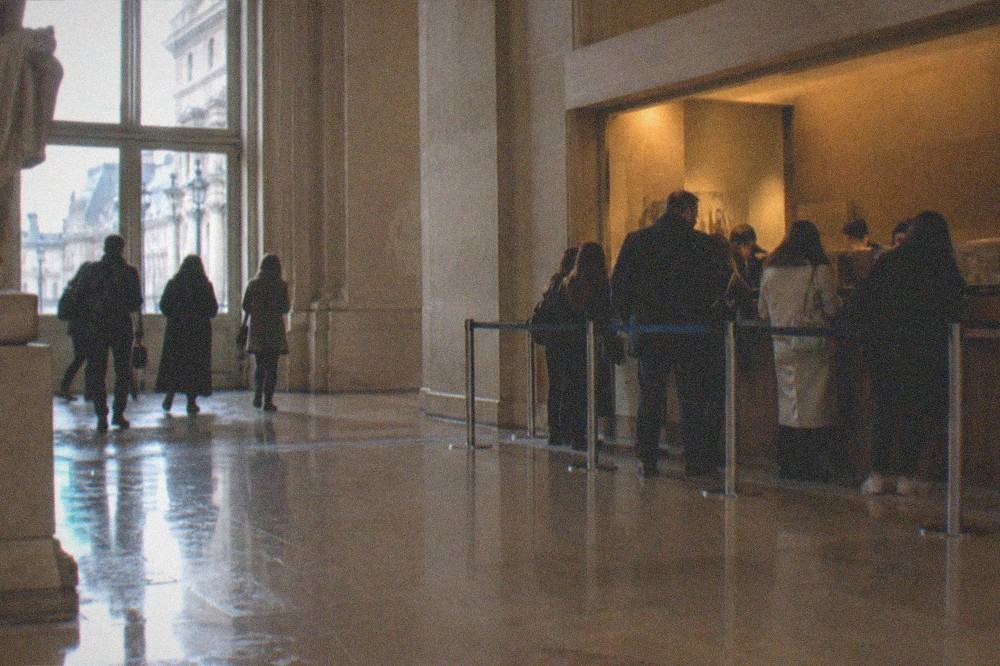
A Verdict By How Much Time You Have
With one museum slot, book the Orangerie: €11 at the door, two oval rooms, nothing else like it. With a full day, add Orsay across the river and Marmottan if the timing allows. With two days and the season open, take the Saint-Lazare train to Vernon and see the pond the paintings came from, €13 at the gate.
The reasoning is about uniqueness. Orsay's Monet is magnificent but partly duplicated in books and other world museums; the Orangerie's two oval rooms and Giverny's water garden exist in exactly one place each. So the priority order for a first-time visitor with limited time is Orangerie, then Giverny if the season and the schedule allow, then Orsay for context, then Marmottan for depth. The Monet obsessive inverts the whole list and starts at Marmottan, and that inversion is legitimate, but it is a minority taste.
One honest warning about combining the three Paris venues in a single day. All three use compulsory timed entry, and the slots at the Orangerie in particular go in blocks, so a three-museum day means three fixed times, and the walk between Orangerie and Orsay is short but the metro ride out to La Muette for Marmottan is not. Visitors regularly report doing Orangerie plus Orsay comfortably in an afternoon, and adding Marmottan only when the day starts early. This is also where the practical detail from our art museums in Paris guide overlaps, if you are building a wider circuit around this Monet core.
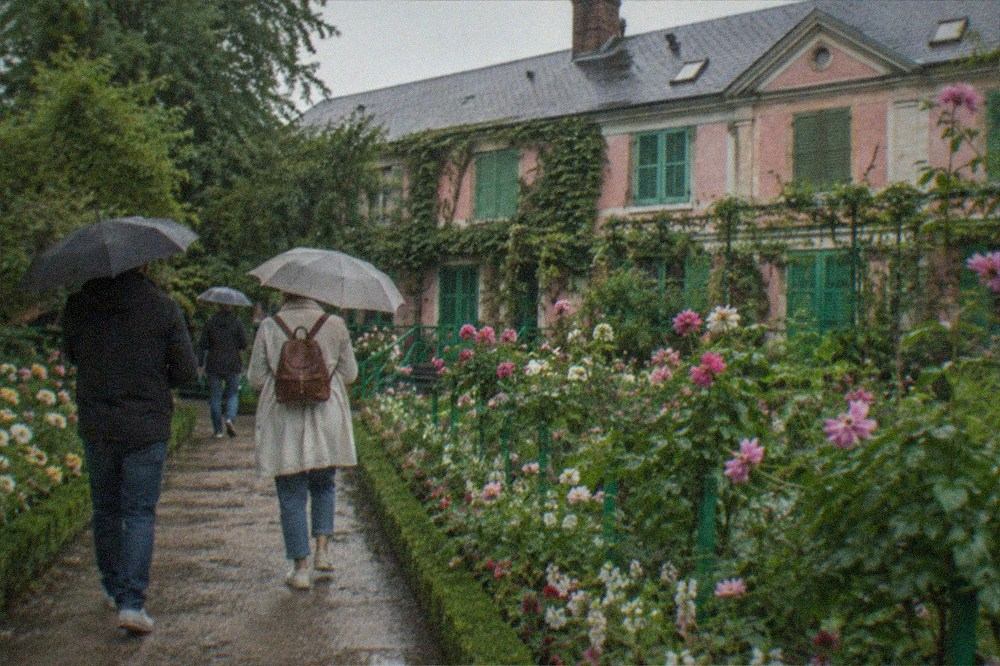
For everything a Monet trip sits inside, Paris Museums is the site this ranking lives on, and each venue page linked through this guide carries the current verified door price, closed day and booking options for that museum. The trio below is the full Monet itinerary in product form: the oval rooms, the world's largest collection, and the garden itself, each bookable with free cancellation.
Common Questions About Seeing Monet In Paris
Where is the best place to see Monet's Water Lilies in Paris?
The Musée de l'Orangerie. Eight Water Lilies panels hang in two oval rooms designed by Monet himself, lit from above, curved around the visitor. Entry is €11 at the museum, the venue is closed Tuesday, and timed entry is compulsory.
Where is Impression, soleil levant?
At the Musée Marmottan Monet in the 16th arrondissement, the canvas that gave Impressionism its name in 1874 hangs in the museum holding the world's largest single Monet collection, collected largely through the bequest of Monet's son Michel. Entry is €14.
How many Monet paintings are at the Musée d'Orsay?
Orsay holds one of the largest Monet collections in a national museum, spanning the Gare Saint-Lazare canvases, Rouen Cathedral fronts and later works. The museum's own collection pages give the exact count, which changes with loans and rotations.
Is Giverny worth the trip from Paris?
Yes, if the season is open. The foundation runs from 1 April to 1 November and shuts all winter, entry is €13 at the gate, and the trip takes about an hour by train from Paris Saint-Lazare to Vernon plus a short shuttle, bike or taxi ride.
Can you see Monet for free in Paris?
Partly. The Orangerie and the Orsay are free the first Sunday of the month, but both require a booked timed slot for the free entry. Marmottan has no free day, and Giverny has none either.
Which Monet museum is closest to the others?
The Orangerie and the Orsay are a fifteen-minute walk apart on opposite banks of the Seine, which makes them the natural pair for a single afternoon. Marmottan is further out in the 16th arrondissement, and Giverny is a day trip.
Do I need to book Orangerie tickets in advance?
Timed entry is compulsory, and the free first-Sunday slots are limited, so booking ahead is the safer play. The online ticket costs €12.50 against €11 at the door, so the price relationship is inverted compared with most museums.
Is Marmottan Monet on the Paris Museum Pass?
No. Marmottan is not on the pass list, so pass holders still buy the €14 ticket. The pass does cover the Orangerie and the Orsay, but both still require a separate timed reservation.