Is The Paris Museum Pass Worth It? The Honest Break-Even Math
The pass sells a promise of skipping ticket lines at 55 sites. The arithmetic says something narrower: it pays off for a specific kind of visitor doing a specific kind of trip, and it loses money for everyone else. This guide runs the numbers from verified door prices.
Short answer
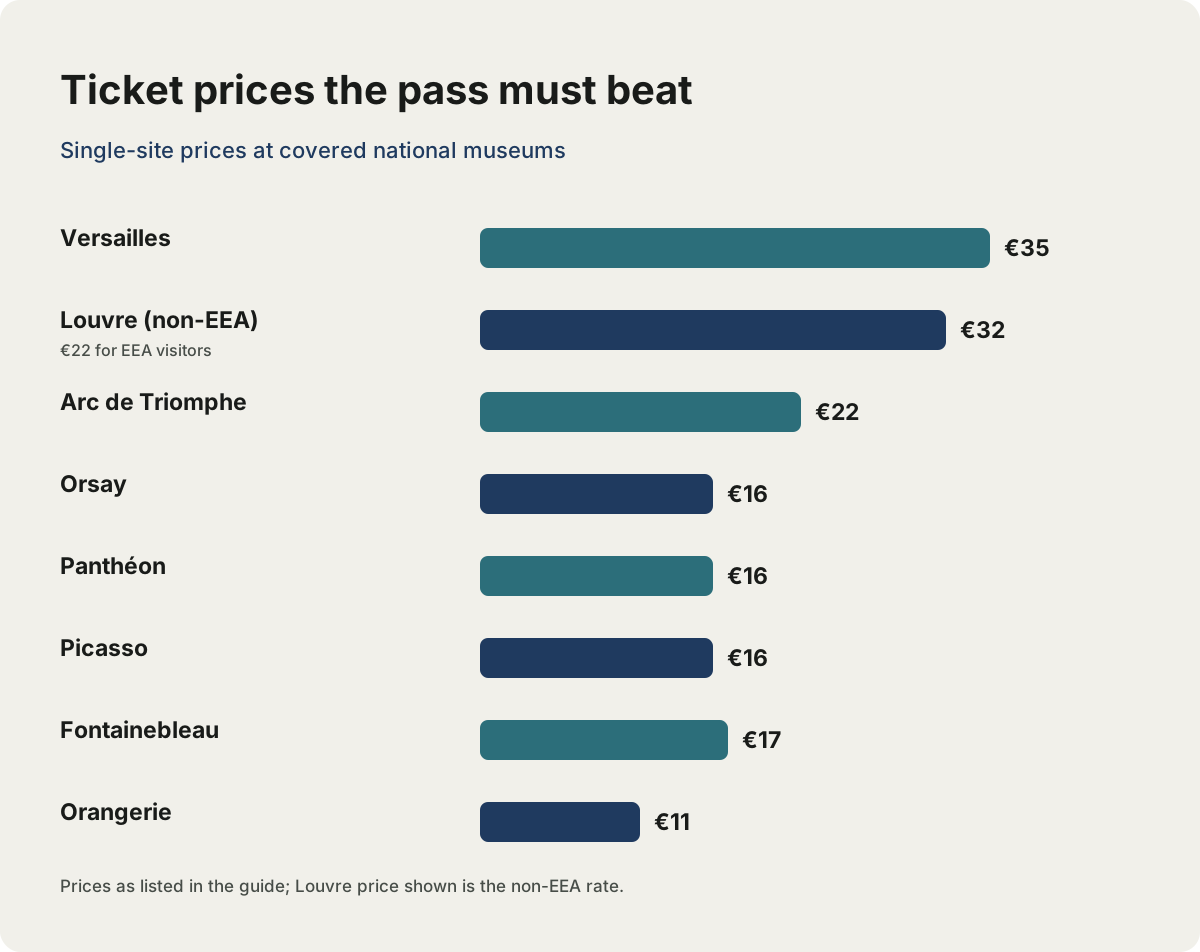
The pass is worth it only for a non-EEA adult doing at least four paid national sites in two days, for example the Louvre at €32, Versailles at €35, the Arc de Triomphe at €22 and Orsay at €16. It is not worth it for under-18s, EEA residents under 26, or anyone whose list leans on free city museums, the Eiffel Tower, the Catacombes or the Opera Garnier.
The Paris Museum Pass costs €85 for two days, €105 for four days and €125 for six days, and it is sold on a simple promise: one card, dozens of museums, no ticket queues. That promise is partly true and partly a trap, because the pass covers a specific slice of Paris, the national museums and monuments, and buys nothing at the eleven city museums that are already free to everyone. Whether it is worth €85 depends almost entirely on your age, your residency, and how many paid sites you will genuinely walk through.
The maths is not flattering for most casual visitors. A single Louvre ticket is €32 for a non-EEA visitor and €22 for an EEA visitor, which means one of the world's great museums barely covers a third of the cheapest pass. Add Versailles at €35 and the Arc de Triomphe at €22 and the pass starts to make sense for a packed two days. Leave any of those three off the list and it usually does not.
This guide runs the honest arithmetic. It uses only verified door prices, prints every number in each sum so you can check the working, and names the groups of visitors who should simply never buy the card. The short version: the pass rewards fast, dense, national-monument-heavy itineraries, and quietly punishes everyone else.
What The Pass Actually Covers And What It Costs
The pass costs €85 for 2 days, €105 for 4 days and €125 for 6 days, is adult only, and includes no transport and no temporary exhibitions. Validity runs in hours from the first scan, not calendar days, so a two-day pass activated at 3pm on Wednesday expires at 3pm on Friday. It covers 55 sites, nearly all of them national museums and monuments, and it buys nothing at the free city museums.
The price ladder is printed plainly on the pass's own site, which also notes that service fees apply in certain sales networks. There is no child or youth version, and that is not an oversight. Under-18s are free at national museums anyway, and so are EU and EEA residents under 26, so a youth pass would be selling something the state already gives away. The official pass page is the only place to confirm current prices before a purchase.
The hours-not-days rule catches more people than any other detail. A six-day pass at €125 sounds generous until you realize it is 144 hours, and that the Louvre's remaining open evenings in that window may be fewer than you assumed. The pass is also strictly one entry per site. A visitor who scans in at the Louvre, exits for lunch, and tries to return on the same pass is turned away at the second attempt.
The mechanic that matters most for value: every site on the pass is a site that already sells a ticket you could buy individually. The pass is never a discount on entry, it is a bundle, and bundles only pay when you use enough of them. The Paris Museums roster makes the comparison straightforward because every door price below comes from the venue's own published tariff.
| Pass duration | Price | What it actually buys |
|---|---|---|
| 2 days (48 hours) | €85 | Entry to covered sites, one visit each, no timed-slot guarantee |
| 4 days (96 hours) | €105 | The same, over a longer window; the stated best seller |
| 6 days (144 hours) | €125 | The same; rarely better value unless the trip is museum-dense |
The Break-Even Math: When The Pass Pays For Itself
A non-EEA visitor breaks even on the €85 two-day pass at roughly four paid national sites, for example the Louvre at €32, Versailles at €35, the Arc de Triomphe at €22 and Orsay at €16. An EEA visitor paying €22 at the Louvre instead of €32 needs a fifth site to clear the same bar. EEA pricing makes the pass worse, never better.
Every figure in those sums appears in this guide, so the arithmetic can be checked line by line. That is the point. Most pass reviews quote a break-even without showing the working, and the working is where the answer changes. The two-tier Louvre price is the sharpest example: the same pass costs €85 whoever buys it, but the tickets it replaces cost €22 to an EEA visitor and €32 to everyone else. The discount the pass delivers shrinks as your individual ticket prices shrink, and a cheaper ticket list needs to be a longer one before the €85 card pays for itself.
The four-day pass at €105 changes the bar only slightly. It rewards a slower pace, but the same logic holds: the pass must beat the sum of the tickets you would otherwise buy, and every free museum on your list drags that sum down. A visitor spending two of four days partly at the Petit Palais and the Musée Carnavalet, both free with no ticket, has effectively bought pass days they cannot spend.
| Two-day itinerary | Tickets on the list | Pass verdict |
|---|---|---|
| Louvre €32, Versailles €35, Arc de Triomphe €22, Orsay €16 | €32 plus €35 plus €22 plus €16 | Pass wins on this list |
| Louvre €32, Orsay €16, Orangerie €11, Panthéon €16 | €32 plus €16 plus €11 plus €16 | Pass loses on this list |
| Versailles €35, Fontainebleau €17, l'Armée €17, Cluny €14 | €35 plus €17 plus €17 plus €14 | Pass roughly ties |
| Louvre €32, Orangerie €11, Rodin €14, Picasso €16 | €32 plus €11 plus €14 plus €16 | Pass loses on this list |
Notice the pattern in that table. The pass only wins when the itinerary stacks the expensive national monuments: the Louvre, Versailles, the Arc de Triomphe, the Panthéon. It loses on itineraries built around the €11 to €17 museums, and it loses even more on itineraries that mix in a free city museum or two, because those hours are spent earning nothing back.
For a trip that is genuinely museum-dense, the four-day and six-day passes widen the window but not the logic. A six-day pass at €125 needs roughly six paid sites to break even, and by day five most visitors have slowed down. The honest advice is to write your actual wish list first, price it ticket by ticket using the numbers above, and only then see whether a pass beats it. The full pass mechanics are laid out separately for readers who want the site list in detail.
Which Pass Sites Still Demand A Separate Timed Reservation
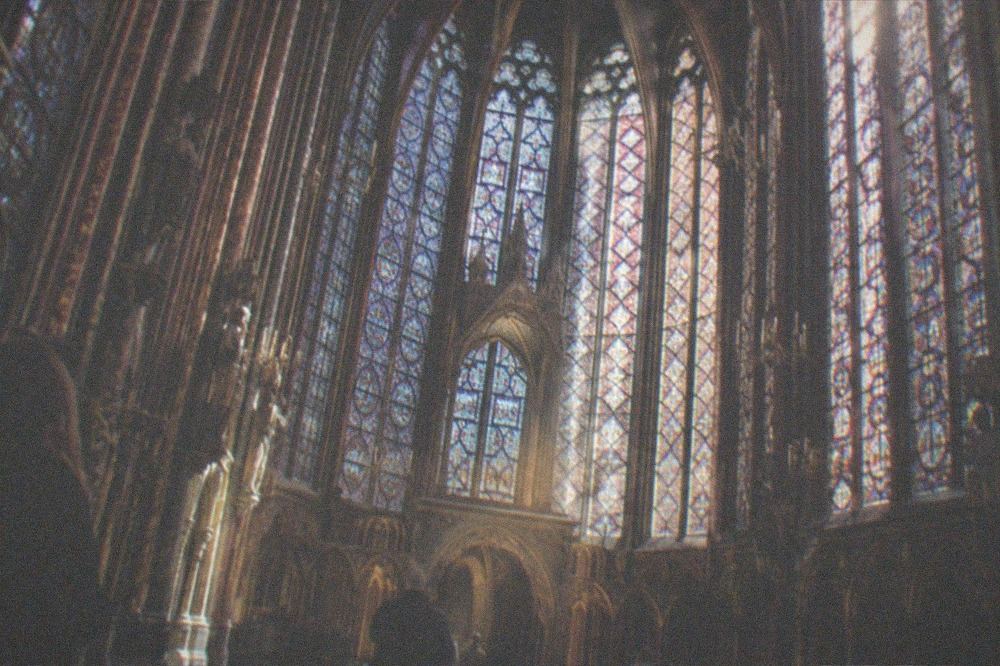
Eight pass sites still require a separate free timed slot even with the pass in hand: the Louvre, Orsay, the Orangerie, Sainte-Chapelle, the Conciergerie, the Hôtel de la Marine, the Tours de Notre-Dame and Versailles. A pass does not get you into the Louvre without booking that slot, and the slots run out. Every other pass site is access without reservation, including the Arc de Triomphe.
This is the rule that turns the pass from a shortcut into a planning obligation. The card covers the price of entry, but at those eight venues the building also manages crowd flow with a booking calendar, and the calendar does not know or care that you hold a pass. Visitors regularly arrive at the Louvre pass-first and ticket-second, only to find the day's free pass slots gone. Our separate skip-the-line strategy at the Louvre covers how the two systems interact in practice.
The Louvre makes the sharpest example because it is the site that sells the pass to most people. Timed entry is compulsory there, full stop, and the two-tier price, €22 for EEA visitors and €32 for everyone else, is in force at the door rather than announced for later. A pass holder books the free slot and scans the card; a ticket holder books the paid slot. Either way, the booking itself is the scarce resource. Details and timing options are on the Louvre tickets and entry page, and the museum's own hours and admission page is the primary source for the free-Friday rule.
Versailles carries the same reservation flag, and it matters more there because day-trippers cluster into late-morning arrivals. A pass holder who has not booked a timed slot at Versailles can be left outside on a Saturday in high season while the estate's own ticket holders stream in. The Arc de Triomphe, by contrast, is badged access without reservation on the pass's own site, which is the opposite of what most guides claim. Checking the badge before assuming the pass is a key is the habit worth forming.
What The Pass Never Covers: The Exclusion List
The pass excludes the Eiffel Tower, the Catacombes, the Opera Garnier, the Musée Marmottan Monet, the Musée Jacquemart-André, the Atelier des Lumières, the Fondation Louis Vuitton, Grand Palais exhibitions, the Sacré-Coeur dome and every Paris Musées city museum. It never covers temporary exhibitions at any site, at any duration. An itinerary built around these venues makes the pass worthless.
The exclusion list matters more than the inclusion list, because the exclusions are the places visitors most often assume are covered. The Eiffel Tower is the single most common wrong assumption in Paris. Its summit lift ticket is €36.70, the second-floor lift is €23.50 and the stairs are €14.80, and none of those numbers can be offset by a pass because the pass simply does not apply. The Eiffel Tower pricing breakdown covers the ladder in detail.
The Catacombes are the same story and a worse surprise, because timed slots there sell out days ahead and every skip-the-line product costs several times the €31 door price. Details are on the Catacombes tickets and timed-slot page. The Opera Garnier is excluded too, and it carries its own two-tier price of €15 for France and EEA visitors against €25 from outside the EEA, sold online only.
| Excluded site | Door price | Why it hurts the pass |
|---|---|---|
| Eiffel Tower | €36.70 summit lift | Not on the pass at all |
| Catacombes de Paris | €31 | Not on the pass; slots sell out days ahead |
| Palais Garnier | €15 EEA / €25 non-EEA | Not on the pass; online sales only |
| Musée Marmottan Monet | €14 | Not on the pass |
| Musée Jacquemart-André | €19 | Not on the pass; open daily |
| Atelier des Lumières | €19.50 | Not on the pass; ticket is per show |
The city-museum exclusion is the one that reads as a scam until you notice the reason. The eleven Paris Musées permanent collections have been free to everyone since December 2001, so the pass excludes them because there is nothing to sell. A visitor whose two-day plan is Carnavalet, the Petit Palais, the Musée d'Art Moderne and the Vie romantique has a free itinerary and no use for an €85 card, which is exactly what our free museums guide lays out.
Why Under-18s And EEA Residents Under 26 Should Never Buy One
Under-18s are free at national museums with photo ID, and so are EU and EEA residents under 26, including holders of a long-stay permit or visa over four months. Residency is what gets checked, not nationality. Since the pass replaces tickets those visitors do not need to buy, it is adult-only by design and loses money for every one of them.
The gratuity rules come straight from the national monuments' own conditions page, which spells out the proof required: an identity document with a photograph, or an official document confirming the age category. A non-citizen EEA resident under 26 must show a valid photographic residency permit longer than 90 days with name and photograph. That wording, residency rather than nationality, is broader than most guides state, and it is the detail that makes the pass redundant for a large share of student and young-adult visitors.
The practical failure mode is a family buying four passes for a two-day sprint. If two of those travelers are under 18, two of the cards replace nothing at all. The honest family arithmetic is the adult passes measured against adult single tickets only, and even then the monument-heavy rule from the break-even table still applies.
Orsay is the clearest case study of a museum that is free to the right visitor on the right day. It is free the first Sunday of every month all year, but the free slot has to be booked, and the online ticket costs €16 against €14 at the museum, an inversion worth knowing before any purchase. A pass holder gets no advantage on that Sunday beyond skipping the counter, and an EEA under-26 visitor gets in free every day of the week regardless.
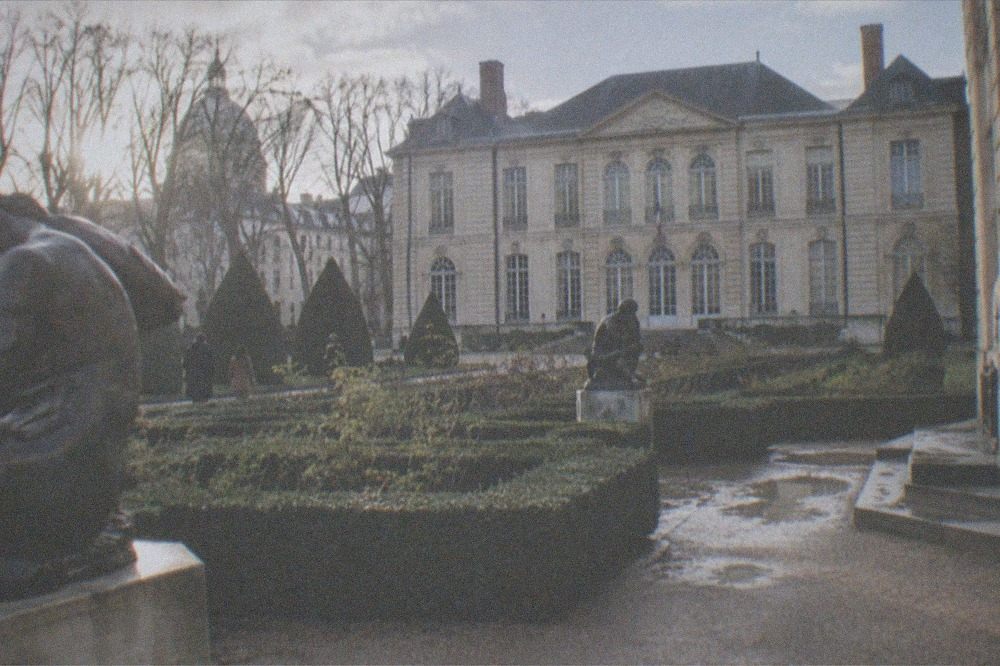
The Rodin museum runs its own seasonal version: free the first Sunday of the month from October to March only, no booking needed, otherwise €14. Picasso, quai Branly and Cluny are free the first Sunday of every month, with quai Branly including its temporary collections. The city's own tariffs page is the primary source for the free eleven and their exhibition caveats, and the national gratuity conditions cover the age and residency rules.
The Seasonal Rules And Oddities That Catch Visitors Out
CMN monuments, the Panthéon, Sainte-Chapelle, the Conciergerie and the Arc de Triomphe, are free the first Sunday of the month only from 1 January to 31 March and from 1 November to 31 December, never from April to October. The Louvre has no free Sunday at all. The Musée des Arts et Métiers is free every Friday from 18:00 to 21:00, a rule no other Paris museum has.
Those three facts reshape pass value by season. A visitor in November can hit the Arc de Triomphe and the Panthéon on a free first Sunday and cut two of the priciest pass-justifying tickets out of the sum. A visitor in June gets nothing from that rule, and the pass's break-even tightens accordingly. The Panthéon is €16 from April to September and €13 all winter, with €13 Wednesdays in the high window, so even its paid price moves with the calendar.
The Louvre correction is worth repeating because most published guides get it wrong. The Louvre is free the first Friday of the month after 6pm, except in July and August, and on 14 July. It is not free on any Sunday of the year. That single correction changes pass arithmetic for evening-capable visitors, because a first-Friday evening entry at €0 removes the €32 or €22 anchor from the break-even sum entirely.
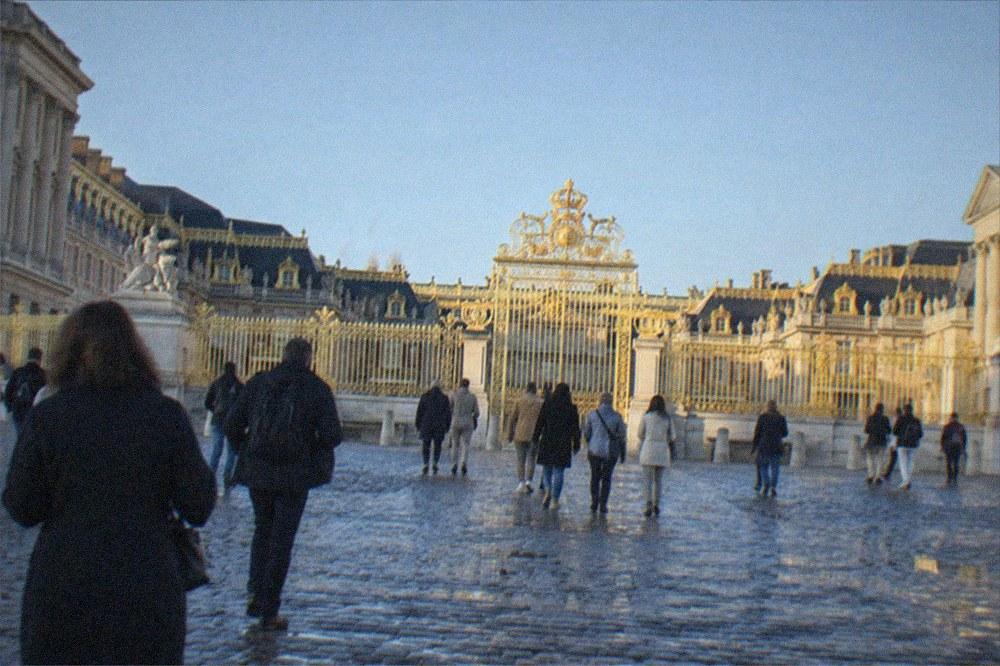
Versailles itself moves with the seasons twice over. The Passport ticket is €35 from 1 April to 31 October and €25 the rest of the year, so the same pass that comfortably beats four summer tickets can fail to beat a winter list. The timed reservation requirement holds year round, and the Versailles tickets and passport options are worth reading before any day-trip decision, as is our comparison of Versailles against Fontainebleau.
Who Should Not Buy The Pass, Plainly
Anyone under 18 should not buy one, nor should any EU or EEA resident under 26, nor anyone whose list is mostly free city museums, nor anyone whose list leans on the Eiffel Tower, the Catacombes or the Opera Garnier, which the pass does not touch. Slow travelers on a four- or six-day card should also skip it, because the pass only pays when paid sites are stacked densely, not spread gently.
That verdict is not anti-pass, it is arithmetic. The card bundles national sites at their face value and nothing more. Every category of visitor listed above either already holds free entry by law, has a free itinerary by choice, or has a wish list dominated by sites the pass excludes. For those groups, single tickets bought per site, timed slots booked per site, are strictly cheaper and no less convenient.
Who should buy it, then, is the mirror image: a non-EEA adult over 26 doing a dense two-day national-monument sprint. The Louvre, Versailles, the Arc de Triomphe, Orsay, maybe the Panthéon or Sainte-Chapelle, booked with timed slots where required, runs past €85 in single tickets and the card saves real money. That traveler is real, and for them the pass is a good product. The catch is that they are a narrower slice of the market than the marketing implies, as our best museums overview shows when the wish list gets realistic.
One last planning habit beats any pass decision: write the list, count the closed days. The national museums close Tuesday, the Louvre and the Orangerie among them, while Orsay, Rodin, Picasso, quai Branly, Cluny, Marmottan and the Catacombes close Monday. A pass activated on the wrong Monday can lose half its first day to closures the card does not warn about.
A Free Walk That Passes These Museums
A free, pay-what-you-want walking tour passes the Petit Palais, and it is not this site's to sell. An all-encompassing tour of every side of Paris! runs 2h 30m and is rated 4.96 across 477 reviews, and it meets at Charles de Gaulle - Étoile, 75008 Paris, France. Booking a place costs nothing at all, and the guide is paid at the end by whatever each walker decides the walk was worth.
Not every way to see Paris costs money, and the walks are the clearest example. An all-encompassing tour of every side of Paris! is the one whose published route reaches the Petit Palais, and there are 39 of these walks across the city, so another covers a different part of the centre. You book a free slot on GuruWalk, turn up, and tip the guide what the walk was worth.
Common Questions About The Paris Museum Pass
Is the Paris Museum Pass worth it for two days?
Only for a non-EEA adult doing at least four paid national sites, for example the Louvre at €32, Versailles at €35, the Arc de Triomphe at €22 and Orsay at €16, a list that together runs past the €85 pass. Museum-led lists built on the €11 to €17 tickets lose money on the card.
Does the Paris Museum Pass include the Eiffel Tower?
No. The Eiffel Tower is on the pass's exclusion list and always has been. Its summit lift costs €36.70, the second-floor lift €23.50 and the stairs €14.80, all bought separately with a compulsory timed entry.
Do I still need a reservation at the Louvre with the pass?
Yes. The Louvre, Orsay, the Orangerie, Sainte-Chapelle, the Conciergerie, the Hôtel de la Marine, the Tours de Notre-Dame and Versailles all require a separate free timed slot even for pass holders, and those slots run out.
Is the Paris Museum Pass valid on the metro?
No. No version of the pass includes public transport. Navigo Easy, Navigo Découverte and Paris Visite are separate products, and airport RER journeys need their own fare.
Does the pass cover temporary exhibitions?
Never. The pass's own terms state it does not include access to temporary exhibitions, at any site, at any duration, with no exceptions.
Are the free Paris city museums included in the pass?
No, and it does not matter. The eleven Paris Musées permanent collections, including Carnavalet, the Petit Palais and the Musée d'Art Moderne, have been free to everyone since December 2001, so the pass would have nothing to buy there.
When do the national monuments have free first Sundays?
The Panthéon, Sainte-Chapelle, the Conciergerie and the Arc de Triomphe are free the first Sunday of the month only from 1 January to 31 March and from 1 November to 31 December. The rule never applies from April to October.