Paris Museum Pass: Prices, Validity And What It Excludes
The Paris Museum Pass costs €85, €105 or €125 depending on length, and its validity is counted in hours from the first scan rather than in calendar days. It excludes the Eiffel Tower, the Catacombes and every Paris Musées city museum.
Short answer
The Paris Museum Pass costs €85 for 2 days, €105 for 4 days and €125 for 6 days, adult only. Validity runs in hours from the first scan, transport is never included, temporary exhibitions are never covered, and eight covered sites, the Louvre included, still require a separate timed reservation.
What The Paris Museum Pass Costs
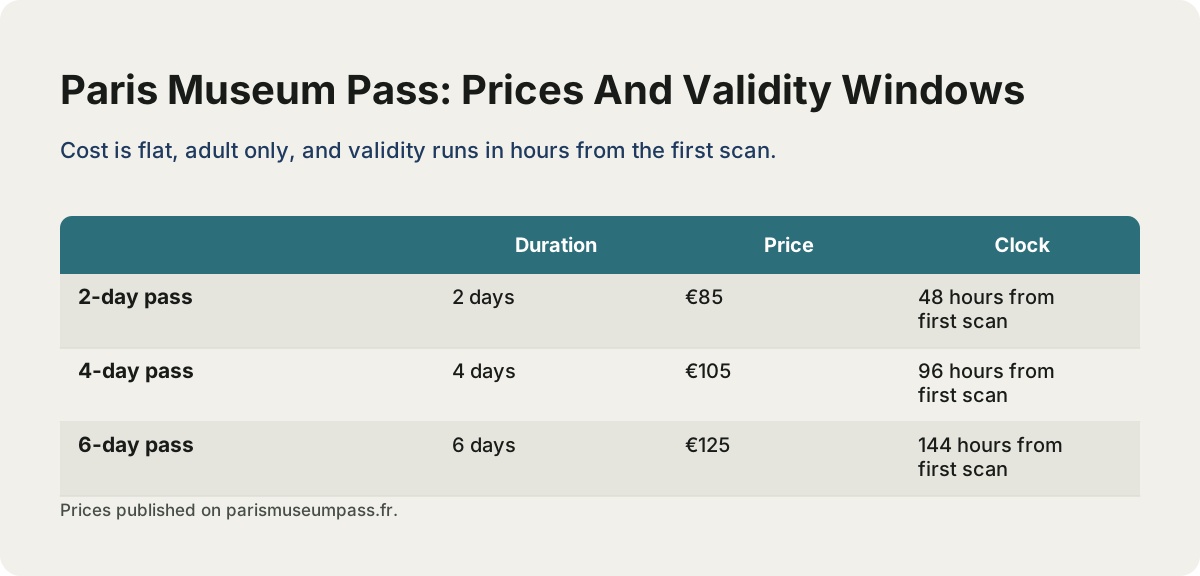
The Paris Museum Pass costs €85 for 2 days, €105 for 4 days and €125 for 6 days. It is adult only, with no child or youth version, and it covers museum and monument entry but never public transport and never temporary exhibitions. Those three exclusions shape almost every mistake visitors make with it.
The pricing is flat and published on the operator's own page at parismuseumpass.fr. There is no student rate, no senior rate and no family card, and that is deliberate rather than an oversight: under-18s are free at national museums with photo ID, and EU and EEA residents under 26 are free too, including holders of a long-stay permit or visa over four months. Residency is what gets checked, not nationality, so a large share of the pass's natural market already enters the biggest sites for nothing. The pass exists for the adult who pays full price.
| Duration | Price | Clock |
|---|---|---|
| 2 days | €85 | 48 hours from first scan |
| 4 days | €105 | 96 hours from first scan |
| 6 days | €125 | 144 hours from first scan |
The 4-day version is the best seller, and it is usually the right starting guess for a first trip of five or six nights. The 2-day version is punishing: it only pays if you move at a pace most people cannot sustain, and it dies mid-afternoon on day two if you scan it late on day one. The 6-day version suits a slow traveller or someone mixing Paris with day trips, and its per-day cost is the lowest of the three.
One practical note on where you buy it: the price is the same for an e-ticket and a counter purchase, though the operator's page states that service fees apply in certain sales networks. Buying electronically and scanning from a phone removes one queue from the trip. This Paris Museums guide treats the pass as a planning tool, not a souvenir: decide the itinerary first, then decide the pass.
Why Validity Counts In Hours And Not Days
Validity is counted in hours from the first scan, not in calendar days. A 2-day pass first scanned at 3pm on a Wednesday expires at 3pm on a Friday, so the activation moment matters more than the purchase date. Each covered site allows one entry only, and no version includes transport.
The hour rule is the single most misunderstood part of the product. People read "2 days" and imagine Saturday and Sunday. What the pass actually sells is a 48-hour window that opens when a scanner first reads it, and that window can straddle any days of the week you like, including a closure day if you have not checked one. The classic error is scanning the pass on an arrival afternoon at one small museum, then discovering the clock is already running while the real sightseeing starts tomorrow morning.
The fix is to hold the pass unactivated until the first major site. Buy it in advance if you like, but let the first scan happen at the Louvre or the Musée d'Orsay on a morning, not at a minor museum at 4pm. And note that one entry per site is enforced: the pass cannot be used to pop back into a museum a second day, so plan each covered visit as a single complete one.
Closure days interact badly with a compressed clock. The Louvre, the Orangerie and Fontainebleau close Tuesdays; the Orsay, the Cluny, Versailles, the Catacombes and most city museums close Mondays. A 48-hour window that runs Sunday afternoon to Tuesday afternoon loses the Louvre entirely. Before activating anything, line the window up against the days your key sites are actually open.
Which Sites The Pass Actually Covers
The operator's own list runs to 55 sites, among them the Louvre, the Musée d'Orsay, the Musée de l'Orangerie, Sainte-Chapelle, the Panthéon, the Arc de Triomphe, the Conciergerie, Versailles, Fontainebleau and the Musée de l'Armée. Every covered site allows one entry. Several of the biggest still require a separate timed reservation.
The headline sites split into two groups: the heavyweights almost every visitor wants, and the long tail that pads the list. The heavyweights are genuinely valuable. The tail includes museums most first-time visitors will never reach, and it is what makes the raw site count misleading. Judge the pass on the ten or twelve places you would actually enter, priced at their door rates, not on the number 55.
| Site | Door price | Closed |
|---|---|---|
| Musée du Louvre | €32 | Tuesday |
| Musée d'Orsay | €16 | Monday |
| Musée de l'Orangerie | €11 | Tuesday |
| Sainte-Chapelle | €22 | none |
| Panthéon | €16 | none |
| Arc de Triomphe | €22 | none |
| Conciergerie | €13 | none |
| Musée de l'Armée | €17 | none |
| Château de Versailles | €35 | Monday |
| Château de Fontainebleau | €17 | Tuesday |
Two things stand out in that table. The Louvre now charges two prices, €22 for EEA visitors and €32 for everyone else, so the value the pass replaces depends on who is holding it. And the Arc de Triomphe and the Panthéon both run seasonal pricing, €22 and €16 in the April to September window, dropping to €16 and €13 from October to March, with cheaper Wednesdays in high season. A pass bought for shoulder-season travel replaces fewer euro than the headline prices suggest.
For the museums themselves, deeper pages exist: Louvre ticket options compared, Musée d'Orsay entry choices and Sainte-Chapelle visiting options each break down what a single ticket buys, and the combined Sainte-Chapelle and Conciergerie ticket at $34.95 is worth a look if the pass does not pay for you.
What The Paris Museum Pass Does Not Cover
The pass does not cover the Eiffel Tower, the Catacombes, the Palais Garnier, the Musée Marmottan Monet, the Musée Jacquemart-André, the Atelier des Lumières, Grand Palais exhibitions or any Paris Musées city museum. It also never covers temporary exhibitions, at any site, without exception. The exclusion list matters more than the inclusion list.
The exclusions deserve their own table rather than a footnote, because this is where money is lost. A traveller who buys a 4-day pass assuming "all Paris museums" and then pays separately for the Eiffel Tower and the Catacombes has bought the pass and its biggest competitors in one trip. Every site below costs its full door price with or without a pass.
| Not covered | Door price | Note |
|---|---|---|
| Eiffel Tower | €36.70 | Summit by lift; second floor by lift €23.50 |
| Catacombes de Paris | €31 | Most expensive ticket in the city network, audio guide included |
| Palais Garnier | €25 | €15 for France and EEA visitors; sold online only |
| Musée Marmottan Monet | €14 | Off the pass entirely |
| Musée Jacquemart-André | €19 | Open daily, still excluded |
| Atelier des Lumières | €19.50 | Ticket is for the running show |
| Grand Palais exhibitions | €19 | Reopened building, still excluded |
| Paris Musées city museums | free | The pass buys nothing because entry costs nothing |
The flat rule on temporary exhibitions is printed by the operator itself: the pass does not include access to them, no exceptions. That bites hardest at the Louvre and the Grand Palais, where the blockbuster shows are exactly what draws the crowds, and at the city museums, where a temporary exhibition can suspend free entry altogether. The Maison de Victor Hugo is ticketed until 22 November 2026 for precisely that reason.
Also worth knowing: the Fondation Louis Vuitton is excluded and currently closed, reopening on 9 October 2026, and Giverny and Vaux-le-Vicomte are seasonal and not on the pass in any case. If any of those sit at the centre of your plan, the pass math changes before you even start adding.
Where The Pass Still Needs A Timed Reservation
Eight covered sites still demand a separate timed reservation even for pass holders: the Louvre, the Musée d'Orsay, the Musée de l'Orangerie, Sainte-Chapelle, the Conciergerie, the Hôtel de la Marine, the Tours de Notre-Dame and Versailles. A pass does not get you into the Louvre without a free booked slot.
This is the quietest catch in the whole product. Coverage and access are two different things. The eight sites below are all on the pass, and all of them still require you to reserve a timed slot separately, at no extra charge. Miss that step and you can stand at the Louvre door with a valid €105 pass and be turned away for lack of a slot.
| Covered site | Separate reservation |
|---|---|
| Musée du Louvre | Required, free timed slot |
| Musée d'Orsay | Required |
| Musée de l'Orangerie | Required |
| Sainte-Chapelle | Required |
| Conciergerie | Required |
| Hôtel de la Marine | Required |
| Tours de Notre-Dame | Required |
| Château de Versailles | Required, timed |
Everything else on the pass list is badged access without reservation, including the Arc de Triomphe, which many guides get wrong in the opposite direction. The practical reading: the pass removes the payment step at the door, not the booking step at the eight most crowded sites. Book the free slots as soon as your dates are fixed, the same week you book the pass, and treat the two as one task.
The Louvre slot is the scarce one. Timed entry is compulsory there for everyone, and the museum publishes a room-by-room closure schedule for its rotating renovations. The museum's own admission page at louvre.fr carries both the two-tier pricing and the free first-Friday rule, and it is the only source worth trusting on either. Reviewers on the bookable listings consistently report that the reserved-slot products are what saved tight itineraries, not the pass alone.
Is The Paris Museum Pass Worth The Money?
The pass pays off above roughly two major sites a day at full door prices. A short trip of the Louvre at €32, the Musée d'Orsay at €16, Sainte-Chapelle at €22 and the Arc de Triomphe at €22 already runs past the €85 two-day pass, while a slow one-museum-a-day plan does not. The arithmetic decides it.
Run the numbers before buying, and run them on the sites you will actually enter, at the prices that apply in your travel month. The table below shows three honest traveller profiles. Every figure in each column is a door price printed on this page, so you can check the working yourself.
| Traveller | Sites actually entered | Verdict |
|---|---|---|
| Two intense days | Louvre €32, Orsay €16, Sainte-Chapelle €22, Arc de Triomphe €22, Conciergerie €13, Panthéon €16 | The 2-day pass at €85 comes out clearly ahead |
| Four relaxed days | Louvre €32, Orsay €16, Versailles €35, Rodin €14, Fontainebleau €17 | The 4-day pass at €105 is close to break-even |
| Five slow days | Orangerie €11, Cluny €14, Panthéon €16, Musée de l'Armée €17, quai Branly €14 | Door tickets cost less than any pass |
The pattern is clear enough to state as a rule: the pass rewards density and punishes leisure. Three national museums in a single day, which is physically possible and mentally ambitious, makes any version look cheap. One museum a morning with long lunches makes every version look expensive, because the free city museums and the free Sundays are doing work the pass is being paid for.
Two further discounts interact with the sum. Orsay costs more booked online, €16, than bought at the museum, €14, and the Orangerie shows the same inversion at €12.50 online against €11 at the door, which slightly flatters the pass's value at those two sites. And anyone eligible for the under-26 EEA residency rule or the under-18 rule enters most national sites free anyway, which can gut the arithmetic in a family's favour before the pass is even considered. The national monuments' own gratuity conditions are published at monuments-nationaux.fr, and they are worth reading once for any trip.
A dedicated walkthrough of the deeper question exists at whether the pass is actually worth buying, which runs the same method across longer itineraries. If your dates are fixed and the Louvre is non-negotiable, a bookable timed ticket from $69.80 exists alongside the pass, and Check availability the moment you know your days, because that slot is the one that sells out.
The Free Museums Where The Pass Buys Nothing
Eleven Paris Musées city museums are free to everyone all year, with no ticket and no pass: the Petit Palais, the Musée d'Art Moderne, the Musée Carnavalet, the Musée Cernuschi, the Musée de la Vie romantique and six others. The pass buys nothing there because nothing is for sale. Three city sites do charge.
The city's own tariffs page at parismusees.paris.fr lists the free eleven, and it is the authoritative source. The three exceptions are the Catacombes at €31, the most expensive ticket in the city network, Palais Galliera, and the Crypte archéologique, which is shut for works. Any guide that says all fourteen city museums are free is wrong, and plenty do.
The caveat that matters: a temporary exhibition suspends free entry at the free eleven. Maison de Victor Hugo is ticketed until 22 November 2026 for exactly that reason, Maison de Balzac is free only outside exhibition periods, and Bourdelle, Cognacq-Jay and Zadkine are only partly free while a show is on. Free is the default, but check the venue's own page on the day.
For the paid museums outside the pass, the same logic as the free ones applies in reverse: skip-the-line and combined products only earn their margin when the door queue is genuinely long. The Catacombes is the clearest case, timed slots sell out days ahead, which is why every resale product costs several times the €31 door price. The wider landscape of free museums in Paris shows how much of a Paris week can be built on no-budget foundations, from the Musée Curie to the Mémorial de la Shoah, with the Curie the one to check twice since it closes Sundays, Mondays and Tuesdays, all of August, and late December to early January.
How To Buy And Use The Pass Well
Buy the pass only after the itinerary exists. Count the covered door prices you would actually pay, compare the sum with €85, €105 or €125, and remember the clock starts at the first scan, so plan that scan for a morning at a major site rather than an arrival afternoon. E-tickets and counter sales cost the same.
The sequence matters more than the product. First fix the dates, then check the closure days, the Louvre and the Orangerie shut Tuesdays while the Orsay, Versailles and most city museums shut Mondays, then book the eight free timed slots if your plan includes those sites, and only then decide whether the pass beats the door-price sum. Buying the pass first and building the trip around it is how people end up sprinting through museums to justify a purchase.
On the ground, carry the pass separately from your passport-style ID, because the age and residency exemptions at national sites are checked against a document with a photograph, and a pass holder who also qualifies for a free rate should take the free rate at uncovered sites. Keep the activation for a morning, and if the trip includes Versailles, note that the estate's own Passport ticket runs €35 in high season and €25 the rest of the year, so a pass day that includes Versailles is the strongest single day the product can buy.
For the sites the pass will never cover, book them independently. The Eiffel Tower, the Catacombes, the Palais Garnier and the Atelier des Lumières each sell their own timed products, and leaving them to the door on the day is the one reliably bad plan in Paris in high season.

The pass is a good product sold with vague marketing. Treat the three prices as a budget line, the hour clock as a planning constraint, and the exclusion and reservation lists as the two documents that actually determine your week, and it will do exactly what it promises and nothing more.
A Free Walk That Passes These Museums
A free, pay-what-you-want walking tour passes the Grand Palais, and it is not this site's to sell. The Eternal Glamour of the Champs-Elysées Avenue runs 2h and is rated 4.59 across 71 reviews, and it meets at Place de la Concorde. Booking a place costs nothing at all, and the guide is paid at the end by whatever each walker decides the walk was worth.
Not every way to see Paris costs money, and the walks are the clearest example. The Eternal Glamour of the Champs-Elysées Avenue is the one whose published route reaches the Grand Palais, and there are 39 of these walks across the city, so another covers a different part of the centre. You book a free slot on GuruWalk, turn up, and tip the guide what the walk was worth.
Common Questions About The Paris Museum Pass
How much does the Paris Museum Pass cost?
€85 for 2 days, €105 for 4 days and €125 for 6 days. There is no child, youth or senior version, because under-18s and EU and EEA residents under 26 already enter most covered sites free.
Does the Paris Museum Pass include public transport?
No. No version of the pass includes metro, RER or bus fares. Transport products such as Navigo Easy and Paris Visite are sold separately by the region's fare authority.
When does the Paris Museum Pass expire?
Validity is counted in hours from the first scan, not in calendar days. A 2-day pass scanned at 3pm on Wednesday expires at 3pm on Friday, so activate it at a morning visit, not an afternoon arrival.
Is the Eiffel Tower included in the Paris Museum Pass?
No. The Eiffel Tower is on the exclusion list and always has been. Summit access by lift costs €36.70, the second floor by lift €23.50, and stairs to the second floor €14.80, all bought separately.
Does the Paris Museum Pass cover temporary exhibitions?
Never. The operator states flatly that the pass does not include access to temporary exhibitions at any site, which matters most at the Louvre and the Grand Palais, where the big shows are the draw.
Do I still need a reservation at the Louvre with the pass?
Yes. The Louvre, the Orsay, the Orangerie, Sainte-Chapelle, the Conciergerie, the Hôtel de la Marine, the Tours de Notre-Dame and Versailles all require a separate free timed slot even for pass holders.
Does the pass work at the free city museums?
It buys nothing there. Eleven Paris Musées museums, including the Petit Palais, the Musée Carnavalet and the Musée d'Art Moderne, are free to everyone year round, so there is nothing for the pass to pay for.
Is the Paris Museum Pass worth it for two days?
Only at a fast pace. Four major sites in two days, the Louvre at €32, the Orsay at €16, Sainte-Chapelle at €22 and the Arc de Triomphe at €22, already runs past the €85 price, but a one-museum-a-day plan does not.