Do You Need Tickets For Giverny, And How Far Is It From Paris?
Giverny needs a timed ticket in high season, sits about 75 km from Paris, and is open only from April to November. Here is what it costs, what is inside, and how to get there.
Do You Need Tickets For Giverny, And How Far Is It From Paris?
Yes, you need a ticket, and yes, it is a real day trip. The Fondation Claude Monet at Giverny charges €13 at the gate for an adult, it lies roughly 75 km from Paris in Normandy, and it is only open from 1 April to 1 November. The train from Paris Saint-Lazare to Vernon-Giverny takes around 45 to 60 minutes, followed by a 10 to 20 minute shuttle, bike ride or taxi from the station to the village.
That is the whole answer in one breath, but the details decide whether your day goes well or badly, so it is worth going slowly through what they mean in practice. Giverny is not a Paris museum with a métro station at the door. It is a country house, two gardens and a barn studio in a farming village, and everything about visiting it, the ticket, the season, the timetable, the food, follows from that.
The first thing that catches people out is the season. The Fondation Claude Monet is open from 1 April to 1 November, then it shuts completely until the following spring. This is not a renovation or a quirk of the year: the gardens are the point of the visit, and water lilies and irises do not perform in a Normandy winter. Anyone planning a Christmas or February trip to Paris should cross Giverny off the list immediately and save it for a second visit between late April and October, when the planting is at its best.
The second thing is that a ticket is genuinely needed. The site is timed-entry, and in the peak weeks of May, June and September the morning slots can sell out. The Fondation runs a timed system precisely because the Clos Normand flower garden and the water garden are narrow paths around a small pond, and an uncontrolled crowd would wreck both the planting and the experience. Booking ahead in high season is not paranoia, it is the difference between walking in at your chosen hour and standing in a village square hoping a slot opens.
The third thing, the distance, is the one people underestimate in the other direction. Seventy-five kilometres sounds far, but the rail line from Paris Saint-Lazare to Vernon is fast and frequent, and the door-to-door journey, train plus connection plus a short walk from the Giverny stop, is usually somewhere between 90 minutes and two hours. Plenty of visitors leave Paris after breakfast, spend five hours at Monet's house and gardens plus lunch in the village, and are back in Paris for dinner.
If you are weighing Giverny against a day of Paris impressionists instead, the three options below cover the country garden, the railway station Impressionist collection, and the Water Lilies rooms in the Tuileries.
What Is Actually Inside The Fondation Claude Monet?
Three things: the flower garden called the Clos Normand, the water garden with the Japanese bridge across the lily pond, and Monet's pink farmhouse itself, where the studio, the blue sitting room and the kitchen are restored and open to walk through. One ticket covers all three, plus the small collection of Japanese prints Monet owned. The gardens take most of the time, and most visitors give the whole site two to three hours.
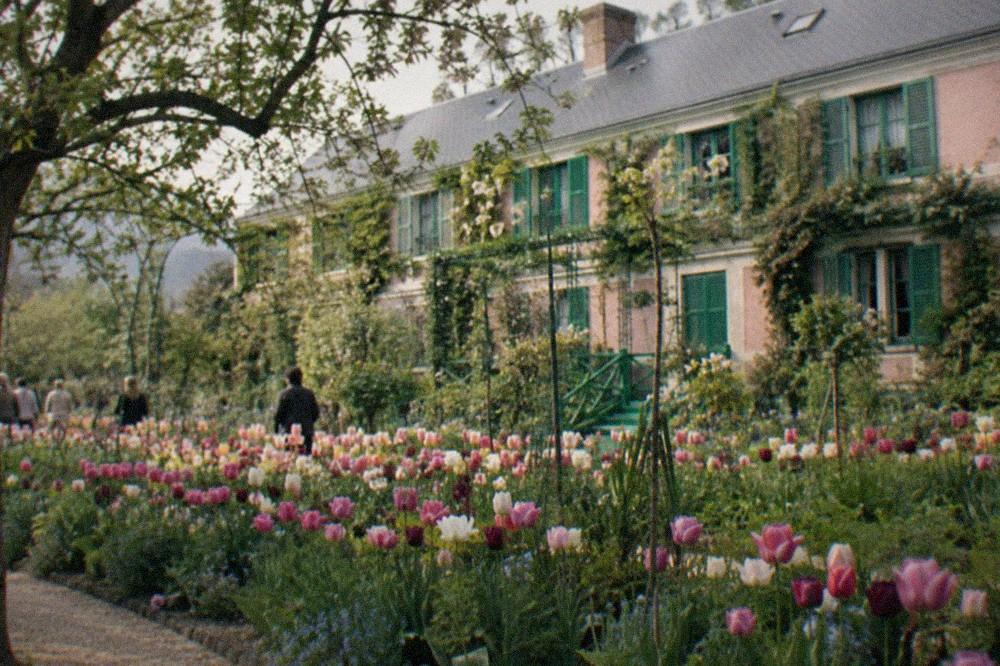
The Clos Normand is the first thing you meet after the entrance. Monet converted an orchard into a formal flower garden with central alleys and long borders, and it is replanted on a rotating scheme through the season: tulips in April and early May, irises and peonies as the weather warms, nasturtiums draping the central path in summer, dahlias and late sunflowers into October. The gardeners change the palette roughly every few weeks, so two visits a month apart look like two different gardens, which is why people return year after year.
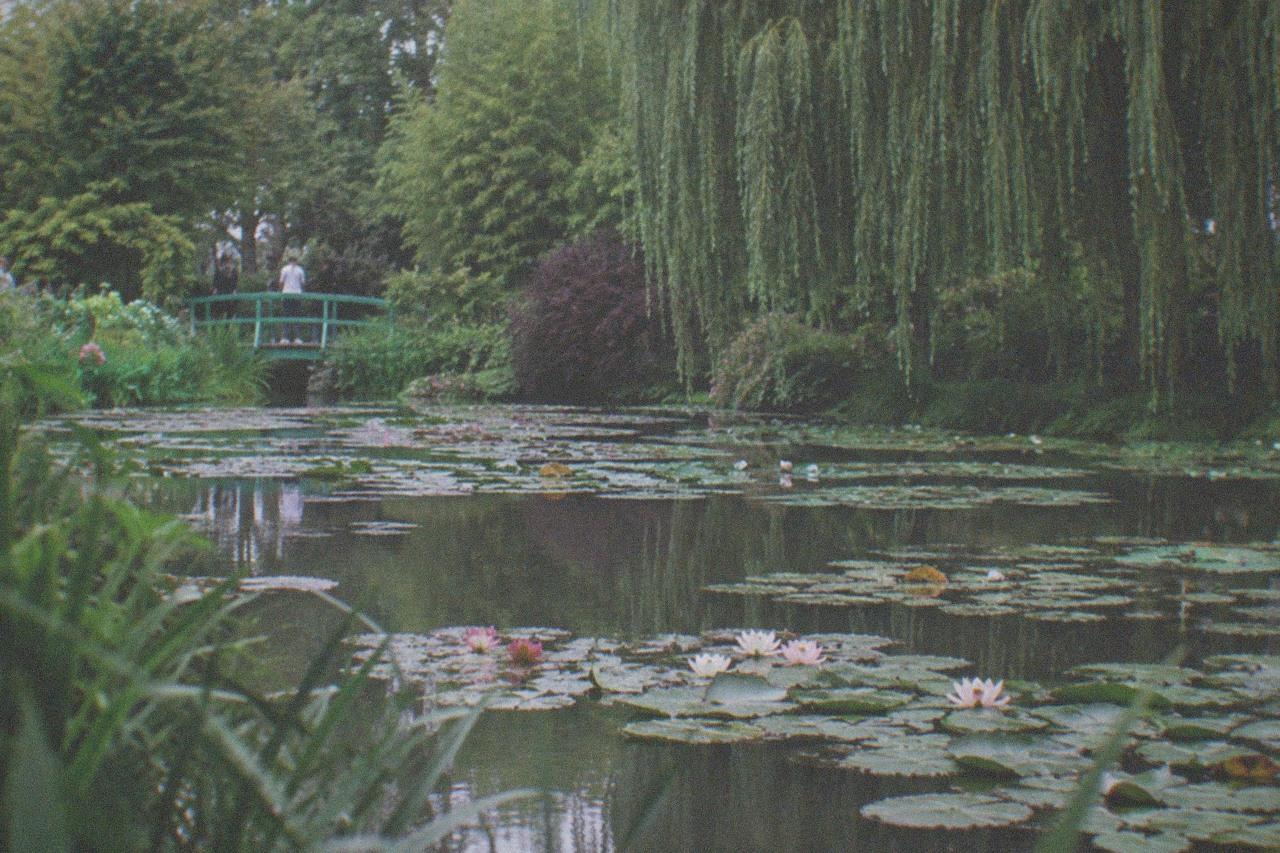
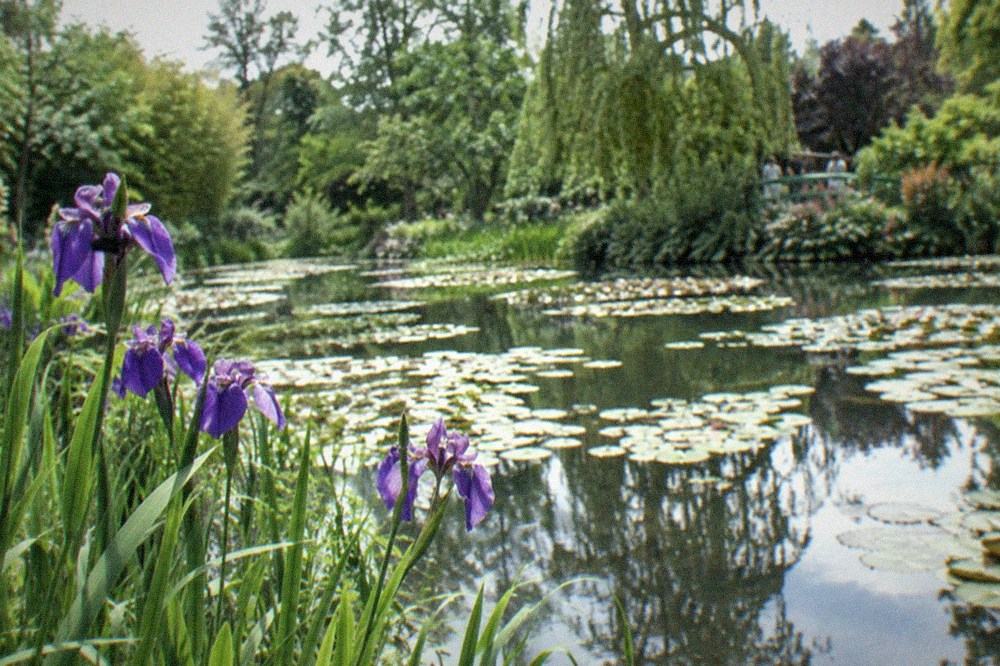
The water garden is across the little road, reached by an underpass. Monet bought the adjoining plot, diverted a branch of the Seine to feed it, and planted it in the Japanese style he knew from the prints he collected. This is the pond from the late Water Lilies paintings, and it is smaller than almost anyone expects: the famous bridge is maybe a dozen steps long, and the pond itself you can walk around in ten minutes at a stroll. That is not a complaint, it is a warning about expectations. The paintings compress and abstract the scene, and the site itself is intimate, green and quiet rather than vast.
Inside the house, the rooms are arranged much as they were when the family lived there. The kitchen, tiled blue with copper pots on the walls, the yellow dining room, and the studio, which holds a display on Monet's life and the American painters who followed him to the village, are all open. The upper floor has a modest collection of reproductions rather than originals, since the real canvases left long ago for the museums of Paris, above all the Musée d'Orsay, which holds the largest single collection of his work under one roof.
What The Ticket Costs, Who Gets In Free, And What It Covers
The adult ticket is €13 at the gate, and it covers the house, the Clos Normand flower garden and the water garden in one entry. There is no separate charge for anything inside. Children under 7 are free, and reduced rates apply for students and other eligible visitors at the site itself. The bookable timed ticket from a reseller reads from $118.66, which is a transport-inclusive product, not the gate price.
It helps to be precise about what those two numbers are, because they get confused constantly. The €13 is what the Fondation charges for entry, the price you pay for the garden, the pond and the house together, with nothing extra inside: there is no audio guide upsell and no separate studio charge. The bookable product that runs from $118.66 is a different thing entirely, a round-trip package that folds rail travel and transfers together with entry, which is why it sits several times above the gate price. Neither number is the other, and a guide that prints one and labels it the other is wrong either way.
On free and reduced entry, the site itself runs the concessions. Young children under 7 enter free, and reduced rates apply to students and to holders of the usual French concession cards. Two things worth knowing because they are negatives: Giverny is not on the Paris Museum Pass, so the pass buys nothing here and never has, and there is no first-Sunday or free-day scheme of any kind in the season. If you hold a 2, 4 or 6 day pass, it is doing nothing for you in this village.
| Ticket or option | Price | What it covers | Notes |
|---|---|---|---|
| Fondation Claude Monet, adult gate ticket | €13 | House, Clos Normand, water garden | Timed entry, one visit |
| Children under 7 | Free | Same | Proof of age may be asked |
| Bookable day product | from $118.66 | Entry with transport folded in | A platform from-price, not the gate price |
| Paris Museum Pass | buys nothing here | Nothing | Giverny is not on the pass |
For the avoidance of doubt about the season and the timetable before you book anything, the Fondation's own site at claudemonetgiverny.fr publishes the opening months and the daily hours each year.
Since timed slots at the gate can run scarce in the peak weeks, the question worth asking before you pick a date is whether your schedule is fixed.
How To Get From Paris To Giverny, Step By Step
Take the train from Paris Saint-Lazare toward Rouen or Le Havre and get off at Vernon-Giverny, about 45 to 60 minutes on the fastest services. From Vernon station it is 10 to 20 minutes more to the village, by shuttle bus, rented bicycle or taxi. The full journey each way is usually 90 minutes to two hours door to door, and the gardens are roughly 75 km from Paris.
Start at Gare Saint-Lazare in the 8th arrondissement, the terminus for the Normandy line. Trains toward Vernon run through the day, and the fast ones make the journey in under an hour while the stopping services take closer to 75 minutes, so it is worth checking the departure time rather than just turning up. Tickets are set by Île-de-France Mobilités for the inner zone and by the national operator for the Normandy leg, and you can check the fare rules at iledefrance-mobilites.fr before you travel. Fares are not printed here because they move with the tariffs and the class of service, and a guide that guesses them dates itself the week it publishes.
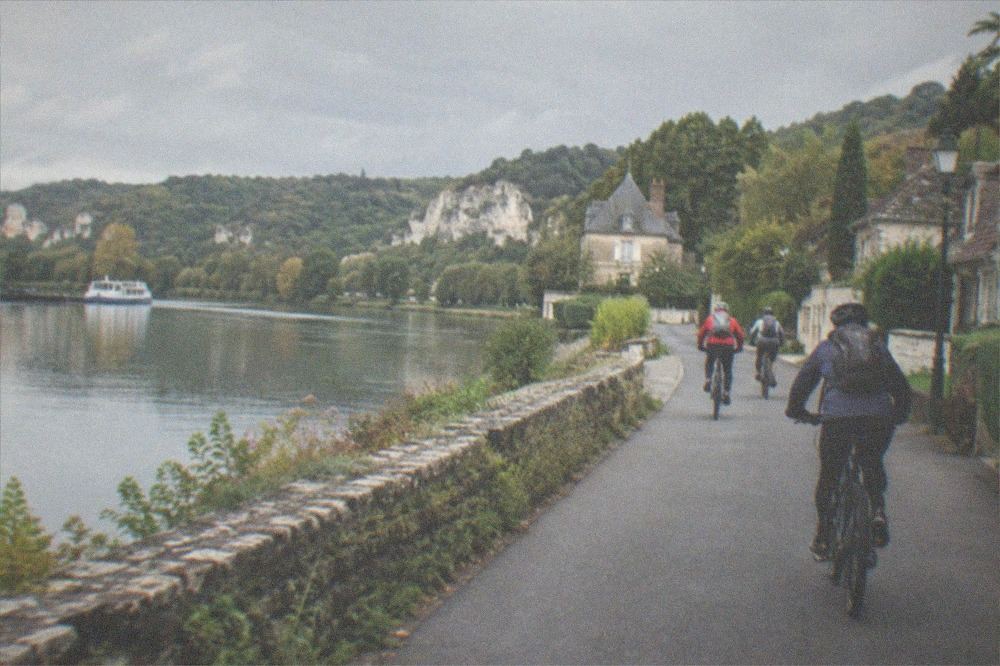
Vernon is the station, but Giverny is not in Vernon. It is a village around 6 km further along, and there are three ways to close the gap. In season a shuttle meets the main trains and runs a short hop to the Fondation's gate, which is the simplest option and the one most day products use. Cyclists can rent a bike in Vernon and ride a flat, signed route along the Seine, which many people describe as half the pleasure of the day. Taxis wait at the station too, at a higher cost, which is worth it if the weather turns or your return train is tight.
Two planning notes that matter. First, the last part of the journey is rural: there is no métro, and the shuttle is a seasonal service, so photograph the return timetable at the Vernon stop when you arrive, because the walk back is not short. Second, Tuesday deserves a check on the calendar, not because Giverny closes, it has no weekly closing day in season, but because other things you might pair with the trip do close on fixed days. If your plan is a Giverny morning and an Orsay afternoon, remember that the Musée d'Orsay closes Monday, and the Musée de l'Orangerie closes Tuesday, so the pairing works best on a Wednesday through Sunday.
| Stage | Time each way | Notes |
|---|---|---|
| Paris Saint-Lazare to Vernon-Giverny by train | 45 to 75 minutes | Fast services quicker, stopping services slower |
| Vernon station to the Fondation gate | 10 to 20 minutes | Seasonal shuttle, bicycle or taxi |
| Whole journey door to door | roughly 90 minutes to 2 hours | Depends on connection at Vernon |
How Long To Allow, And When To Go
Allow two to three hours on site, longer if you plan lunch in the village, and most people treat Giverny as a half-day or full-day excursion from Paris. The best months are May to September, April is tulip season but weather is changeable, and October brings the late dahlias. Arriving at opening time or in the late afternoon means thinner crowds, since midday is when the tour coaches land.
The honest time budget for the site itself is about two hours for a focused visit: 30 to 40 minutes in the Clos Normand, 30 in the water garden, 20 to 30 in the house, and the rest for walking between them and stopping at the two museums' shop and café. Photographers and painters routinely double that, because the light on the pond changes through the afternoon and the bridge gets different moods at each end of the day. Add lunch, and the village has restaurants and crêpe stands that fill at midday, and the day easily becomes five or six hours in Giverny itself before the return train.
Crowd patterns are predictable enough to plan around. Coaches from Paris arrive mid-morning, so the first hour after opening is the calmest, and the last two hours before closing thin out again. Midday in July is the busiest the site gets, hot, loud on the narrow paths, and the least like the paintings. If your train schedule forces a midday arrival, the house is the better first stop, since the gardens are where the crowd concentrates.
One more reason to check the day of the week: the Tuesday-closed camp in Paris is large, and a common mistake is to spend Monday in Paris museums that were shut the day before, then travel Tuesday. That works for Giverny, which opens every day in season, but it fails if the plan was to return to Paris and visit the Orangerie the same afternoon. The closed-day map is the single most useful thing to hold in your head when a Giverny day is in the itinerary.
Giverny Versus The Paris Alternatives: Where The Monet Actually Hangs
Giverny is the garden, and Paris holds the canvases. The Musée d'Orsay, €16 booked online against €14 at the museum, carries the largest collection of Monet paintings plus the whole Impressionist context, and the Musée de l'Orangerie, €12.50 online against €11 at the museum, is the purpose-built home of the Water Lilies cycle. A first Paris trip can skip Giverny, but an Impressionist trip should not skip either museum.
The comparison is worth making plainly, because people ask whether the trek is worth it if they only care about paintings. The Fondation has almost no originals: the house shows reproductions, and the studio display is about the man rather than the canvas. The originals are in Paris. The Orsay's rooms hold the Rouen cathedral series, the Gare Saint-Lazare canvases he painted as a young man, and the poplar and haystack series, alongside the Manet, Degas and Renoir context that makes the movement legible. The Orangerie is the single most direct companion to Giverny, because its two elliptical rooms were built around the late Water Lilies panels Monet gave the state, the same pond, the same bridge, the same obsession, at a scale you can stand inside.
For a Monet-themed Paris stay, the sensible order is the Orsay and the Orangerie first, Giverny second, because seeing the paintings before the garden makes the garden read like the subject, and seeing it the other way round makes the panels feel like memory. A deeper guide to the full Monet trail across the city, including the Musée Marmottan Monet with its early Impression, Sunrise, is in our guide to where to see Monet in Paris, and the smaller Marmottan museum gets its own treatment in what the Marmottan holds and how long to spend. For the two Paris staples nearest Giverny in spirit, the entry pages at Musée d'Orsay tickets and Musée de l'Orangerie tickets hold the current prices and free-day rules.
| Fondation Claude Monet, Giverny | Musée d'Orsay | Musée de l'Orangerie | |
|---|---|---|---|
| Adult price | €13 at the gate | €16 online, €14 at the museum | €12.50 online, €11 at the museum |
| Rating on this site's roster | 4.5 across 404 reviews | 4.7 across 27,881 reviews | 4.7 across 7,188 reviews |
| Closed day | none in season, shut November to March | Monday | Tuesday |
| Timed entry | yes | yes | yes |
| On the Paris Museum Pass | no | yes, with a separate reservation | yes, with a separate reservation |
Is The Day Trip Worth It?
For most visitors with a full day to spare, yes. Giverny is the only place where the subject of the Water Lilies paintings and the life that produced them sit in the same 90 minutes, and the journey, 45 to 60 minutes by train plus a short hop, is manageable. The case against is a short Paris stay, a winter trip, when the site is shut, or a visitor who only cares about finished canvases.
The honest framing is that Giverny is a garden with a story attached, not a museum. If what you want is to stand where the painter stood and see the actual bridge, the actual willows and the actual water, there is no substitute, and every year hundreds of thousands of people make the trip and report loving it. Reviewers on the ticket listings consistently praise the gardens and the calm of the water garden, and the common complaint is crowd density at midday rather than disappointment with the site, which is a scheduling problem rather than a quality one. For that crowd, the Orsay alone will do the job.
The case against is real too. On a three-day first visit to Paris, four hours of travel to a garden competes badly with the Louvre, the Orsay, a walk along the Seine and an hour in the Marais, and it should lose that contest. In winter it is not a hard call at all: the gates are shut, and the Fondation's own pages at claudemonetgiverny.fr will say so for the whole closed season. The visitor in between, five days or more in the city, an April-to-October trip, a second visit to Paris, or a dedicated Impressionist pilgrimage, should go, book a morning slot, take the early train, and eat lunch in the village.
There is also a middle path that suits some travellers: pair Giverny with a Normandy direction day, or with Versailles, which sits on a different rail line but shares the morning-train logic. Our planning page on the Versailles day trip from Paris covers the other great excursion west of the city, and comparing the two is a fair way to decide which full day your itinerary can afford. Whichever you pick, this site's coverage at Paris Museums keeps the door prices, free days and closed days current for every venue on the list, so the numbers you planned from are the numbers you meet at the gate.
Common Questions About Giverny
Do You Need Tickets For Giverny, And How Far Is It From Paris?
Yes, the Fondation Claude Monet charges €13 at the gate for adults and runs timed entry. It lies about 75 km from Paris, reached by a 45 to 60 minute train from Paris Saint-Lazare to Vernon-Giverny plus a 10 to 20 minute shuttle, bike or taxi connection to the village.
Can You Just Turn Up At Giverny Without Booking?
In shoulder season, often yes. In May, June, September and weekends in high summer, morning slots can sell out, and the Fondation runs a timed system because the garden paths are narrow. Booking ahead in peak weeks is the safe choice; turning up at opening time is the next best.
What Time Of Year Is Giverny Open?
From 1 April to 1 November, every day of the week in season. It is closed completely from November to March, because the gardens are the point of the visit and the water lilies do not perform in a Normandy winter.
How Much Does The Giverny Ticket Cost?
€13 per adult at the gate, covering the house, the Clos Normand flower garden and the water garden in one entry. Children under 7 are free, and student and concession rates apply at the site. Bookable transport-inclusive day products start from $118.66, which is a package price, not the gate price.
Is Giverny Included In The Paris Museum Pass?
No. Giverny is not on the Paris Museum Pass in any version, so a 2, 4 or 6 day pass buys nothing at the gate. The pass also excludes the Eiffel Tower, the Catacombes, the Opéra Garnier and every city of Paris museum, so it is worth checking the exclusion list rather than the inclusion list.
Which Day Of The Week Is Giverny Closed?
None in season. The Fondation opens every day from 1 April to 1 November, with no weekly closing day. The closures that catch Giverny visitors are in Paris: the Musée d'Orsay closes Monday and the Musée de l'Orangerie closes Tuesday, which matters if you plan a museum afternoon after the garden.
How Long Should You Spend At Giverny?
Two to three hours on site covers the two gardens, the house and the studio comfortably. Add lunch in the village and the day becomes five or six hours in Giverny itself, plus roughly 90 minutes to two hours of travel each way from Paris.