History Museums In Paris: A Route From Roman Baths To Napoleon
Paris tells its own history in buildings you can walk through, and the order matters. Start with Roman baths, move through the Revolution, and finish under Napoleon's golden dome.
Short answer
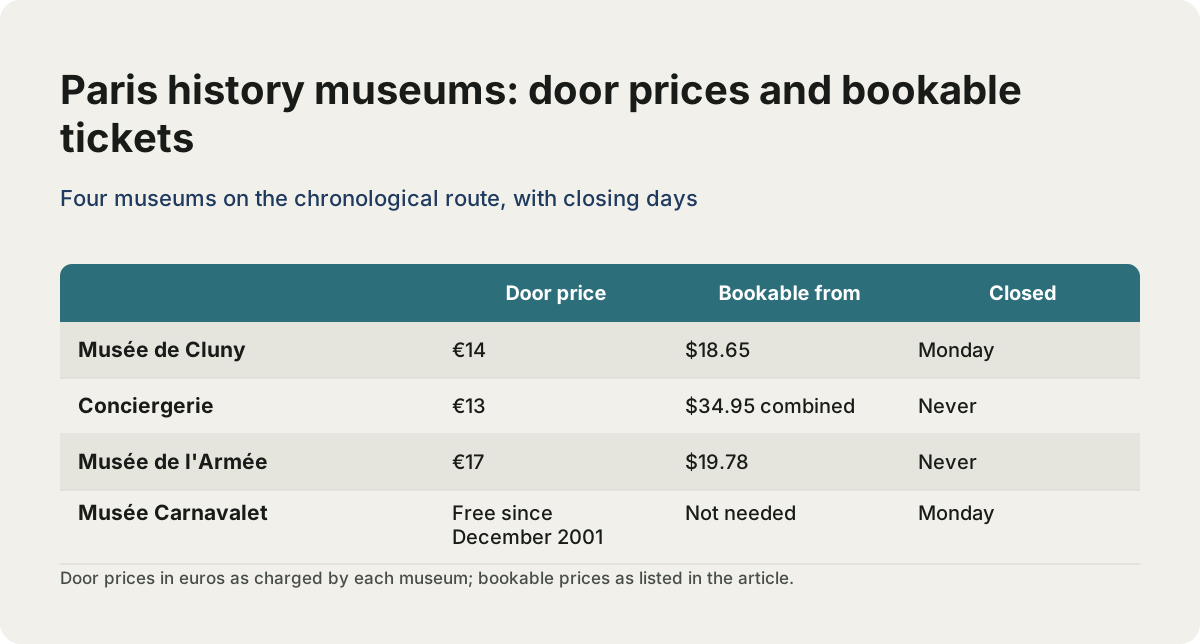
The four anchor stops are the Musée de Cluny for Roman and medieval Paris, the Conciergerie for the Revolution, the Musée de l'Armée at Les Invalides for Napoleon, and the Musée Carnavalet for the city's own story. Cluny costs €14, the Conciergerie €13, Les Invalides €17, and Carnavalet is free.
Which History Museums In Paris Should You Actually Visit?
Paris holds its history in four places that map neatly onto four eras: the Roman and medieval world at the Musée de Cluny, the Revolution at the Conciergerie, the Napoleonic Empire at the Musée de l'Armée, and the whole sweep of the city at the Musée Carnavalet. Two of the four charge admission, one sells a timed ticket, and one is free with no ticket at all.
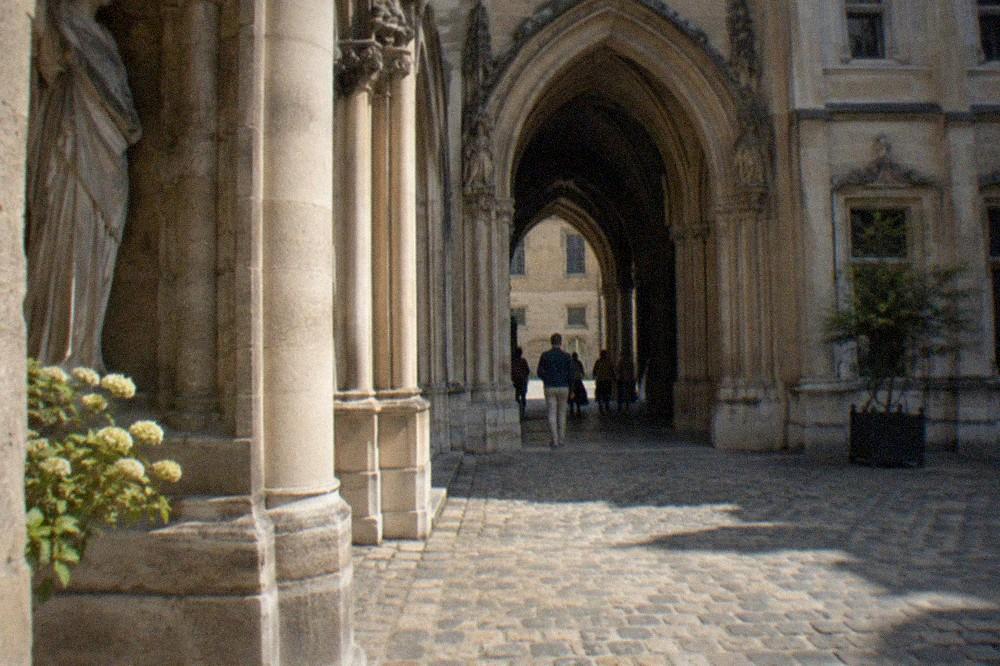
Most visitors treat these museums as a list to pick from. The better way is to treat them as a route, because the buildings themselves are the exhibits. The Cluny sits inside real Gallo-Roman thermal baths from the Roman era, so the oldest thing in the collection is the floor you walk on. The Conciergerie was a royal palace before it became a Revolutionary prison, which means Marie Antoinette's cell sits inside the same halls where kings once dined. Les Invalides was built as a soldiers' hospital under Louis XIV and became the site of Napoleon's tomb by accident of politics.
The sequence also has a practical logic. Cluny and the Conciergerie sit in the 5th and 1st arrondissements, within a short walk of each other across the Île de la Cité. Les Invalides stands a little further southwest, and Carnavalet sits in the Marais, east of the centre. A traveler following the chronology ends up following a sensible walking line through the oldest parts of the city, not crisscrossing it.
Money matters too, and the differences are large. Carnavalet has charged nothing for its permanent collection since December 2001, while the Conciergerie charges €13 at the door and Les Invalides charges €17. Cluny charges €14, and the bookable skip-the-line ticket for it runs from $18.65. Our Paris Museums coverage keeps those two numbers separate on purpose: the euro figure is the museum's own door price, the dollar figure is a booking platform's from-price for a ticket that usually includes a timed slot.
There is one more reason to plan rather than wander. The Conciergerie and the Sainte-Chapelle stand on the same island, a few minutes apart, and a combined ticket for both exists, sold as a bookable product at $34.95. Anyone visiting one of them and then paying separately for the other is leaving money on the table, and the savings question deserves its own section below.
Where Does Paris History Start: The Musée de Cluny And The Middle Ages?
The Musée de Cluny is the starting point, because it is built on top of Roman baths and a medieval abbots' residence and holds the Lady and the Unicorn, the most celebrated medieval artwork in France. Admission is €14 at the museum, it closes on Mondays, and the bookable ticket starts at $18.65. The Roman frigidarium is included in the same entry.
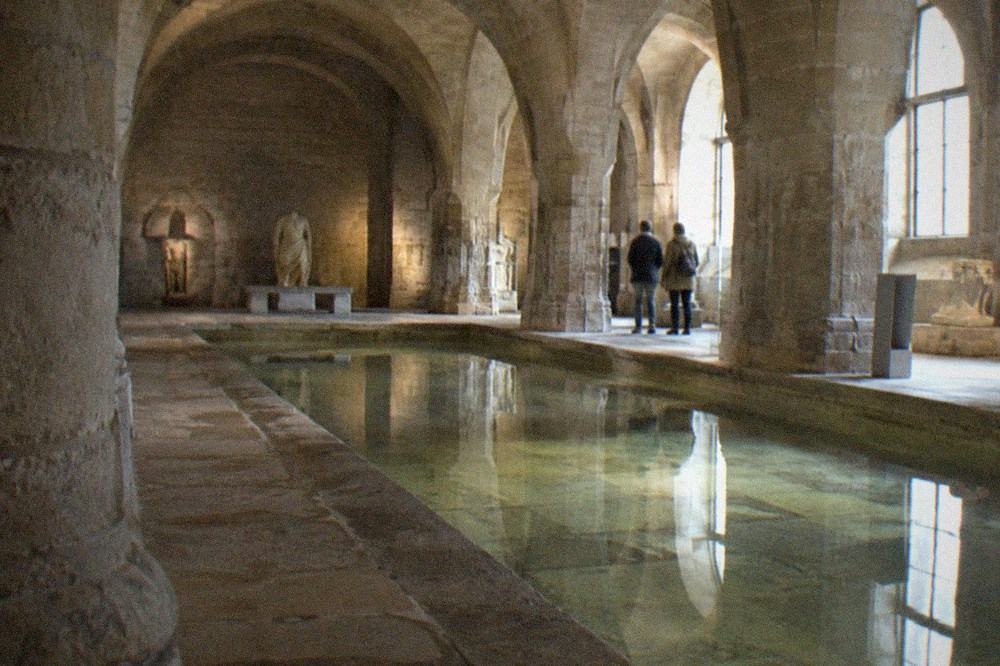
The museum's location is not a coincidence of city planning. The Thermes de Cluny, the bath complex of a Roman-era villa, still stands in place below street level, and the frigidarium, the cold bath hall, survives with its vaults intact. You descend into it as part of the visit. Above it, the hôtel des abbés de Cluny, the Paris townhouse of the abbots of Cluny, was built in the late medieval period and houses the rest of the collection. The result is a museum where the building and the objects argue over which is older.
The collection tells the story of Paris between the fall of Rome and the end of the Middle Ages. The Lady and the Unicorn, six woven wall hangings, are the headline, and they hang in their own circular room where the museum controls the light. Around them sit capitals from demolished churches, Gothic ivories, stained glass rescued from buildings that no longer exist, and the heads of the kings of Judah from Notre-Dame's facade, knocked off during the Revolution and dug up generations later from a bank courtyard. That last find is one of the great accidental discoveries of Paris archaeology, and the museum tells it well.
Practically, the Cluny rewards a half day rather than an hour. The building has stairs and level changes, the Roman hall is at the bottom of them, and the hanging room draws a slow-moving crowd most of the day. It is free the first Sunday of every month, with no reservation required, which makes it one of the easier free-Sunday visits in the city. It is also closed on Mondays, a pattern it shares with the Louvre's Tuesday closure as the awkward midweek trap of Paris sightseeing, and it is covered in our guide to Paris museums open on Monday for anyone caught out by the closed doors.
Tickets for the museum itself can be bought at the door, but the queue in high season makes the bookable option worth knowing about. You can see what a Cluny ticket costs and book it if you want the timed entry in advance.
What Does The Conciergerie Tell You About The French Revolution?
The Conciergerie is a palace that became a prison, and its Revolution section preserves the cells and the record of the prisoners who passed through on the way to the guillotine, Marie Antoinette among them. Entry is €13 at the door, the first-Sunday free rule applies only from January to March and November to December, and the combined Sainte-Chapelle ticket is the smarter buy for anyone doing both.
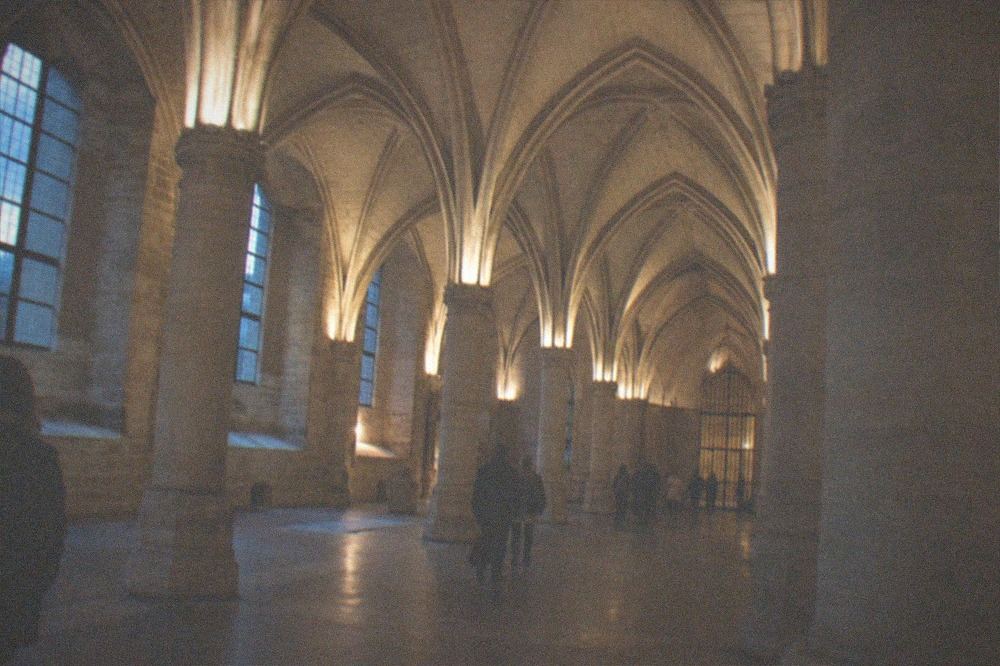
The building's split personality is the whole exhibit. The lower halls, the Salle des Gens d'Armes among them, are the remains of the medieval royal palace, built for the medieval crown and among the finest surviving secular Gothic interiors in Europe. Kings stopped living here when the court moved to the Louvre and then to Versailles, and the building drifted into use as a courthouse and a holding prison. During the Terror it was the antechamber of the guillotine: the Revolutionary Tribunal sat nearby, and prisoners held here were walked to the tumbrels outside.
The museum's presentation walks that line carefully. The medieval halls are left as architecture, while the upper floors reconstruct the prison world, including a chapel marked on the spot of Marie Antoinette's cell. The list of those held here reads as a cross-section of the old regime: the queen, the poet André Chénier, Danton and Robespierre, both of whom had sent others here before following the same route themselves. The visit is compact, an hour or so for the main circuit, longer if the temporary exhibition is running.
The pricing deserves attention before the history does. The Conciergerie charges €13 at the door, and the free first Sunday applies only in the winter half of the year, from January to March and November to December, never from April to October. That rule comes straight from the national monuments conditions of gratuity, and it catches a lot of summer visitors who assumed Paris free Sundays were universal. The under-18 and the EU and EEA resident under-26 exemptions do apply, with photo ID.
The smart purchase is the combined ticket. The Sainte-Chapelle, with its wall of 13th-century stained glass, is five minutes away on the same island, and the bookable combined product for both sites is sold at $34.95. Against buying the two admissions separately, it is the version that matches how people actually visit the island, and we break it down further in how long the wait for Sainte-Chapelle is and what the combined ticket covers.
For history visitors deciding how to spend a morning on the Île de la Cité, these are the three bookable ways to handle the island and the Invalides across the city:
| Site | What the history is | Door price | Bookable from | Closed |
|---|---|---|---|---|
| Musée de Cluny | Roman baths, medieval art, the Lady and the Unicorn | €14 | $18.65 | Monday |
| Conciergerie | Royal palace turned Revolutionary prison | €13 | $34.95 combined | Never |
| Musée de l'Armée | French military history and Napoleon's tomb | €17 | $19.78 | Never |
The dollar figures are platform from-prices for bookable tickets, not the door prices in the euro column, and the Conciergerie row's dollar figure is the combined Sainte-Chapelle product because that is the version worth buying. Before choosing between them, it is worth comparing the trio directly, since all three can be bought with free cancellation before the visit.
Was Napoleon Really Buried At Les Invalides?
Yes, and the Musée de l'Armée around his tomb is the largest military history museum in France, covering armour, both world wars and the Empire in one ticket. Admission is €17, which includes the Dôme des Invalides where Napoleon lies, and the museum is open every day of the week with no timed reservation required. Bookable tickets start at $19.78.
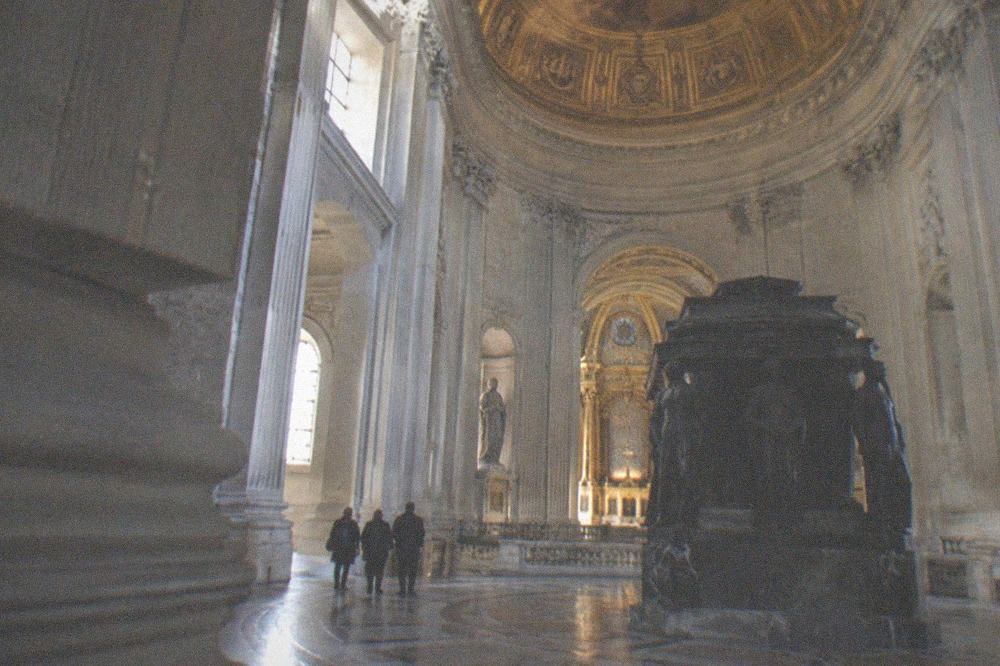
Les Invalides was commissioned by Louis XIV as a hospital and retirement home for soldiers, and it kept that function long past the era that made it famous. Napoleon's body was returned from Saint Helena and placed in the open crypt under the golden dome, in a tomb of red quartzite on a green granite base, ringed by statues and an inscription of his victories. The dome above it is real gold leaf, and the effect is deliberate theatre: the Empire presenting its emperor as a monument rather than a man.
The Musée de l'Armée occupies the wings around the courtyard, and its scope is far wider than Napoleon. The armour collection is one of the oldest in Europe, the two world wars are covered in full galleries, and the modern wing runs to the end of the 20th century. For a visitor following the chronological route, this museum is where the story of France hardens from palace politics into mass armies. Allow three hours for the main collections and the dome together, or two if the world war galleries are skipped.
The pricing is straightforward, which is rare in Paris. A single €17 ticket covers the museum and the dome, there is no separate Napoleon surcharge, and the museum has no weekly closing day at all. It is also one of the museums with no first-Sunday free entry: only the conditional exemptions, the under-18s and the EU and EEA residents under 26 with ID, apply. The under-26 exemption matters here more than most visitors expect, because a family with adult students from the EEA can walk the whole site for nothing.
We cover the tomb visit and its practicalities in detail in how much it costs to see Napoleon's tomb at Les Invalides. The short version: the dome is the emotional climax of the site, the world war galleries are the intellectual one, and the two halves sit a ten-minute walk apart through the courtyard.
Should you lock in a ticket before you travel? The door never sells out the way the Catacombes do, but the queue at the Esplanade entrance can be long in summer.
Why Is The Musée Carnavalet Free When The Others Charge?
The Musée Carnavalet is a City of Paris museum, and the city has made the permanent collections of its museums free to everyone since December 2001, no ticket needed. The temporary exhibitions still charge, and the museum closes on Mondays. It tells the whole story of Paris from prehistory to the present, which makes it the narrative spine of any history-themed visit.
The free rule is worth stating precisely, because most guides blur it. The city's own tariffs page lists eleven museums whose permanent collections are free to all publics, and the Carnavalet is one of them. That is a different system from the national museums, which are free only one Sunday a month under conditions, and the two systems never overlap. The trade-off is the exhibition caveat: when a temporary show is installed, that part is ticketed, and at some city museums, the Maison de Victor Hugo among them right now, an exhibition can suspend the free access entirely.
The Carnavalet itself is the city's own museum, housed in two adjoining mansions in the Marais. Its rooms move from Gallo-Roman Lutetia through medieval Paris, the Revolution, the Haussmann rebuilding and the 20th century, with interiors rescued from buildings that were demolished, including whole rooms from the Hôtel de la Rivière and Marcel Proust's cork-lined bedroom. For a visitor who has done the Cluny, the Conciergerie and Les Invalides, the Carnavalet is where the threads come together: the Revolution you saw as a prison cell is here again as street signs, paintings and personal objects.
Budget-wise the museum costs nothing for the permanent collection, but a coffee in the garden courtyard is a fair substitute for a ticket, and the temporary shows are worth checking before you go. Two to three hours covers the permanent route at a normal pace. The museum is the anchor of our broader free museums in Paris guide, which covers the other ten city museums on the same free rule.
Which Paris History Museums Are Free Or Cheap, And When?
Nine of the museums relevant to a history visit are free or conditionally free: the eleven city museums are free all year, the Cluny and the Conciergerie run first-Sunday or winter-Sunday rules, and under-18s plus EU and EEA residents under 26 get into the national sites with photo ID. The Conciergerie's free Sundays run only January to March and November to December. Nothing on the island is free on a summer Sunday.
The rules split along ownership lines, and the split is the single most useful thing to understand about Paris museum pricing. City museums, the Carnavalet among them, are free to everyone whenever they are open. National museums and monuments run the free first Sunday, but with the seasonal carve-out at the national monuments: the Conciergerie, the Sainte-Chapelle, the Arc de Triomphe and the Panthéon are free the first Sunday only from 1 January to 31 March and from 1 November to 31 December, never from April to October. The city's own conditions are published on the Paris Musées tariffs page, and the monuments' rule on the national monuments gratuity page.
Age and residency exemptions cut across both systems. Under-18s are free at the national museums with a photo ID, and so are EU and EEA residents under 26, including holders of a long-stay permit or visa over four months. What is checked at the door is residency, not nationality, which surprises people who assumed a passport from outside Europe disqualified them. A long-stay resident of France under 26 walks into the Louvre free on exactly the same terms as a French student.
Here is where the main history-relevant sites land on the price spectrum:
| Museum or monument | Ownership | Permanent collection | Free first Sunday | Closed |
|---|---|---|---|---|
| Musée Carnavalet | City of Paris | Free, no ticket | Open anyway | Monday |
| Musée de Cluny | National | €14 | Yes, all year | Monday |
| Conciergerie | National monument | €13 | Jan-Mar and Nov-Dec only | Never |
| Musée de l'Armée | National | €17 | No | Never |
| Sainte-Chapelle | National monument | €22 non-EEA, €16 EEA | Jan-Mar and Nov-Dec only | Never |
The Paris Museum Pass changes some of this arithmetic and ignores the rest. It costs €85 for 2 days, €105 for 4 days and €125 for 6 days, counted in hours from the first scan, and it covers the Cluny and the Conciergerie but never the temporary exhibitions. For a history route made only of the four anchor stops, the pass rarely pays, because Carnavalet is already free and the two paid sites cost €14 plus €13. A traveller adding the Louvre and Versailles to the route changes that math entirely, and our Paris Museum Pass guide works through the whole list.
How Do You Fit The History Route Into One Day?
A one-day history route runs Cluny in the morning, the Conciergerie and the Sainte-Chapelle at midday, Les Invalides in the afternoon, and the Carnavalet at the end of the day or on a second morning. The walking distances are short, every stop except Cluny and Carnavalet is open daily, and the total door cost for one adult is €14 plus €13 plus €17, with Carnavalet free.
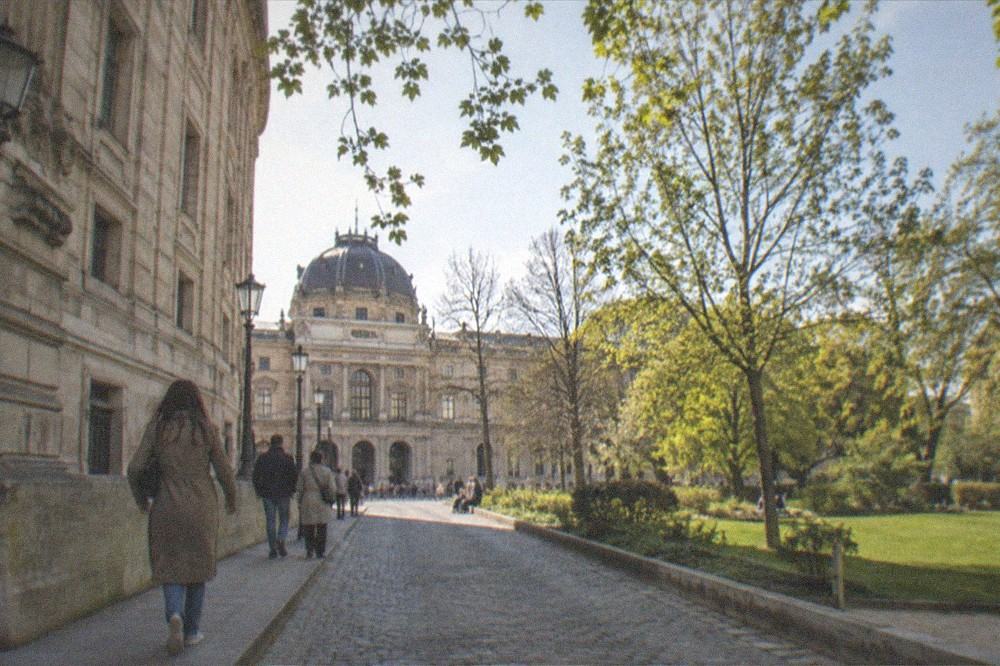
The geography cooperates with the chronology. Cluny sits at the corner of the Boulevard Saint-Michel and the rue Sommerard, on the Left Bank. From there it is a fifteen-minute walk north across the Seine to the Conciergerie and the Sainte-Chapelle on the Île de la Cité. The march west along the river to Les Invalides takes about twenty-five minutes, or ten on the métro with one change, and the final leg to the Carnavalet in the Marais is another pleasant walk along the river or a short ride on line 1. Nothing in the day requires a vehicle unless the weather turns.
Timing each stop matters more than the order. Cluny opens at a fixed morning hour and is quietest in the first hour; the Lady and the Unicorn room fills by lunchtime. The Conciergerie can absorb a midday visit in under an hour, and the Sainte-Chapelle next door is at its most crowded at exactly that hour, so the combined ticket saves money and the early morning or late afternoon saves the queue. Les Invalides needs the longest block, three hours with the dome, and the dome's light is at its best late in the day. Carnavalet has no queue to speak of and works as the flexible final stop, or as the whole of a second morning at a slower pace.
Two closed-day traps can break the plan. Cluny and Carnavalet both close on Mondays, which makes Tuesday through Sunday the safe window for the full route. A Monday visit is still possible: the Conciergerie, the Sainte-Chapelle and Les Invalides all open daily, so the Revolution and Napoleon halves of the story survive a Monday, and the medieval and city halves move to another day. Our guide to the best museums in Paris covers which of the big sites can fill a Monday morning.
The practical totals are easy to hold in your head. One adult doing all four stops pays €14 at the Cluny, €13 at the Conciergerie, €17 at Les Invalides and nothing at the Carnavalet, with the combined Sainte-Chapelle and Conciergerie ticket replacing the middle figure for anyone doing both island sites. Under-18s pay nothing at the three national sites, and EU and EEA residents under 26 pay nothing either, which can zero out most of the day's cost for a student group.
What Else Should A History Lover Add To The List?
Four second-tier stops reward a second day: the Panthéon for the tombs of Voltaire, Rousseau and Hugo at €16, the Arc de Triomphe for the First World War memorial at €22, the Petit Palais for free French art in a historic building, and the Château de Fontainebleau for the royal palace that Versailles oversells, at €17 and closed Tuesdays. None of them needs a timed reservation except the Arc.
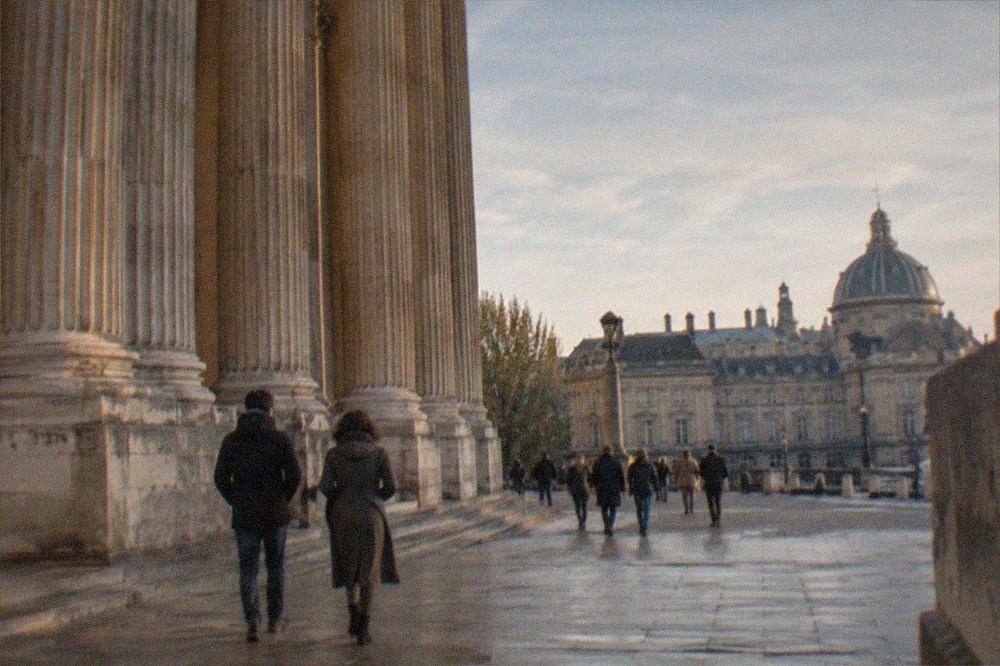
The Panthéon is the most history-dense of the four. Its crypt holds the tombs of Voltaire, Rousseau, Victor Hugo, Émile Zola, Marie Curie and Louis Braille, among others, and its nave holds Foucault's pendulum, still swinging to demonstrate the earth's rotation as it did when it was first installed. It costs €16 from April to September and €13 in the winter months, with the same Wednesday reduction pattern as the Arc de Triomphe, and it is open every day. The Arc de Triomphe, at €22 in the summer season, is both a monument and a viewpoint, with the Tomb of the Unknown Soldier at its base and the nightly relighting ceremony at 18:30, and we cover the climb itself in whether going up the Arc de Triomphe is worth it and how hard the climb is.
The Petit Palais belongs on the history list for a different reason: it was built for the 1900 Exposition Universelle and is now a free city museum, so the building itself is a piece of Paris history and the collection inside costs nothing. The Château de Fontainebleau, an easy day trip from the Gare de Lyon, was the royal residence centuries before Versailles existed and keeps a more human scale. It costs €17, closes on Tuesdays rather than Mondays, and is free the first Sunday of the month except in July and August. Travellers torn between it and Versailles should read our comparison piece on which is better, Versailles or Fontainebleau.
A final word on the two systems, because this is where history visitors lose money. The free city museums and the fee-charging national sites sit within walking distance of each other everywhere in this article, and the distinction between them is invisible on the street. A visitor who knows the Carnavalet is free but the Conciergerie is €13, and who knows the free Sundays are seasonal at the monuments, plans a trip that costs half as much and misses nothing.
Here is the full second-day menu at a glance:
| Stop | The history | Price | Open daily | On the Paris Museum Pass |
|---|---|---|---|---|
| Panthéon | Tombs of the great names of French thought | €16 Apr-Sep, €13 Oct-Mar | Yes | Yes |
| Arc de Triomphe | First World War memorial and viewpoint | €22 Apr-Sep, €16 Oct-Mar | Yes | Yes |
| Petit Palais | 1900 exposition building, free collections | Free | No, closed Monday | No, free anyway |
| Château de Fontainebleau | Royal palace predating Versailles | €17 | No, closed Tuesday | Yes |
Whether the first day's anchor stops or these four fill your second day, these are the three tickets history visitors compare most often:
Common Questions About History Museums In Paris
What are the best history museums in Paris?
The four anchor stops are the Musée de Cluny for Roman and medieval Paris, the Conciergerie for the Revolution, the Musée de l'Armée at Les Invalides for Napoleon and French military history, and the Musée Carnavalet for the city's own story, free of charge.
Is the Musée Carnavalet really free?
Yes. Its permanent collection has been free to everyone since December 2001, with no ticket and no age condition. Temporary exhibitions are ticketed, and the museum closes on Mondays.
How much does the Conciergerie cost?
€13 at the door, or a combined bookable ticket with the Sainte-Chapelle at $34.95. It is free the first Sunday of the month only from January to March and November to December.
Where is Napoleon buried in Paris?
In the Dôme des Invalides, under the golden dome of the Hôtel national des Invalides. The tomb is included in the Musée de l'Armée's single €17 ticket.
Is the Musée de Cluny worth visiting?
Yes, for the Roman bath hall in place beneath the building and the Lady and the Unicorn. Entry is €14, it closes Mondays, and it is free the first Sunday of the month.
What history museums in Paris are free?
The eleven City of Paris museums, including the Carnavalet and the Petit Palais, are free all year. National sites are free for under-18s and EU and EEA residents under 26 with photo ID, plus first-Sunday rules that are seasonal at the national monuments.
Can you do the Conciergerie and Sainte-Chapelle in one visit?
Yes, they are five minutes apart on the Île de la Cité and a combined bookable ticket at $34.95 covers both, which is the version worth buying over two separate admissions.