How Much Does A Paris Catacombs Ticket Cost, And Can You Just Turn Up?
A Paris Catacombs ticket costs €31 at the door with the audio guide included, and no, you cannot just turn up: timed slots sell out days ahead and the site is closed on Mondays.
How Much Does A Paris Catacombs Ticket Cost, And Can You Just Turn Up?
A full-price Paris Catacombs ticket costs €31 at the door, and that price includes the audio guide. You cannot just turn up expecting a ticket: entry is by timed slot only, those slots regularly sell out days ahead, and the whole site is closed on Mondays. Booking ahead is the normal way in, not the precaution.
The Catacombes de Paris sit in the 14th arrondissement, at 1 avenue du Colonel Henri Rol-Tanguy, and they occupy a strange position in the city's museum landscape. They are run by Paris Musées, the City of Paris network whose eleven other permanent collections are free to everyone all year, yet the Catacombs have always charged. Alongside Palais Galliera and the shut Crypte archéologique, they are one of only three sites in the network that sell a ticket at all, and at €31 they are the most expensive single admission in this roster, more than the Louvre's €22 rate for EEA visitors. The city's own tariffs page states it plainly: access to the Catacombes is paid all year round.
The gap between the door price and what visitors actually pay in practice is where this question gets interesting. The museum's own site sells timed slots at €31, but those slots, capped and strictly enforced, are the scarce commodity. When the official allocation runs dry, resold and skip-the-line tickets are the only remaining route in, which is why platform from-prices for a Catacombs entry start at $92.95, roughly three times the door figure. That is not a markup on the same product; it is the price of availability once the cheap allocation is gone.
Visitors who arrive without a booking are the ones the question is really about. The queue at the pavement can run for hours in high season, and it leads nowhere if the day's timed slots are already sold out, which is common by mid-morning. Reviewers rate it 4.6 across 1,084 reviews, and they say much the same thing in different words: the site itself is memorable, the ticketing is the hard part. Plan around Monday's closure, book a slot before you leave home, and the price of the visit stays at €31. Leave it to the day and you may pay triple or not get in at all.
If you are building a whole Paris itinerary, the Catacombs slot is worth locking in first, before the museums with bigger daily capacity. These three pair well with it:
What Is Actually Inside The Catacombs?
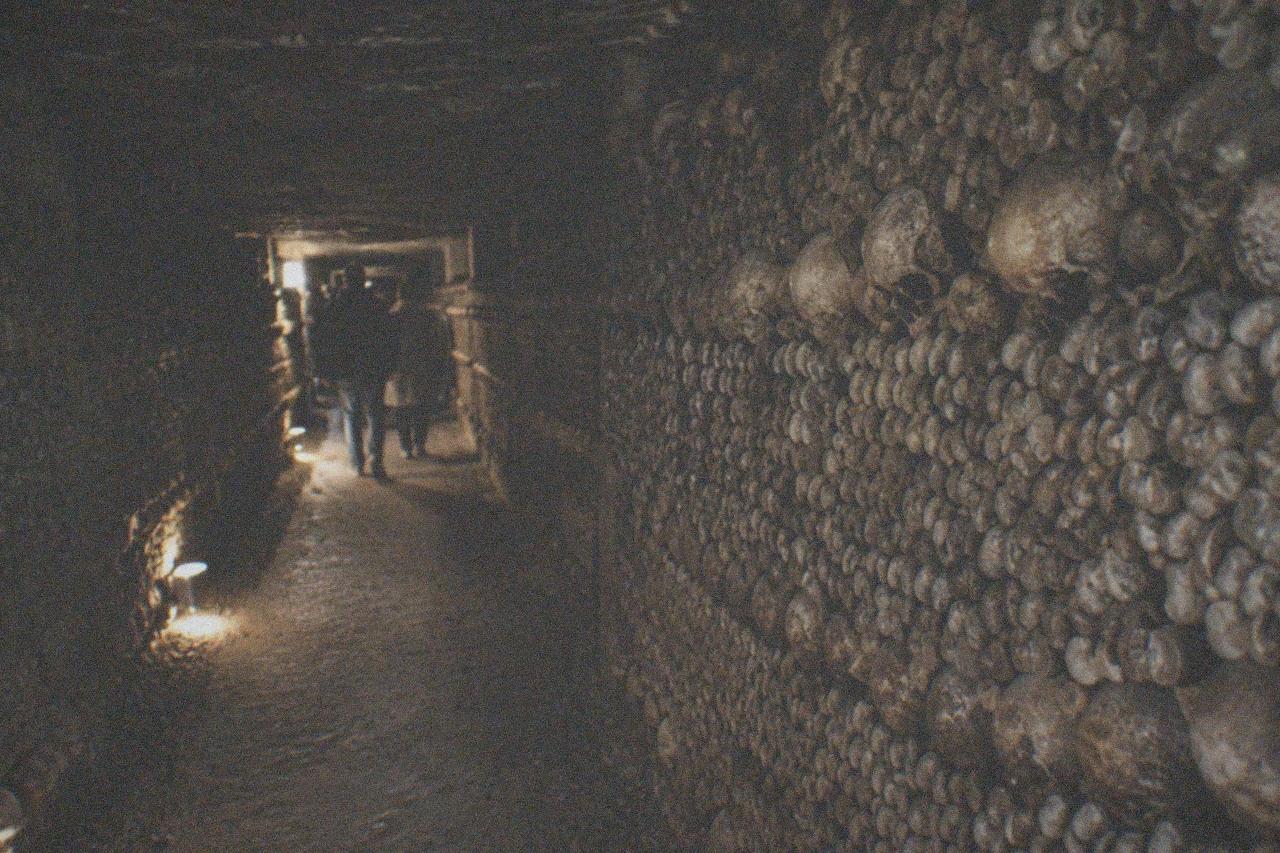
The Catacombs are a working ossuary: roughly 300 kilometres of old limestone quarry tunnels under the Left Bank, of which the public route covers about a kilometre and a half, lined from floor to ceiling with the arranged bones of an estimated six million Parisians. There is no art collection and no permanent exhibition, just the bones, the stone and the history.
The story starts with commerce, not death. Paris was built out of the limestone beneath it, and by the eighteenth century the quarries had honeycombed the Left Bank so badly that whole streets began collapsing into the voids. Inspectors mapped the tunnels, and the city, needing stable ground above, took ownership of the problem below. The ossuary came later. Parisian cemeteries, the Cimetière des Innocents chief among them, had been overcrowded for centuries, and in the late eighteenth century the authorities began moving their contents into the empty quarries. The bones travelled at night, in covered carts, over years, and masons stacked and arranged them into the walls, patterns and pillars visitors walk past today: femurs and tibias as masonry, skulls as ornament.
The visit itself is deliberately narrow. You descend a tight spiral staircase, walk a long low gallery of bare quarry stone, and then pass under the carved entrance that warns, in the original French, that you are entering the empire of death. From there the route is a single one-way corridor, roughly 1.5 kilometres of it, about twenty metres underground, with a constant temperature around 14 degrees. The atmosphere is the attraction: dim lighting, damp air, the quiet of stone. Sections bear street names picked out in bone, marking which cemetery each wall of remains came from, and plaques and inscriptions collected over two centuries punctuate the route. There is nothing interactive and nothing gilded. People who love it describe it as solemn and genuinely moving; people who do not describe it as an hour in a cold tunnel looking at bones. Both are fair descriptions of the same walk.
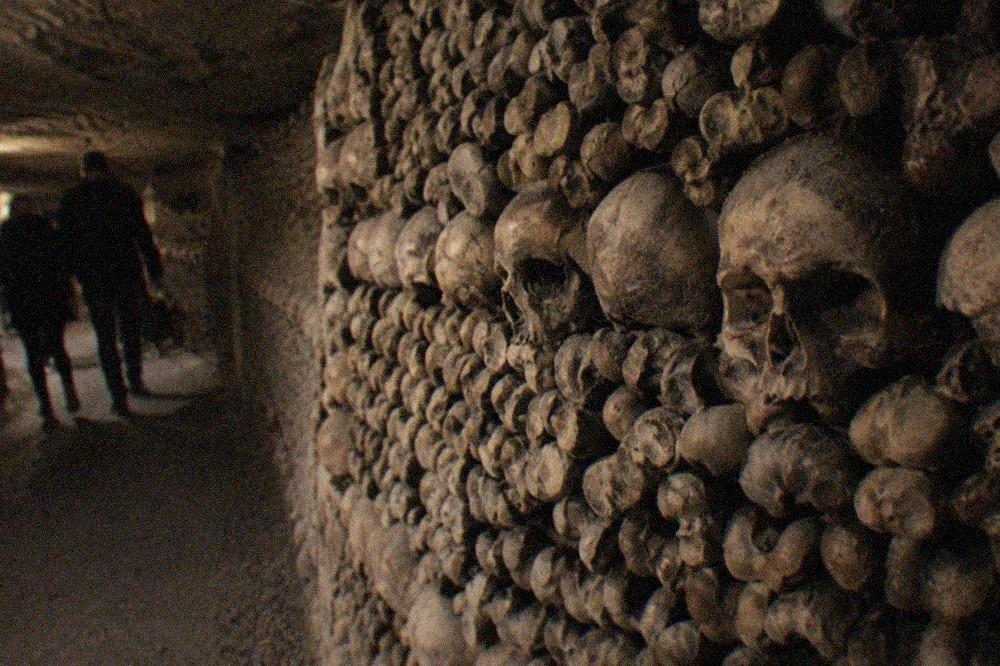
Practicalities matter more here than at most museums. The route has no bypass: visitors with limited mobility will find the stairs, the low sections and the uneven floor genuinely difficult, and the site's own guidance says as much. There are no toilets along the route and no cloakroom beyond a small bag check at the entrance, so travel light. Photography is allowed, though without flash, and tripods and selfie sticks are not. Children under a certain size are not admitted, and the site is candid that the experience is not pitched at young kids. Two hours is the honest allowance, door to door, including the descent, the walk and the staircase back up.
What Does The €31 Ticket Cover, And Who Gets In Free?
The €31 ticket covers the full underground route and the audio guide, which is included rather than rented. Nothing else is on sale down there. The Catacombs have no free Sunday at all: as a paid Paris Musées site they charge every day they are open, so the free-entry rules that apply to the city's other museums do not apply here.
Start with what the price buys. The audioguide is bundled into the €31 rate, which is unusual in Paris, where most museums sell commentary separately or run it through your own phone. The commentary walks you through the quarry history, the bone transfers and the notable inscriptions, and most reviewers say it is worth using: the route is deliberately spare, and the narration carries a lot of the context. The ticket is also strictly timed. You choose a half-hour arrival window when you book, and late arrivals are treated as no-shows, which is the single most common way people lose their money here. Other pages covering the same trip are gathered on Paris Museums.
Who gets in free is a short list. The Catacombs are a City of Paris site, not a national monument, so the generous national rules, free under-18s and free EU and EEA residents under 26 at state museums, do not transfer automatically. What the site itself publishes is a set of conditional exemptions, reduced rates and free cases for specific categories, and the honest advice is to check the current concessions on its own page when you book, because city-network concessions shift more often than national ones. What does not shift is the headline: there is no free first Sunday, no free evening, no free month. Guides that lump the Catacombs in with the free city museums are simply wrong; the city's own tariffs page names it as one of the three sites that charge all year.
The Paris Museum Pass point catches a lot of people out. The pass, at €85 for 2 days and €105 for 4, covers more than fifty museums and monuments, but the pass's own site confirms the Catacombs are not among them: the exclusion list also includes the Eiffel Tower, the Opéra Garnier and every city museum, free or paid. Anyone planning a pass-heavy itinerary needs to budget the Catacombs separately, in both money and a timed slot. If you are weighing the pass generally, our Paris Museum Pass guide works through the arithmetic site by site.
So the decision comes down to one question: do you want your Catacombs slot guaranteed before you land in Paris?
How Long Should You Allow, And Which Day Is It Shut?
Allow about two hours in total: roughly forty-five minutes underground for the full route at a normal pace, plus the staircase descent, the queue at your arrival window and the exit climb. The Catacombs are closed every Monday, and they are otherwise open daily on a timed schedule that varies by season.
The Monday closure is fixed and non-negotiable, and it puts the Catacombs in the city-camp of Paris closures: Orsay, Rodin, Picasso, quai Branly, Cluny, the Cité des sciences and Versailles all shut the same day, while the Louvre and Orangerie shut Tuesday. That makes Monday the worst museum day in Paris for the paid headline sights and a good day to plan around carefully. If your trip starts on a Monday, the Catacombs slot has to go on Tuesday or later. The daily opening hours shift with the season and with demand, and the timed-entry windows mean "hours" are really about which slots remain, not when the door opens.
Length of visit surprises people in both directions. The underground route itself is about 1.5 kilometres and most visitors cover it in 45 minutes to an hour, longer if you listen to the full audioguide at every stop. Add the descent and the exit stairs, the security check at the entrance and the walk to and from the métro, and the realistic commitment is two hours. Visitors regularly report that the underground portion feels shorter than expected, and reviewers who came expecting a two-hour subterranean trek sometimes leave mildly deflated, so calibrate: this is a concentrated, one-way walk, not a sprawling site you can linger in for a whole afternoon. There is no café underground and no seating along the route.
The practical frame around the visit deserves a line of its own. Arrive inside your half-hour window, not before it, because early arrivals queue separately. Wear closed shoes: the floor is uneven and damp in places, and the temperature underground sits around 14 degrees whatever the weather above, so a layer is useful in summer and essential in winter. Book the first slot of the day or a weekday slot if you want the quietest walk; the single corridor means crowds move as one slow pack, and the atmosphere of the place, which is most of what you are paying for, survives a packed tunnel far less well. Reviewers consistently say the early slots are the difference between solemn and shuffling.
A reservation that guarantees your half-hour window removes the one genuinely uncontrollable variable in this visit, which is the pavement queue. This is the bookable version:
How Does The Catacombs Compare With The Nearest Alternative?
As a paid Paris experience the Catacombs have no true equivalent, but the closest comparisons are Sainte-Chapelle at €22 for non-EEA visitors and Versailles at €35 high season. The Catacombs cost €31, are closed Monday, and sell the scarcest timed slots of the three, which makes booking discipline matter more here than anywhere else.
The honest comparison set is not other ossuaries, of which Paris has one and only one, but the other ticketed anchors a visitor is likely to pair with it. Sainte-Chapelle is the natural companion: it is on the Île de la Cité, a short métro ride from the Catacombs' 14th arrondissement entrance, and a combined Sainte-Chapelle and Conciergerie bookable ticket runs from $34.95, which only pays off if you plan to do both. Sainte-Chapelle charges €16 for EEA visitors and €22 from outside the EEA, runs compulsory timed entry, and holds a 4.3 rating across 141 reviews. It is the opposite experience in every sense: light, colour, height and glass, rather than dark, bone, stone and depth. Doing both in one day is a genuinely good pairing, one in the morning and one in the afternoon, and the contrast is the point.
Versailles plays a different role. At €35 for the high-season Passport, from 1 April to 31 October, and €25 the rest of the year, it is the more expensive day out and it demands a full day rather than two hours, plus the RER C ride out and back. It also carries the most generous review profile of anything in the city, 4.7 across 11,852 reviews, and it needs a timed reservation even for pass holders. If your Paris budget stretches to one big-ticket monument plus the Catacombs, the choice is between a half-day of staggering opulence outside the city and two solemn hours under it. Our Versailles versus Fontainebleau comparison breaks down that trade-off in more detail.
| Site | Door price | Closed day | Timed entry | Rating and reviews |
|---|---|---|---|---|
| Catacombes de Paris | €31, audioguide included | Monday | Compulsory, sells out days ahead | 4.6 across 1,084 reviews |
| Sainte-Chapelle | €16 EEA / €22 non-EEA | None | Compulsory | 4.3 across 141 reviews |
| Palace of Versailles | €35 high season / €25 low | Monday | Compulsory, even with the pass | 4.7 across 11,852 reviews |
| Eiffel Tower | €36.70 summit by lift | None | Compulsory | 4.2 across 649 reviews |
| Musée de l'Armée | €17, Dôme and Napoleon's tomb included | None | Not required | 4.6 across 10,794 reviews |
The table earns a note on what "door price" means for the Catacombs specifically. At every other site in that list, the printed euro figure is a ticket you can realistically buy on the day, online or at a counter. At the Catacombs, €31 is the price of a slot that may already be gone, and the honest planning figure for a last-minute visit is the platform from-price of $92.95 for a skip-the-line entry, because that is what availability costs once the official allocation is exhausted. Two figures, two meanings, and confusing them is how people end up feeling overcharged for what is, on paper, a €31 attraction. You can compare the bookable options for the Catacombs ticket and the Sainte-Chapelle ticket directly.
One more angle worth weighing before you commit: what kind of memory you want from a paid Paris visit. The Catacombs deliver atmosphere and a story about the city's own ground that no other site tells, at a flat €31 and with the city's scarcest slots. Sainte-Chapelle delivers thirty minutes of astonishment for €16 or €22. Versailles delivers a whole day of grandeur for €35 plus travel. This is not a ranking; it is three different products, and the Catacombs are the only one of the three that regularly turns away people who did not plan ahead, which is the final answer to the "just turn up" half of this question. If you have read this far, you are already the kind of visitor who books the slot, which is the kind the Catacombs reward.
For a final side-by-side of the three, with prices and closed days side by side:
Common Questions About Paris Catacombs Tickets
How Much Does A Paris Catacombs Ticket Cost, And Can You Just Turn Up?
A full-price ticket costs €31 at the door, audioguide included. You cannot reliably just turn up: entry is by timed slot only, slots sell out days ahead, and the site is closed every Monday. Book your half-hour window before you travel.
Is the audio guide included in the €31 Catacombs ticket?
Yes. Unlike most Paris museums, the Catacombs bundle the audioguide into the full €31 rate rather than renting it separately. Most reviewers recommend using it, since the route itself is deliberately sparse and the narration carries most of the context.
Why do resold Catacombs tickets cost three times the door price?
Because the official timed slots, sold at €31, are capped and sell out days ahead. Platform from-prices start at $92.95 for skip-the-line entry, and that premium is the price of availability once the cheap allocation is gone, not a markup on a different product.
Are the Catacombs ever free, like other Paris city museums?
No. The Catacombs are one of only three Paris Musées sites that have always charged, alongside Palais Galliera and the shut Crypte archéologique. There is no free first Sunday and no free evening, ever.
Does the Paris Museum Pass cover the Catacombs?
No. The Catacombs sit on the pass's exclusion list alongside the Eiffel Tower, the Opéra Garnier and the Fondation Louis Vuitton. Pass holders must buy a separate timed ticket at the full €31 rate.
How long does a Catacombs visit take?
Allow about two hours door to door. The underground route is roughly 1.5 kilometres and takes 45 minutes to an hour at a normal pace with the audioguide, plus the staircase descent, the security check and the exit climb.
What day are the Paris Catacombs closed?
Every Monday, without exception. The Catacombs share that closure day with Orsay, Rodin, Picasso, quai Branly, Cluny and Versailles, while the Louvre and the Orangerie close on Tuesdays instead.
Can children visit the Catacombs?
The site restricts entry by height and is candid that the experience is not designed for young children. The route is a one-way tunnel with low sections, uneven floors and exposed human remains, so check the current admission rules for children on the official page before booking.