What Is There To See At The Institut du monde arabe, And Is The Rooftop Open?
A full guide to the Institut du Monde Arabe in Paris: the collections, the mechanical facade, the €10 ticket, the Monday closure, and the honest state of the rooftop.
What Is There To See At The Institut du monde arabe, And Is The Rooftop Open?
The Institut du Monde Arabe is a museum of Arab civilization, founded as a cultural institute and research library, holding textiles, ceramics, calligraphy, astrolabes and carpets across several floors. It charges €10, closes every Monday, and offers no free Sunday. The rooftop terrace belongs to the building's top-floor restaurant, so access depends on the restaurant, not the museum ticket.
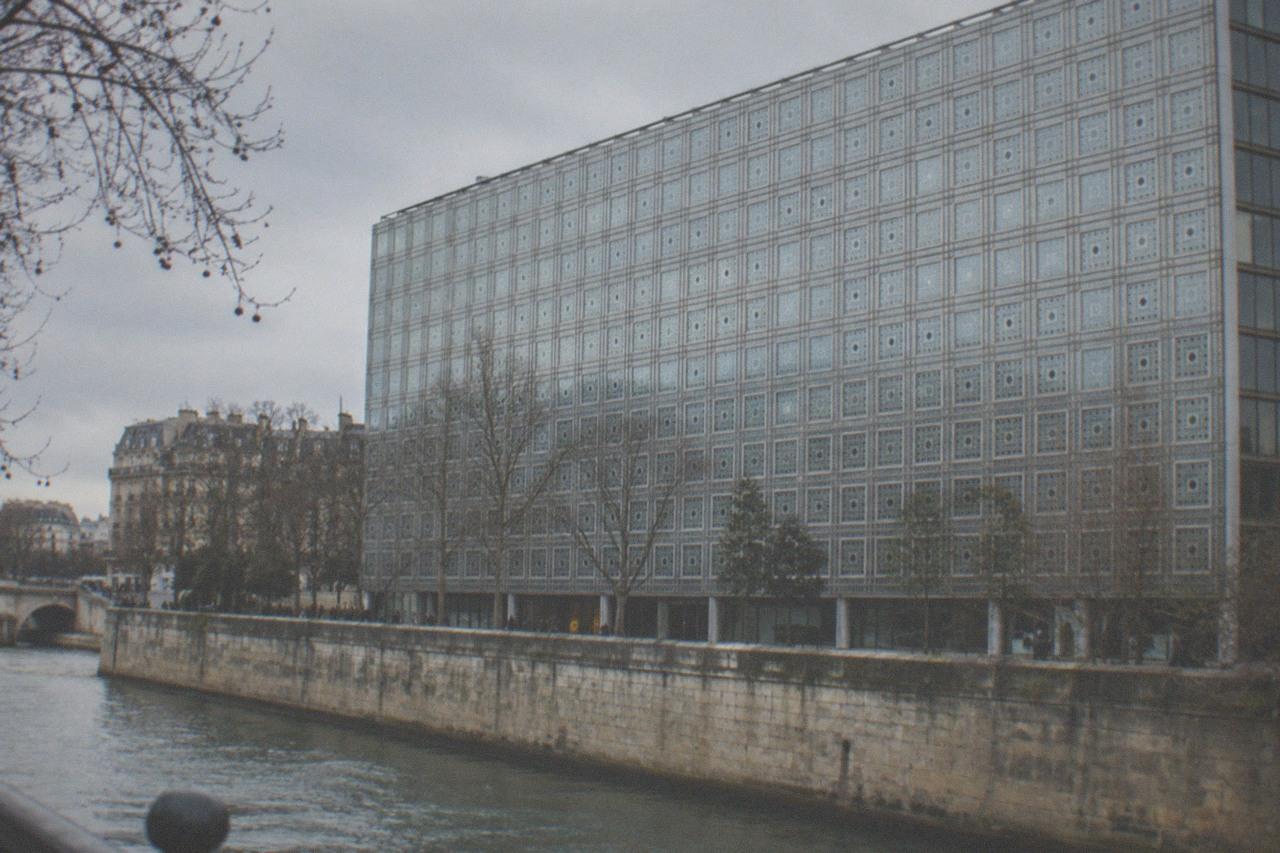
That is the short version, and it hides a building that is itself the main exhibit. The institute sits at 1 rue des Fossés Saint-Bernard in the 5th arrondissement, pressed between the Jussieu campus and the river, directly across the water from the Île de la Cité. The view of Notre-Dame from its upper floors is one of the best in the 5th, which is exactly why the rooftop question comes up so often. Visitors arrive expecting a public observation deck and find a museum, a library and a restaurant stacked on top of each other, with the outdoor space run by the restaurant rather than by the museum.
This museum sells no ticket on this site, which is worth saying plainly and early. The facts page for admission and opening times lives at the Institut du Monde Arabe facts page, and the institute's own site at imarabe.org is where live hours and any terrace conditions are confirmed before a visit. What follows is what the building holds, what it costs, how long it takes, and how the rooftop actually works.
If you are planning a wider week of museums rather than one afternoon on the Left Bank, the trio below covers three of the most reliable bookings in the city, all bookable with free cancellation.
Why The Building Itself Draws Photographers?
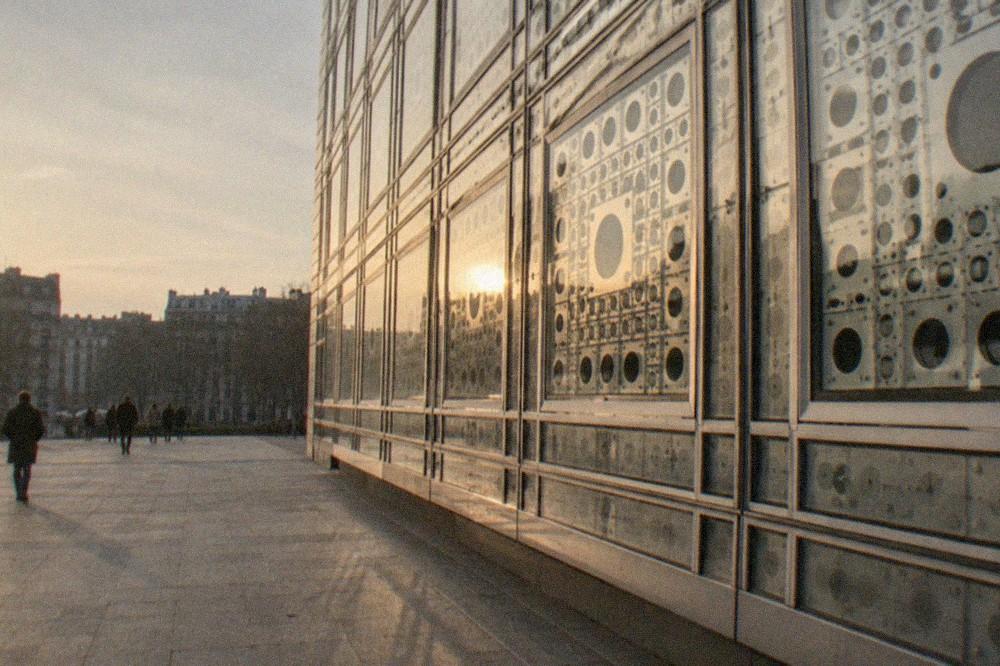
The institute's fame rests on its south facade, a wall of metal screens fitted with light-sensitive diaphragms that open and close like camera shutters to regulate sunlight into the library. Designed by Jean Nouvel with Architecture-Studio, it won the Aga Khan Award for Architecture. It is the most photographed mechanism in Paris after the tower clocks.
The screens borrow their logic from the mashrabiya, the latticed wooden window screen traditional across the Arab world, and re-interpret it in motorized metal at building scale. Each aperture contracts and dilates through the day as the light changes, so the facade you photograph in the morning is not quite the facade you photograph in the late afternoon. People set up across the street and wait for the movement, which is the one piece of street theatre in the 5th arrondissement that runs on a schedule nobody publishes.
That facade is also the practical reason the interior feels the way it does. Inside, the light arrives filtered and softened, and the reading rooms behind the screen wall are among the calmest public rooms in the city. The building was conceived as a bridge institution, part museum, part library, part research centre, and that mixed purpose still shapes the visit: you walk through a working institute rather than a purpose-built gallery.
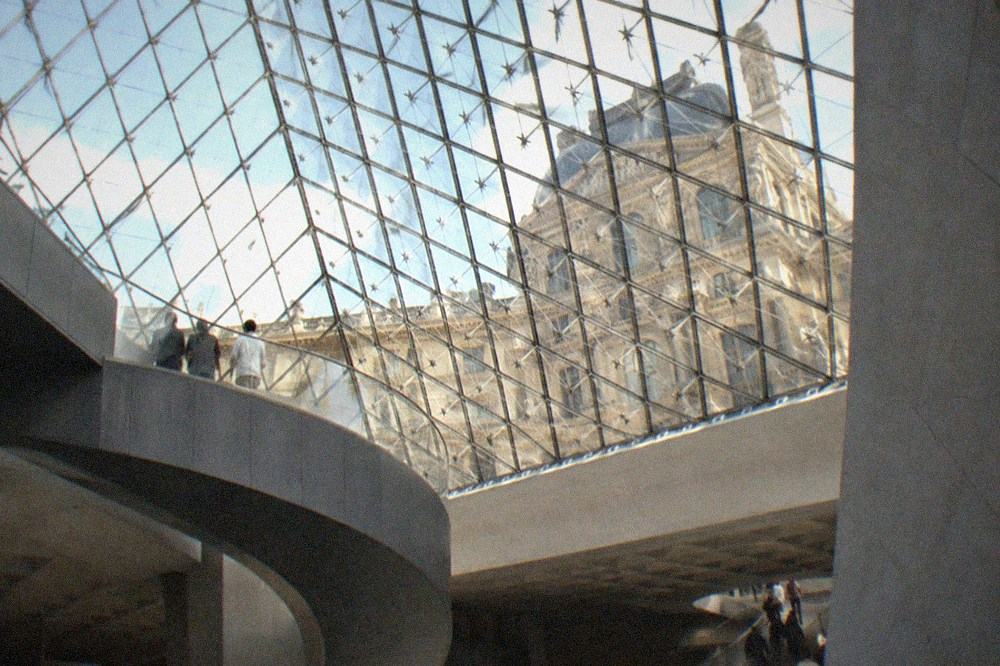
There is a larger point here for anyone building a Paris itinerary around architecture. The 5th arrondissement and its neighbours hold several buildings that are destinations in themselves, and if museums-as-buildings interest you more than any single collection, the art museums walking guide covers the rooms worth crossing the city for.
What The Collections Actually Contain?
The museum floors hold one of the largest collections of Arab and Islamic art in Europe: ceramics from Iznik and Persia, calligraphy across a thousand years, astrolabes and scientific instruments, carpets, textiles, jewellery, and a notable group of carved woodwork. The displays run from pre-Islamic Arabia through the modern era, organized floor by floor, with the temporary exhibitions in the basement level.
The collection's strength is breadth rather than a single superstar object, which changes how you should visit. The Louvre rewards a plan; the Institut du Monde Arabe rewards wandering. Visitors regularly report spending the most time on two things: the scientific instruments, where the brass astrolabes and celestial globes sit under good light, and the calligraphy, which is displayed with enough translation to follow even for visitors who read no Arabic.
The museum also carries contemporary work, and this is where its programming most clearly separates it from the decorative-arts collections elsewhere in Paris. Temporary shows in recent years have mixed contemporary Arab artists with the historic holdings, and the basement gallery is rebuilt around each one. That means two visits a year apart can feel like two different museums, and it is the honest answer to the question of whether one visit is enough: for the permanent floors, yes; for the programme, no.
How long to allow, realistically, is a common planning question and deserves a straight answer.
| What you came for | Realistic time | Notes |
|---|---|---|
| The facade and one floor | 45 minutes | The screen wall is the headline; one gallery floor gives the flavour |
| The full permanent collection | 90 minutes to 2 hours | Comfortable pace, instruments and calligraphy included |
| Permanent plus a temporary show | 2 to 3 hours | Depends entirely on the show in the basement |
| Rooftop or restaurant stop | Add 30 to 60 minutes | The view over the Seine deserves the time, weather permitting |
Those times assume you arrive with a ticket already settled. The €10 admission is the standard adult rate, with the reductions published on the institute's own tariff page; the museum sells nothing through this site, so confirm the current reduced rates and any age conditions on the institute's own site rather than from a summary.
If the institute's price and its closed Monday have you reworking the day, the Musée du quai Branly is the natural swap: the same Monday closure, but the first Sunday of every month is free, permanent and temporary collections alike.
How Much Does Entry Cost, And Is It Ever Free?
Entry is €10 for an adult, which is a mid-priced Paris museum ticket: cheaper than the Louvre or the Catacombes, dearer than the Musée delacroix or the Musée de la musique. There is no first-Sunday free entry at the Institut du Monde Arabe, which is unusual among Paris national museums, most of which open free one Sunday a month.
That last point is worth sitting with, because it catches out visitors who have read that "national museums in Paris are free on the first Sunday." Many are. The Musée d'Orsay is free the first Sunday of every month, with a booked slot. The Musée Picasso is free the first Sunday with no reservation, and the Musée du quai Branly goes further, opening both its permanent and temporary collections free that day. The Institut du Monde Arabe simply has no free day at all, and no pass covers it either, since it is not on the Paris Museum Pass list.
This is where Paris's two-system free structure matters, and it is the single most misunderstood thing about visiting museums in this city. The City of Paris museums, a network of fourteen sites, open their permanent collections free to everyone all year with no ticket: the Carnavalet, the Petit Palais, the Musée d'Art Moderne and their siblings. National museums run a different rule, free one Sunday a month. The institute sits in neither free column. The city's own tariff page at parismusees.paris.fr sets out which museums are in the free eleven, and the institute is not among them.
Age rules do still apply at the institute, the same way they apply across the French national system: under-18s enter free with a photo ID, and EU and EEA residents under 26 enter free too, including holders of a long-stay permit or visa, because it is residency that is checked, not nationality. Those rules can make a family visit to the institute effectively free for everyone under 26 in the group, with only the adults paying €10 each.
Is The Rooftop Open, And What Can You Actually See From It?
The honest answer is that the top of the building is a restaurant and its terrace, not a public museum observation deck. The panorama is real: the Île de la Cité, Notre-Dame and the rooftops of the 4th arrondissement. But access belongs to the restaurant's opening arrangements, and the museum ticket does not include it.
This is the distinction that matters, and most one-line guides blur it. When people ask whether "the rooftop is open," they are asking one of two different questions. If they mean the panorama level, then the view is genuinely one of the finest over the historic centre of Paris, and the reason so many photographs of Notre-Dame's spires were taken from this exact spot. If they mean whether a museum ticket gets them there, it does not: the terrace sits above the museum floors and operates on the restaurant's own hours, seating policy and booking conditions, all of which the institute's site confirms before you plan around it. The wider set of guides lives on Paris Museums.
The practical advice, given that, is simple. Treat the rooftop as a maybe rather than a plan. Visit the museum for the screens, the astrolabes and the calligraphy, and if the restaurant is open when you come out, the view is the bonus. Turning up specifically for the terrace, in the way people turn up for the dome of Sacré-Coeur, risks a wasted journey, because the space is a commercial one with its own rhythm, seasonal changes and closures that the museum does not control.
For comparison, the observation points in Paris that reliably sell a view as part of a ticket are different products. The Arc de Triomphe's rooftop is a genuine monument terrace open daily, bookable at €22 from April to September, €16 from October to March, and the panorama there sweeps down the whole Champs-Élysées; the facts for that are on the Arc de Triomphe facts page. The institute's terrace is a restaurant table with a famous church in front of it. Both are worth doing, but only one of them is a monument.
The Musée du quai Branly, the museum this page is paired with, covers a different set of civilizations in a building that is nearly as theatrical.
Which Day Is The Institut Shut, And What Else Is Nearby?
The museum closes every Monday, along with the rest of the Monday camp: the Musée d'Orsay, the Musée Rodin, the Musée Picasso, the Musée de Cluny and the Catacombes. Open-Monday alternatives within walking distance are thinner than in most districts, because the free city museums of the Marais also shut that day.
The Monday closure is worth planning around rather than around-the-edges. On a Monday in this district your bookable options skew to the monuments that never close: the Panthéon, open daily at €16 from April to September, and the Sainte-Chapelle on the Île de la Cité, visible from the institute's upper floors and open every day at €22. The pairing writes itself, since the Sainte-Chapelle is directly across the river and its stained glass is the other must-see interior in this stretch of the Seine.
On every other day of the week, the institute anchors one of the densest museum afternoons on the Left Bank. The Musée de Cluny, the national medieval museum, is fifteen minutes away toward the boulevard Saint-Michel at €14, medieval gardens and the Lady and the Unicorn tapestries included. Walk east instead and the Jardin des Plantes fills an hour. The institute's own district, around the place Mohammed V and the rue Mouffetard market streets, absorbs the rest of a day without any further ticket at all.
| Nearby option | Distance from the institute | Ticket | Closed |
|---|---|---|---|
| Musée de Cluny | 15 minutes on foot | €14 | Monday |
| Panthéon | 15 minutes on foot | €16 April to September, €13 the rest of the year | Never |
| Sainte-Chapelle | Across the river, 10 minutes on foot | €22 | Never |
| Musée d'Orsay | One métro stop or a river walk of 40 minutes | €16 online, €14 at the museum | Monday |
If the Monday camp has caught you out, the museums open on Monday guide lists the full set that keeps its doors open on the day the rest of the city shuts, including the daily-open institutions like the Musée de l'Armée and the Jacquemart-André.
How Does The Institut Compare With The Other World-Cultures Museums?
Paris has three great collections of non-European art: the Institut du Monde Arabe for the Arab world, the Musée du quai Branly for Africa, Asia, Oceania and the Americas, and the Musée Guimet for Asian art. All three sit in the same mid-price band, €10 to €15, and two of them, the Institut and the quai Branly, close Monday while the Guimet closes Tuesday, which makes them substitutes for one another rather than a single day's run.
The three museums reward different visitors, and choosing between them is a real decision rather than a ranking. The institute is the most architecturally dramatic and the most compact; a two-hour visit covers it well. The quai Branly is the largest and the most immersive, a single collection walk rather than a floor-by-floor survey, and it holds the strongest free-Sunday offer of the three. The Guimet, out at place d'Iéna near the Trocadéro, is the deepest single-civilization collection and the only one of the three with a first-Sunday rule that extends to its temporary shows, though its €15 ticket carries no age-based reduction at all, only a €12 reduced rate.
For a like-for-like sense of what each offers at the door, the comparison is short.
| Museum | Focus | Adult ticket | Closed | Free Sunday |
|---|---|---|---|---|
| Institut du Monde Arabe | Arab world, historic and contemporary | €10 | Monday | None |
| Musée du quai Branly | Africa, Asia, Oceania, the Americas | €14 | Monday | First Sunday, all collections |
| Musée Guimet | Asian art | €15, €12 reduced | Tuesday | First Sunday, all collections |
The deeper comparison between the institute and the quai Branly is written up in full in the piece on what the Musée du quai Branly is known for, including how the two buildings handle their collections so differently, one in daylight-filtered glass, the other almost entirely in the dark.
One booking note belongs here, because it is the decision moment on this street. If your Paris week includes the impressionists, the Musée d'Orsay is the one museum near this district that both closes Monday and sells out its timed slots in high season, so it is the single booking most worth making ahead of the day rather than at the door.
Should You Go, And How Do You Plan The Visit?
Go if Arab art, Islamic science or landmark architecture is a reason you travel; the €10 ticket is among the better values in Paris for a two-hour museum. Skip it if you only came for the rooftop, since the terrace belongs to the restaurant and is not part of the ticket. Avoid Monday entirely, and check the institute's own site for the day's hours and any terrace conditions.
The visit plan that works is a half-day anchored on the river. Arrive at opening, spend ninety minutes on the permanent floors, come back down through the hall under the screens, and then decide on the terrace based on what the restaurant is doing that day rather than on what a guide promised. The afternoon then walks itself: down the quai along the Seine, across to the Île de la Cité, and the Sainte-Chapelle in the same stretch of riverbank, with the Panthéon uphill behind you if the legs allow.
Two small practical points finish it off. First, the institute's neighborhood is student Paris, the Jussieu campus is next door, so the cheap lunch options on the rue Mouffetard side are better than around most museums in the city. Second, the museum's temporary exhibitions change the character of the basement floor entirely, so a return visit in a different season is not a repeat.
And the planning headline for the whole article: this is a €10 museum, closed Monday, no free Sunday, no pass coverage, with the best mechanical facade in Paris and a rooftop you should treat as a bonus rather than a booking.
If you are filling out the rest of a museum week, these three are the bookings most worth locking in before the day itself.
Common Questions About The Institut du monde arabe
What Is There To See At The Institut du Monde Arabe, And Is The Rooftop Open?
One of Europe's largest collections of Arab art: ceramics, calligraphy, astrolabes, carpets, textiles and contemporary work, in a Jean Nouvel building with motorized metal screens on its south facade. Entry is €10 and the museum is open every day except Monday. The rooftop is a restaurant terrace rather than a public deck, so access belongs to the restaurant, not the museum ticket.
How much does the Institut du Monde Arabe cost?
€10 for an adult. Under-18s enter free with photo ID, and EU and EEA residents under 26 enter free as well, including holders of a long-stay permit or visa; residency is what is checked, not nationality.
Is the Institut du Monde Arabe free on the first Sunday of the month?
No. It has no free Sunday at all, which is unusual among Paris national museums. The Musée d'Orsay, the Musée Picasso and the Musée du quai Branly all open free the first Sunday; the institute does not.
Which day is the Institut du Monde Arabe closed?
Monday, like the Musée d'Orsay, the Musée Rodin, the Musée Picasso, the Musée de Cluny and the Catacombes. On Mondays, the nearby monuments that never close, the Panthéon and the Sainte-Chapelle, are the alternatives.
How long does a visit to the Institut du Monde Arabe take?
About 90 minutes for the permanent collection at a comfortable pace, longer if a temporary exhibition is running in the basement. A short visit of 45 minutes covers the facade and one floor.
Can you see Notre-Dame from the Institut du Monde Arabe?
Yes. The building faces the Île de la Cité directly across the Seine, and the upper floors and restaurant terrace look onto Notre-Dame and the rooftops of the 4th arrondissement, one of the best river panoramas on the Left Bank.
Is the Institut du Monde Arabe on the Paris Museum Pass?
No. It is not on the pass's site list, and the pass covers no temporary exhibitions anywhere in any case. The €10 ticket is bought directly or through the institute's own channels.